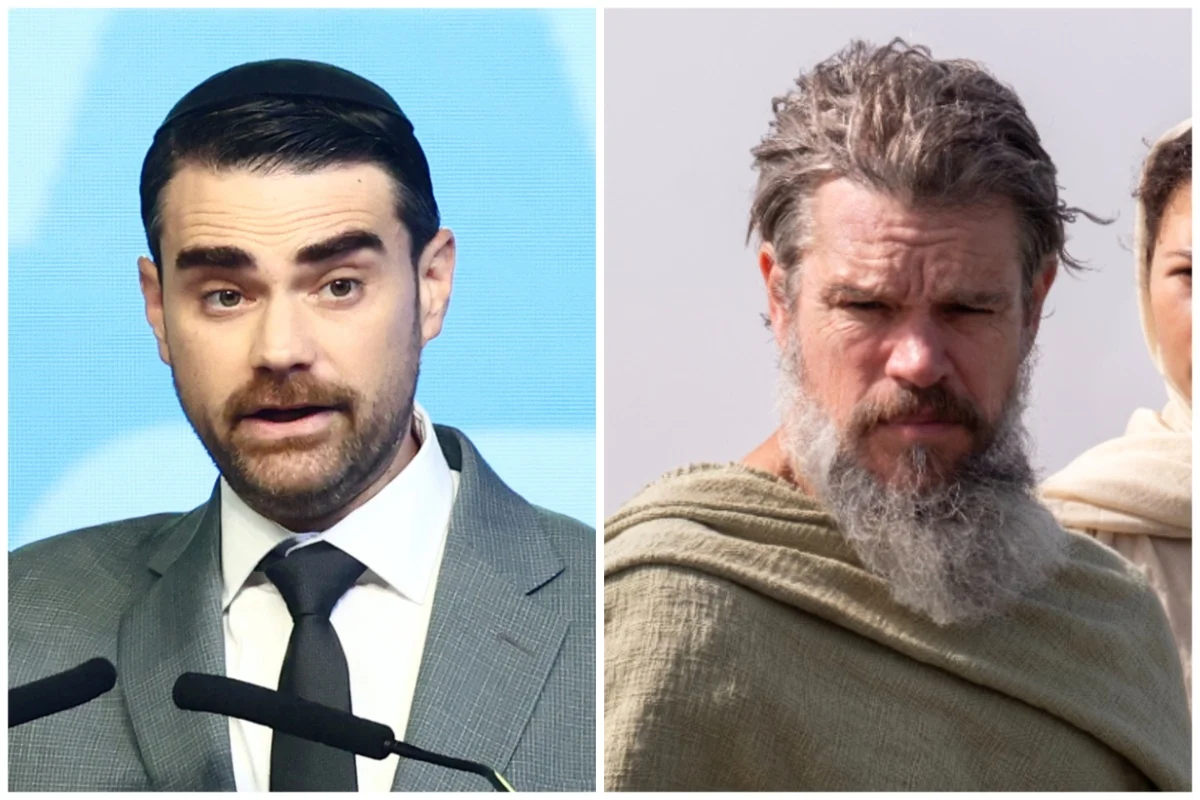
The intersection of modern political discourse and Hollywood filmmaking has once again taken center stage, this time surrounding Christopher Nolan’s highly anticipated cinematic adaptation of Homer’s epic, The Odyssey. In a surprising turn of events, prominent conservative commentator and The Daily Wire co-founder Ben Shapiro has broken ranks with a significant portion of his right-wing peer group. On Saturday, Shapiro published an 18-minute video review on his YouTube channel, declaring the film an absolute "masterpiece" despite the intense cultural backlash that has dominated social media feeds since the film’s casting was first announced.
Shapiro’s review has injected a new layer of complexity into the ongoing debate over "colorblind" casting, historical accuracy, and the creative license afforded to modern auteur directors. While online critics, including high-profile figures like tech billionaire Elon Musk, have condemned the film as an example of modern Hollywood revisionism, Shapiro’s analytical defense of the film suggests a growing division within conservative cultural criticism itself—separating those who engage in reflexive culture-war opposition from those who prioritize narrative execution and cinematic merit.
Main Facts
The core of the current discourse revolves around three primary developments: Ben Shapiro’s extensive public endorsement of Christopher Nolan’s film, the specific casting decisions that ignited the initial controversy, and Nolan’s own steadfast refusal to let internet backlash dictate his artistic vision.
In his 18-minute video essay, Shapiro was effusive in his praise for the director, asserting that Nolan’s visual and narrative capabilities remain unmatched in contemporary cinema. "Nolan is unparalleled. He’s the best director working today, without a doubt. He just creates iconic movie after iconic movie," Shapiro told his audience.
Beyond directing, Shapiro offered high praise for the film’s star-studded ensemble cast, particularly Matt Damon in the lead role of Odysseus. He also lauded the supporting performances of Robert Pattinson, Tom Holland, and Anne Hathaway. However, the most notable aspect of Shapiro’s review was his robust defense of Lupita Nyong’o’s casting as Helen of Troy—a casting choice that had previously served as the lightning rod for right-wing boycott campaigns.
While Shapiro did not give the film a completely uncritical review—taking sharp aim at the casting of Elliot Page in a key supporting role—his overall designation of the film as a "masterpiece" represents a significant departure from the prevailing narrative of conservative outrage that has characterized the film’s rollout.
Chronology of the Controversy
To understand the significance of Shapiro’s review, it is necessary to trace the timeline of The Odyssey’s production, the subsequent online outrage, and the public responses from both the filmmaker and cultural commentators.
[Late 2024: Production Announced]
       │
       ▼
[Mid-2025: Casting Revealed] ──► Lupita Nyong'o (Helen of Troy) & Elliot Page (Sinon) trigger online backlash.
       │
       ▼
[Early 2026: Film Released] ───► High-profile figures (e.g., Elon Musk) condemn casting on social media.
       │
       ▼
[Mid-2026: Nolan Responds] ────► Nolan tells 'The Telegraph' he is unbothered, citing 'The Dark Knight' experience.
       │
       ▼
[Saturday: Shapiro's Review] ──► Shapiro releases an 18-minute video calling the film a "masterpiece."
Phase 1: Production and High-Profile Casting (Late 2024 – Mid-2025)
Following the massive critical and commercial success of his historical epic Oppenheimer, Christopher Nolan announced his intention to adapt Homer’s The Odyssey for modern audiences. Given Nolan’s reputation for practical effects, non-linear storytelling, and grand scale, the project immediately became one of the most anticipated films in Hollywood.
However, when the casting sheet was made public in mid-2025, the internet erupted. The announcement that Kenyan-Mexican Oscar winner Lupita Nyong’o would portray Helen of Troy—traditionally described in mythology as a woman of Greek origin—sparked immediate accusations of "forced diversity." Concurrently, the casting of Oscar-nominated actor Elliot Page as Sinon, the cunning Greek warrior who plays a pivotal role in convincing the Trojans to accept the Trojan Horse, drew criticism from conservative circles online.
Phase 2: The Escalation of the Culture War (Early 2026)
As the film neared its theatrical release, the debate migrated from film forums to the mainstream political arena. Prominent right-wing accounts on X (formerly Twitter) began calling for a boycott of the film. The discourse reached a fever pitch when Elon Musk publicly criticized the casting of Nyong’o, framing it as an ideological decision by Hollywood executives that compromised historical and literary fidelity.
Phase 3: Nolan’s Refusal to Bow to the Noise (Mid-2026)
In an interview with The Telegraph, Christopher Nolan addressed the brewing controversy. Rather than apologizing or defending his casting choices through a political lens, the director dismissed the online outrage as an occupational hazard of modern blockbuster filmmaking. He drew direct parallels to his time directing the Dark Knight trilogy, noting that intense public scrutiny is nothing new to him.
Phase 4: Shapiro’s Surprising Intervention (Saturday)
On Saturday, Ben Shapiro uploaded his detailed review of The Odyssey. Rather than joining the chorus of condemnation, Shapiro offered a nuanced critique that praised the film’s structural integrity, defended the controversial casting of Helen of Troy, but validated conservative concerns regarding Elliot Page’s role. This review effectively disrupted the monolithic "anti-woke" narrative surrounding the film.
Supporting Data: Casting Analysis and Narrative Choices
A closer look at Shapiro’s review reveals a methodical breakdown of why Nolan’s creative decisions work on screen, even when they defy traditional expectations.
The Defense of Lupita Nyong’o as Helen of Troy
Shapiro directly addressed the online faction that expressed outrage over Nyong’o’s casting, arguing that the obsession with her physical appearance in relation to historical accuracy is fundamentally flawed.
"So, I know a lot of people were like, ‘Oh my god, Lupita Nyong’o is supposed to look like Diane Kruger.’ I don’t know. Diane Kruger doesn’t look very Greek. She’s German," Shapiro pointed out, referencing the actress who played Helen in Wolfgang Petersen’s 2004 epic Troy.
Furthermore, Shapiro highlighted a crucial narrative detail from Nolan’s script that renders the casting controversy irrelevant. In Nolan’s adaptation, the script explicitly deconstructs the myth of Helen of Troy. Rather than presenting the Trojan War as a conflict literally fought over a single woman’s physical beauty, the film explores the geopolitical pretexts of the war.
"Lupita Nyong’o is a beautiful woman," Shapiro said. "But here’s the thing, actually, in the script, Nolan goes out of his way to explain that the war wasn’t really launched over Helen being gorgeous." By framing the conflict around political opportunism and imperial ambition, Nolan aligns his film more closely with the cynical realities of ancient warfare, making the physical race of Helen a secondary detail to the broader narrative.
The Critique of Elliot Page as Sinon
While Shapiro was quick to defend Nyong’o, he was equally vocal in his criticism of Elliot Page’s casting as Sinon. In Homer’s epic, Sinon is a Greek soldier who allows himself to be captured by the Trojans, pretending to have been abandoned by his comrades. He then delivers a highly convincing, emotionally charged speech that persuades the Trojans to bring the wooden horse inside their city walls—an act that requires immense physical and theatrical presence to fool an entire city.
Shapiro argued that Page lacked the physical and vocal gravitas required for such a high-stakes, historically demanding role. He called Page’s casting an "absolute puzzler," adding:
"He’s about 5’2 and 105 pounds soaking wet and has the voice of a woman. It doesn’t work."
For Shapiro, this specific casting detracted from the suspension of disbelief necessary for the film’s climax, representing a rare misstep in an otherwise impeccably cast feature.
Praise for the Core Ensemble
Aside from the Page critique, Shapiro found little else to fault in the performances. He reserved his highest praise for Matt Damon’s portrayal of Odysseus, the cunning King of Ithaca:
| Actor | Role | Shapiro’s Assessment | Key Quote / Observation |
|---|---|---|---|
| Matt Damon | Odysseus | Immersive, transformative | "He sort of disappears into the part in a way that he doesn’t in a lot of other movies. He’s great as Odysseus." |
| Robert Pattinson | Antinous | Highly effective antagonist | "An excellent antagonist. He’s sleazy and gross." |
| Tom Holland | Telemachus | Well-cast, authentic | "Excellent, well cast" as Odysseus’ loyal son. |
| Anne Hathaway | Penelope | Powerful, emotionally resonant | "Does a great job" portraying the enduring Queen of Ithaca. |
Official Responses: Nolan’s Philosophy on Adaptation
Christopher Nolan’s response to the backlash surrounding The Odyssey offers a window into his broader philosophy as an artist. Speaking to The Telegraph, Nolan made it clear that he does not allow internet commentary to influence his creative decisions.
Nolan explained that managing public expectations and dealing with vocal fanbases has been a part of his career for decades. "Remember, I spent 10 years of my life dealing with Batman," Nolan said, referencing his work on Batman Begins (2005), The Dark Knight (2008), and The Dark Knight Rises (2012).
"When I came on Begins, writers and artists had been working on this beloved character for almost 65 years, and a lot of freighted thoughts were out there about what he represents," Nolan continued. "And what I learnt over my time on that trilogy is you can’t worry about any of that at all. What you have to do is honor the original text by interpreting it in the strongest way you personally can."
Nolan’s comments underscore a fundamental truth about classical adaptation: works like The Odyssey, which originated as oral poetry nearly three thousand years ago, have been reinterpreted, translated, and reimagined by countless cultures over millennia. For Nolan, the goal of a modern adaptation is not to produce a rigid, museum-grade replica of past interpretations, but to capture the thematic essence of the source material through a contemporary lens.
Implications: The Fracturing of Cultural Criticism
The reaction to Christopher Nolan’s The Odyssey—and Ben Shapiro’s unexpected defense of it—points to several broader trends in the current media landscape.
1. The Divide in Conservative Cultural Commentary
For years, conservative cultural criticism has often operated as a monolith, unified in its opposition to what it perceives as progressive ideology or "wokeness" in Hollywood casting. However, Shapiro’s review of The Odyssey demonstrates a growing divide between:
- Reflexive Culture-War Populism: Driven by social media algorithms and figures like Elon Musk, this faction focuses heavily on identity, casting, and surface-level representation, often calling for boycotts based on pre-release casting announcements.
- Aesthetic-Focused Intellectual Criticism: Represented by Shapiro’s review, this faction evaluates a film based on its narrative cohesion, script quality, and directorial execution, arguing that artistic excellence can transcend casting controversies.
By praising The Odyssey as a "masterpiece" while simultaneously offering specific critiques of Elliot Page, Shapiro has modeled a more traditional form of film criticism that refuses to reject a high-quality piece of art simply because it does not align perfectly with political expectations.
2. The Durability of the Auteur in the Blockbuster Era
In an era dominated by corporate franchises, intellectual property, and committee-driven filmmaking, Christopher Nolan remains one of the few directors who commands complete creative control over massive budgets. His ability to withstand intense online pressure and deliver box-office successes demonstrates the enduring power of the auteur.
Nolan’s track record suggests that audiences are ultimately drawn to compelling storytelling and cinematic spectacle, regardless of the online controversies that precede a film’s release. By focusing on "interpreting the original text in the strongest way," Nolan continues to prove that artistic integrity is often the best defense against temporary internet outrage.
3. Reimagining the Classics for a Modern Audience
The success of The Odyssey—both critically and, as Shapiro’s review suggests, artistically—will likely encourage other filmmakers to take bolder risks when adapting classical literature. As the film industry continues to grapple with representation, Nolan’s approach offers a potential blueprint: cast world-class actors, write a script that addresses the thematic realities of the source material, and let the quality of the final product speak for itself.