One year after the historic dissolution of the United States Agency for International Development (USAID) and the subsequent absorption of its remaining functions into the State Department, a sobering reality is beginning to take shape across the Global South. As the Trump administration executes its aggressive strategy to slash U.S. foreign aid spending, a new comprehensive survey from the Pew Research Center reveals a pervasive sense of apprehension and profound uncertainty among the populations of 16 middle-income nations.
The data, collected in the spring of 2026, paints a picture of a world grappling with the abrupt withdrawal of American soft power. Across these nations, which saw their U.S. aid packages plummet from a collective $5 billion in fiscal year 2024 to just over $500 million by 2026—a reduction of over 75%—the prevailing sentiment is not one of indifference, but of deep concern regarding the future stability of their essential social services.
The Core Findings: A Shift in Global Perception
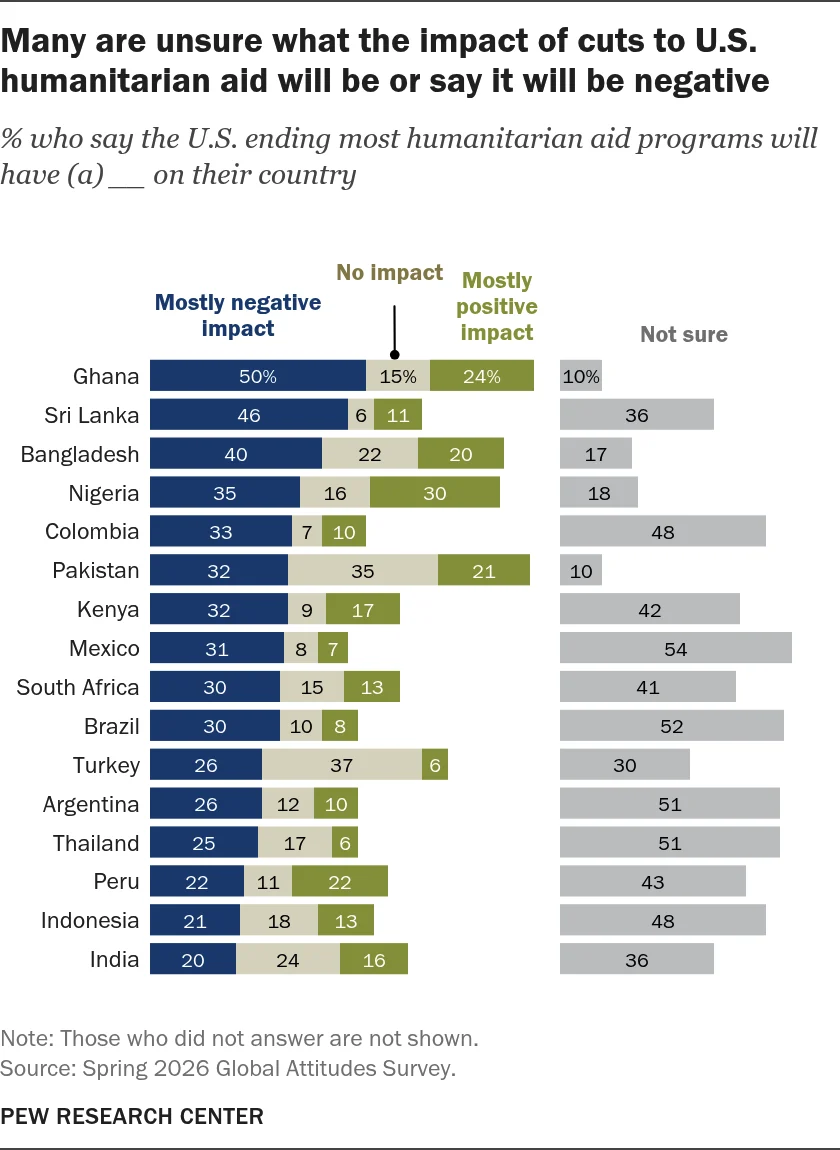
The Pew Research Center’s Spring 2026 Global Attitudes Survey highlights a critical trend: when citizens in these impacted nations are forced to confront the loss of U.S. humanitarian assistance, the majority lean toward a pessimistic outlook.
In countries like Ghana, Sri Lanka, and Bangladesh, the perception of the cuts is stark. Four-in-ten or more respondents in these nations explicitly stated that the cessation of U.S. programs would have a "mostly negative impact" on their country. This sentiment stands in sharp contrast to the negligible percentage of citizens who foresee a positive outcome from the withdrawal of American support.
However, perhaps more telling than the negative outlook is the sheer volume of "uncertainty." In nations such as Mexico, Brazil, and Colombia, a staggering portion of the population—often exceeding 50%—admitted they were simply unsure of how the loss of aid would manifest in their daily lives. This, experts suggest, reflects the opaque nature of the transition and the speed with which the aid apparatus was dismantled, leaving local governments and civil society organizations scrambling to fill the void.
A Chronology of Retrenchment: From USAID to Integration
The closure of USAID was not a singular event, but the culmination of a multi-year shift in American foreign policy. To understand the current climate, one must look at the timeline of the agency’s decline:
- 2024 (The Baseline): Under the existing administration’s budgetary priorities, U.S. foreign aid remained a cornerstone of diplomatic engagement. Middle-income nations were receiving significant financial infusions to bolster public health, infrastructure, and humanitarian resilience.
- Early 2025 (The Signaling): The administration began signaling a fundamental pivot toward "America First" fiscal policies. Rhetoric regarding "foreign entanglements" intensified, leading to the first round of drastic budgetary freezes.
- July 2025 (The Dissolution): The U.S. Agency for International Development officially ceased independent operations. Its remaining staff and programs were absorbed into the Department of State, a move critics argued would prioritize geopolitical leverage over humanitarian need.
- Late 2025–Early 2026 (The Implementation): The "new normal" set in. Programs that had sustained local medical facilities and agricultural initiatives were systematically shuttered, resulting in a more than 75% reduction in aid across the 16 surveyed nations.
- Spring 2026 (The Evaluation): The Pew Research Center conducted its survey to gauge the pulse of the affected nations exactly one year after the primary bureaucratic restructuring.
Supporting Data: The Scale of the Withdrawal
The financial figures are as dramatic as the political shift. The 16 nations analyzed represent a diverse cross-section of the developing world, ranging from South Asia to Latin America and Sub-Saharan Africa.
In terms of raw impact, the data shows that even in countries where the aid cuts were relatively smaller in total dollar volume—such as Pakistan and Turkey—the proportional loss remains catastrophic. For example, while Pakistan and Turkey experienced high levels of "no impact" responses (often due to the complexity of local economic factors), both countries still saw their U.S. aid packages reduced by 96% and 92% respectively.
Table: Public Sentiment on U.S. Aid Cuts (Selected Nations)
| Country | Mostly Negative Impact (%) | No Impact (%) | Mostly Positive (%) | Not Sure (%) |
|---|---|---|---|---|
| Ghana | 50 | 15 | 24 | 10 |
| Sri Lanka | 46 | 6 | 11 | 36 |
| Bangladesh | 40 | 22 | 20 | 17 |
| Nigeria | 35 | 16 | 30 | 18 |
| Colombia | 33 | 7 | 10 | 48 |
| Mexico | 31 | 8 | 7 | 54 |
The disparity between regions is also noteworthy. In Nigeria, for instance, a significant sectarian divide has emerged: Christians are notably more likely to perceive the cuts as harmful (39%) compared to their Muslim counterparts (30%), highlighting how the withdrawal of aid can inadvertently exacerbate internal social tensions.
Official Responses and the Domestic Context
Within the United States, the debate remains polarized. While the executive branch defends the cuts as a necessary measure to reduce federal debt and prioritize domestic spending, the public appears conflicted.

According to earlier 2025 polling, while there is a general desire for fiscal restraint, Americans maintain a strong preference for targeted aid. For instance, 83% of Americans expressed support for providing medicine and medical supplies to developing nations. However, that support drops precipitously when the focus shifts to broader development or cultural initiatives.
The administration’s position has been that the State Department is better equipped to manage a "streamlined" version of aid that serves U.S. national interests. Critics, however, argue that the "integration" of USAID into the State Department has effectively turned humanitarian aid into a blunt instrument of diplomacy, rather than a tool for sustainable development.
The Broader Implications: A Vacuum in Influence
The implications of this policy shift are vast and extend beyond the immediate loss of funding.
1. Erosion of Soft Power
For decades, the presence of USAID-funded projects served as a tangible testament to the American commitment to global stability. By pulling back, the U.S. is not merely saving money; it is creating a vacuum. In many of the surveyed nations, local leaders are already looking to other global powers—specifically China and regional middle-powers—to provide the development assistance that was once the domain of the United States.
2. Humanitarian Instability
The "uncertainty" noted by respondents is not just a statistical anomaly; it is a lived experience for thousands of healthcare workers and local officials. In regions where U.S. aid was the primary source of funding for essential medications and disaster response, the sudden lack of clarity regarding the future of these programs creates a climate of extreme vulnerability.

3. The Future of Diplomatic Reliability
The survey’s release coincides with a broader downward trend in the international reputation of the United States. As more nations perceive the U.S. as an unreliable partner, the ability of Washington to form coalitions or secure cooperation on global issues—such as climate change, migration, and trade—becomes increasingly constrained.
Conclusion
The dismantling of USAID represents a fundamental realignment of the American role in the world. While the policy satisfies the domestic demand for a retreat from international commitments, the survey data from 16 middle-income nations suggests that the world is watching with a mixture of anxiety and resignation.
As the "new normal" of reduced engagement continues into its second year, the primary question for global leaders is no longer whether the U.S. will return to its previous levels of support, but rather how the global order will adapt to a world where the primary architect of post-war development has largely walked off the stage. The uncertainty in the data is a warning: when the world is left to wonder about the intentions of a superpower, the resulting instability may eventually come back to haunt the very domestic interests the administration sought to protect.