
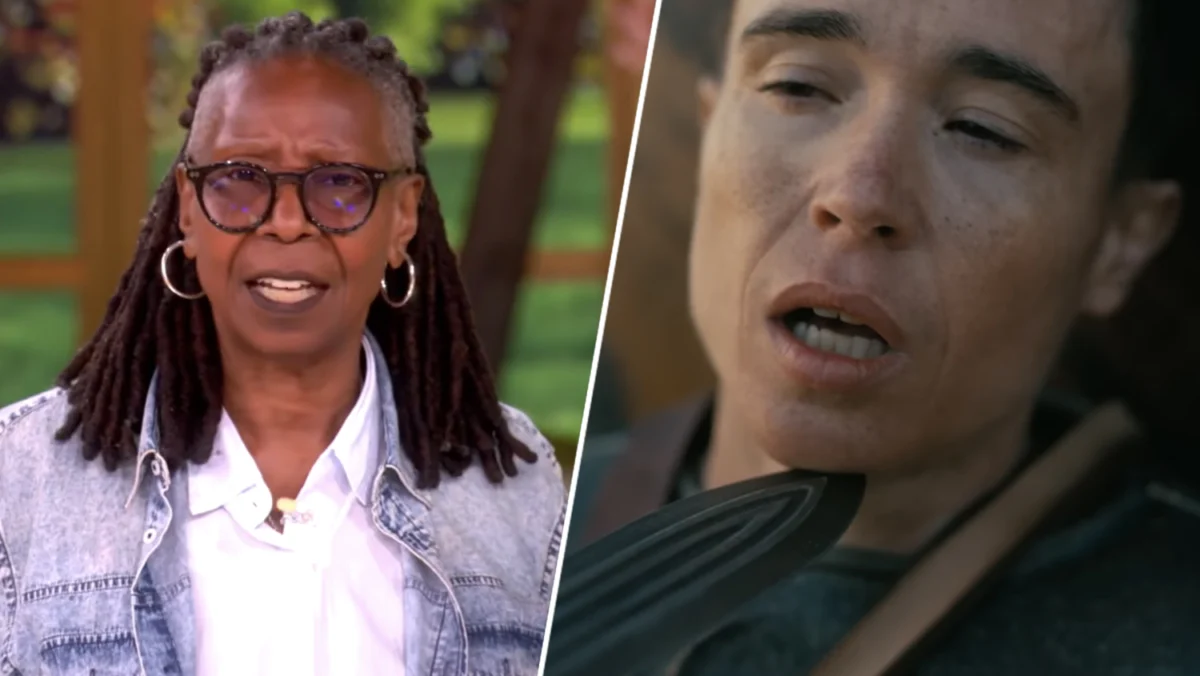
LOS ANGELES — In what is becoming a definitive moment for the 2026 summer box office, Christopher Nolan’s sprawling adaptation of The Odyssey has officially surged past the $300 million mark globally. This milestone follows a record-breaking opening weekend that has silenced many industry skeptics, though it has simultaneously reignited a firestorm of cultural debate. As the film continues its dominant theatrical run, the discourse surrounding its diverse casting has moved from the fringes of social media to the forefront of national television, most notably on ABC’s The View.
The film, a high-concept reimagining of Homer’s ancient Greek epic, has found itself at the center of a "culture war" narrative. Despite the financial success, conservative commentators have spent weeks lambasting the production’s casting choices. However, as the box office receipts continue to climb, proponents of the film argue that the "Go Woke, Go Broke" mantra has once again failed to materialize in the face of high-quality filmmaking and a globally recognized auteur brand.
I. Main Facts: A Box Office Juggernaut Meets Social Friction
Christopher Nolan’s The Odyssey is not merely a film; it is a cultural event. Produced by Universal Pictures with an estimated budget exceeding $225 million, the film marks Nolan’s most ambitious project since Oppenheimer. Its narrative follows Odysseus (Matt Damon) on his grueling ten-year journey home to Ithaca following the Trojan War.
The primary facts of the current situation include:
- Financial Performance: The film surpassed $300 million in global ticket sales within its first ten days of release, bolstered by a $145 million domestic opening.
- The Casting Controversy: Critics, led by figures such as Ben Shapiro, Elon Musk, and Matt Walsh, have targeted the film for its "color-blind" and inclusive casting. Key points of contention include Lupita Nyong’o’s dual role as Helen of Troy and Clytemnestra, and Elliot Page’s portrayal of the Greek soldier Sinon.
- The "View" Defense: On the July 14 episode of The View, the panel of hosts stepped into the fray, with Whoopi Goldberg and Alyssa Farah Griffin defending the film’s artistic integrity and dismissing the boycotts as performative.
- Nolan’s Stance: The director has maintained a characteristic distance from the online vitriol, labeling the pre-release backlash as "irrelevant" to the cinematic experience.
II. Chronology of a Controversy: From Announcement to Release
The road to $300 million was paved with digital skirmishes. To understand the current climate, one must look at the timeline of the film’s development and the subsequent reactions.
The Initial Announcement and Vision
In late 2024, Universal Pictures announced that Christopher Nolan would be adapting The Odyssey. Nolan promised a "visceral, grounded take" on the mythology, utilizing 70mm IMAX cameras and practical effects to recreate the Mediterranean of the Bronze Age. The initial hype was universal, but the first tremors of dissent began when the casting list was finalized.
May 2026: The "Helen of Troy" Debate
The controversy reached a fever pitch in May 2026 when it was revealed that Oscar-winner Lupita Nyong’o would play Helen of Troy, historically described as "the face that launched a thousand ships." Critics on X (formerly Twitter) argued that casting a Black actress as a figure from Greek mythology was an act of "historical revisionism." Elon Musk famously weighed in, suggesting that the casting prioritized "identity politics over historical accuracy," a sentiment echoed by Matt Walsh.
June 2026: The Elliot Page Speculation
Shortly before the film’s premiere, rumors circulated that Elliot Page would be playing Achilles. This sparked a wave of transphobic rhetoric from conservative pundits, including Ben Shapiro, who questioned the "logic" of casting a trans man in a hyper-masculine warrior role. When the film was released, it was clarified that Page played Sinon—the soldier who convinced the Trojans to bring the wooden horse inside their city—but the damage in the eyes of his critics was already done.
July 2026: Premiere and Box Office Triumph
The film premiered in Mumbai, India, on July 11, 2026, signaling Universal’s intent to capture the massive South Asian market. Despite the calls for a boycott in the United States, the film’s opening weekend shattered records for an R-rated epic, proving that the general public was more interested in Nolan’s spectacle than social media grievances.
III. Supporting Data: The Numbers Behind the Success
The data suggests that the "anti-woke" backlash has had a negligible impact on the film’s bottom line. In fact, some analysts suggest the controversy may have acted as "earned media," increasing the film’s profile.
Domestic and International Breakdown
- North America: $162 Million (54% of total)
- International: $138 Million (46% of total)
- Top International Markets: United Kingdom, India, South Korea, and France.
Audience Demographics
Exit polls from CinemaScore indicate a broad appeal:

- Age: 45% of the audience was under the age of 35.
- Ethnicity: The audience was highly diverse, with a 30% increase in Black and Hispanic ticket buyers compared to Nolan’s previous film, Oppenheimer.
- Critical Reception: The film currently holds a 94% "Certified Fresh" rating on Rotten Tomatoes, with critics praising the "thematic depth" and "staggering visual scale."
IV. Official Responses: The Battle of Ideas
The debate moved from the keyboard to the television screen this week, providing a clear contrast between the film’s detractors and its defenders.
‘The View’ Weighs In
Whoopi Goldberg led the charge on Tuesday’s episode of The View, directly addressing the social media "trolls." Goldberg’s argument was rooted in the freedom of the consumer. "Why go see the movie? If you don’t want to see it, then don’t go see it," she stated. She specifically addressed the animosity toward Elliot Page, telling viewers, "We will be okay if you don’t go see it."
Alyssa Farah Griffin, the panel’s conservative voice, offered a more nuanced defense. She labeled the film a "masterpiece" and argued that the critics were missing the forest for the trees. "It’s about devotion to family, it’s about faith, it’s about upholding institutions," Griffin explained. She noted that the film’s core themes are actually deeply conservative, emphasizing the sanctity of the home and the dangers of war. "The fact that conservatives can’t take the win… I’ll never understand," she added.
The Conservative Critique
The opposition remains steadfast. Ben Shapiro, in a widely circulated video, complained that casting Page as a "dude" was "stupid," focusing on biological essentialism rather than the narrative requirements of the role. The criticism from this camp centers on the idea that Hollywood is "re-writing history" to suit a modern progressive agenda, regardless of the artistic merit of the final product.
Christopher Nolan’s Perspective
Nolan, known for his stoicism regarding his creative choices, addressed the backlash during the press junket for the Mumbai premiere. He dismissed the criticisms as "irrelevant," noting that the nature of adapting "major IP" (Intellectual Property) like the works of Homer always involves reinterpretation. For Nolan, the film is a standalone piece of art that exists beyond the political leanings of its audience.
V. Implications: The Future of the Hollywood Epic
The success of The Odyssey carries significant implications for the film industry and the broader cultural landscape.
1. The Myth of "Go Woke, Go Broke"
The financial trajectory of The Odyssey serves as a powerful counter-narrative to the idea that inclusive casting leads to financial ruin. Similar to the success of The Little Mermaid or The Woman King, Nolan’s film demonstrates that star power, directorial pedigree, and high production values are the primary drivers of box office success, far outweighing the impact of organized online boycotts.
2. The Universal Nature of Myth
By casting actors like Lupita Nyong’o and Zendaya in roles traditionally envisioned as white, Nolan is leaning into the idea that the Homeric epics are universal human stories rather than strictly European ones. This approach may set a new standard for how ancient texts are adapted for a globalized, 21st-century audience.
3. The Resilience of the "Auteur"
In an era of franchise fatigue, Christopher Nolan remains one of the few directors whose name alone can sell a ticket. His ability to navigate a massive cultural controversy while maintaining his artistic vision suggests that the "Auteur" still holds significant power in Hollywood. If The Odyssey continues its current pace, it is likely to become one of the highest-grossing films of the decade, further cementing Nolan’s status as a filmmaker who can bridge the gap between high-art and mass-market entertainment.
4. The Polarization of Film Criticism
The divide over The Odyssey highlights a growing trend where films are no longer judged solely on their technical or narrative merits, but on their alignment with political ideologies. As film criticism becomes increasingly polarized, the role of the "blockbuster" as a unifying cultural experience is being challenged.
As The Odyssey prepares for its third week in theaters, with projections suggesting it could reach the $1 billion mark by the end of its run, the noise of the "culture war" may eventually be drowned out by the sound of falling box office records. For now, however, the journey of Odysseus remains as fraught with conflict off-screen as it is on-screen.