By Tim Peterson
September 9, 2026
Main Facts: The Evolution of Cord-Cutting
For over a decade, the media landscape has been defined by a singular, monolithic narrative: cord-cutting. Consumers were ditching their expensive, cumbersome traditional cable packages in droves, opting instead for the flexibility, on-demand convenience, and perceived cost-savings of a la carte streaming services. The traditional pay-TV bundle—complete with its hidden box rentals, broadcast fees, and bloated channel lineups—was widely declared a dying relic of the 20th century.
However, data from late 2025 and 2026 reveals a fascinating plot twist in the evolution of home entertainment. While consumers are still actively getting rid of physical cable boxes, they are not actually abandoning traditional television. Instead, the television industry is undergoing a subtle structural evolution. Traditional pay-TV providers, streaming services, and consumers are meeting in the middle, creating a hybrid entertainment ecosystem where traditional programming is consumed through new digital pipelines, and cable providers are aggressively survival-proofing their businesses by embracing the very streaming apps that once threatened to destroy them.
According to the Advertising Research Foundation’s (ARF) DASH TV Universe study, more than 30% of U.S. households are now strictly streaming-only entities. Yet, a deeper dive into quarterly financial reports, audience metrics, and consumer behavior analysis indicates that the historic pace of cord-cutting is not only slowing down—it is fundamentally transforming.
Chronology: From Aggressive Defection to Strategic Re-Bundling
To understand where the television market stands today, it is helpful to look at how the modern viewing household has evolved over the past several years:
- The Early Wave (2015–2020): Driven by surging cable subscription costs and the rise of Netflix, Hulu, and Amazon Prime Video, millions of households severed ties with traditional multi-channel video programming distributors (MVPDs). This era was characterized by pure a la carte adoption; consumers believed they could curate a cheaper, leaner selection of entertainment.
- The Fragmentation Era (2021–2024): Every major media conglomerate launched its own proprietary streaming service (Disney+, Paramount+, Peacock, Max). Subscription fatigue set in as content was scattered across dozens of walled gardens, and the cumulative cost of maintaining multiple streaming apps began to rival or exceed the cost of traditional cable.
- The Hybrid Realignment (2025–2026): Pay-TV providers recognized an existential threat and shifted strategies. Rather than fighting streaming, legacy distributors began integrating major streaming applications directly into their basic video packages. Simultaneously, virtual MVPDs (vMVPDs) and live-sports-enabled streaming tiers captured the segments of the audience that wanted to escape physical hardware without losing access to linear broadcasts, news, and live sports.
Supporting Data: What the Numbers Tell Us
The narrative that consumers are finding new ways to consume traditional TV—even after kicking their cable providers to the curb—is heavily backed by recent market intelligence and industry research.

Decelerating Subscriber Losses
Recent quarterly earnings reports from major U.S. pay-TV providers show that while subscriber erosion continues, the rate of loss has noticeably decelerated. Companies like Charter Communications have managed to stabilize their subscriber bases far better than industry analysts predicted.
The secret weapon? Simplified pricing structures and the strategic bundling of major streaming applications—such as ESPN Unlimited, Fox One, Paramount+, and Peacock—directly into Spectrum’s expanded basic video packages. Charter explicitly noted in a quarterly earnings call that this slowdown in cord-cutting was "driven by simplified pricing and packaging and benefits from the inclusion of programmers’ streaming applications." In short: when it becomes cheaper and easier to get your streaming apps through your pay-TV provider than to buy them separately, the financial incentive to cut the cord evaporates.
Where Do Cord-Cutters Actually Go?
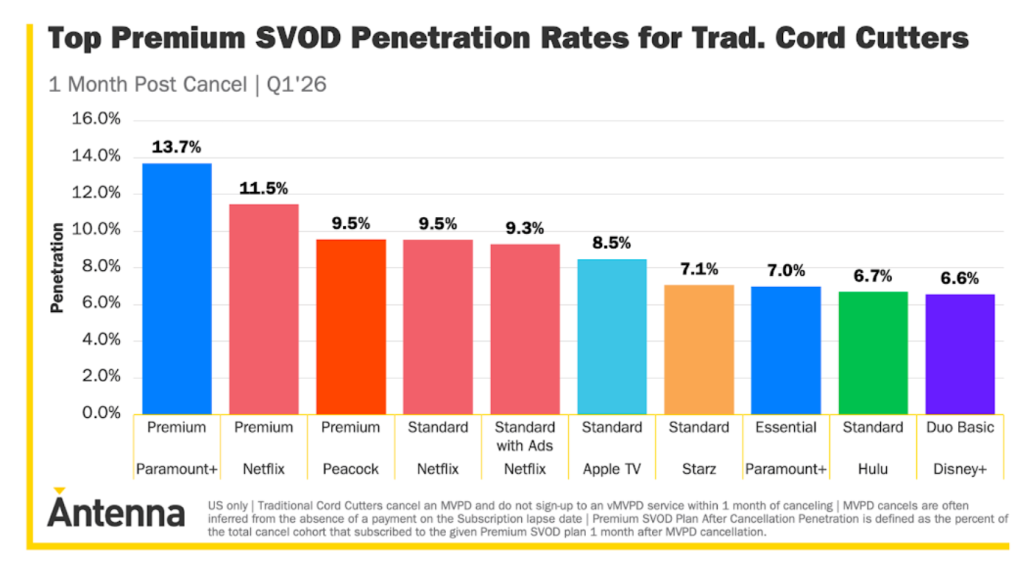
Data from research firm Antenna provides a revealing look at consumer habits immediately following the cancellation of a traditional pay-TV subscription. While 72% of cord-cutters already subscribe to at least one streaming service prior to cutting the cord, an additional 31% actively sign up for a new streaming service within the first month of cancellation.
Notably, premium streaming tiers that feature live linear programming win the lion’s share of these new sign-ups:
- Paramount+’s premium tier frequently ranks as a top beneficiary. Industry experts attribute this to viewers wanting to shed their traditional pay-TV subscriptions while retaining access to core linear programming, such as live CBS sports broadcasts.
- Netflix consistently secures the second, fourth, and fifth slots in various sign-up metrics—largely a testament to its dominant market penetration and ubiquitous cultural footprint.
- Peacock’s premium tier ranks third, driven heavily by high-profile live sports content including Sunday Night Football, NBA games, and major international events like the Olympics.
The Virtual and Over-the-Air Safety Nets
Perhaps the definitive proof that viewers are not abandoning traditional TV programming is how they consume media after leaving traditional cable behind. According to data from S&P Global Market Intelligence Kagan:
- 47% of cord-cutters or "cord-nevers" (households that have never paid for traditional linear TV) maintain a streaming pay-TV subscription (vMVPDs like YouTube TV or Hulu + Live TV).
- 20% still rely on traditional broadcast television via free, over-the-air digital antennas.
When combined, these figures demonstrate that roughly two-thirds of households that lack a traditional cable box are still regularly consuming linear, scheduled, or broadcast-style television content.
Official Responses and Industry Perspectives
Media executives and analysts point out that the economics of the entertainment industry have forced a pragmatic convergence.
Aundrea Leckie of Open Influence recently highlighted parallel cost pressures across the digital media ecosystem, noting how brands and creators grapple with shifting rights management and pricing models. Similarly, in the television and streaming sector, platforms are racing to maximize monetization as consumer wallet share tightens.
Streaming platforms are no longer operating at a permanent, venture-backed loss to capture market share. This financial reality has triggered aggressive price hikes paired with rising ad loads. Recent reports indicate an 18% increase in the number of ads aired per hour on major streaming services over the past year. As streaming platforms become more expensive and increasingly resemble traditional cable commercial breaks, the historical cost advantage of cutting the cord has dramatically eroded.
Broader Implications for the Future of TV
The maturation of the streaming era and the stabilization of pay-TV portend several significant shifts for the media industry at large:
- The Death of Pure A La Carte: The dream of paying only for the exact channels or shows you want has largely vanished. As streaming services bundle themselves together, adopt cable-like tiered pricing, and partner with legacy distributors, the industry has effectively reinvented the bundle under a digital guise.
- Live Sports as the Ultimate Anchor: Live sports remain the single most resilient glue holding traditional television formats together. Whether distributed via a legacy cable box, a vMVPD, or the premium tier of a standalone streamer like Prime Video—which recently secured exclusive local streaming rights for multiple NHL teams—live sports dictate where audiences spend their money.
- The Blurring Lines of Distribution: For the end consumer, the distinction between "cable" and "streaming" is rapidly dissolving. As long as the content arrives on the living room screen, the underlying delivery mechanism—fiber optic cable, coaxial line, or IP stream—matters less than the simplicity, user experience, and overall value of the package.
Ultimately, the narrative of cord-cutting is evolving from a tale of outright rejection into one of structural re-engineering. The cable box may be fading into obsolescence, but traditional television—repackaged, digitized, and rebundled—is proving remarkably difficult to kill.