TORONTO — The Toronto International Film Festival operates at a cadence entirely its own. Over the span of eleven dizzying days, the city’s hotels, upscale lounges, and bustling eateries morph into high-speed transit hubs for global cinema. Amid the espresso shots and rapid-fire press junkets, Sebastian Stan is running across town.
When we finally sit down for lunch at a packed, vibrant restaurant, the actor settles into a banquette, orders a chicken salad, and takes a brief breath. The whirlwind schedule is the price of a career-best run. Stan arrives fresh off a monumental 2024—a year that brought him an Academy Award nomination for his blistering portrayal of a young Donald Trump in The Apprentice, alongside a Golden Globe win for Best Actor in a Comedy or Musical for his work in Aaron Schimberg’s psychological exploration A Different Man.
Yet, for all the accolades and red-carpet triumphs of the past year, Stan’s focus today is firmly fixed on a passion project he has been chasing since adolescence. He is here to discuss Fjord, a film that represents both a creative departure and a deeply personal homecoming.
Main Facts: The Anatomy of Fjord
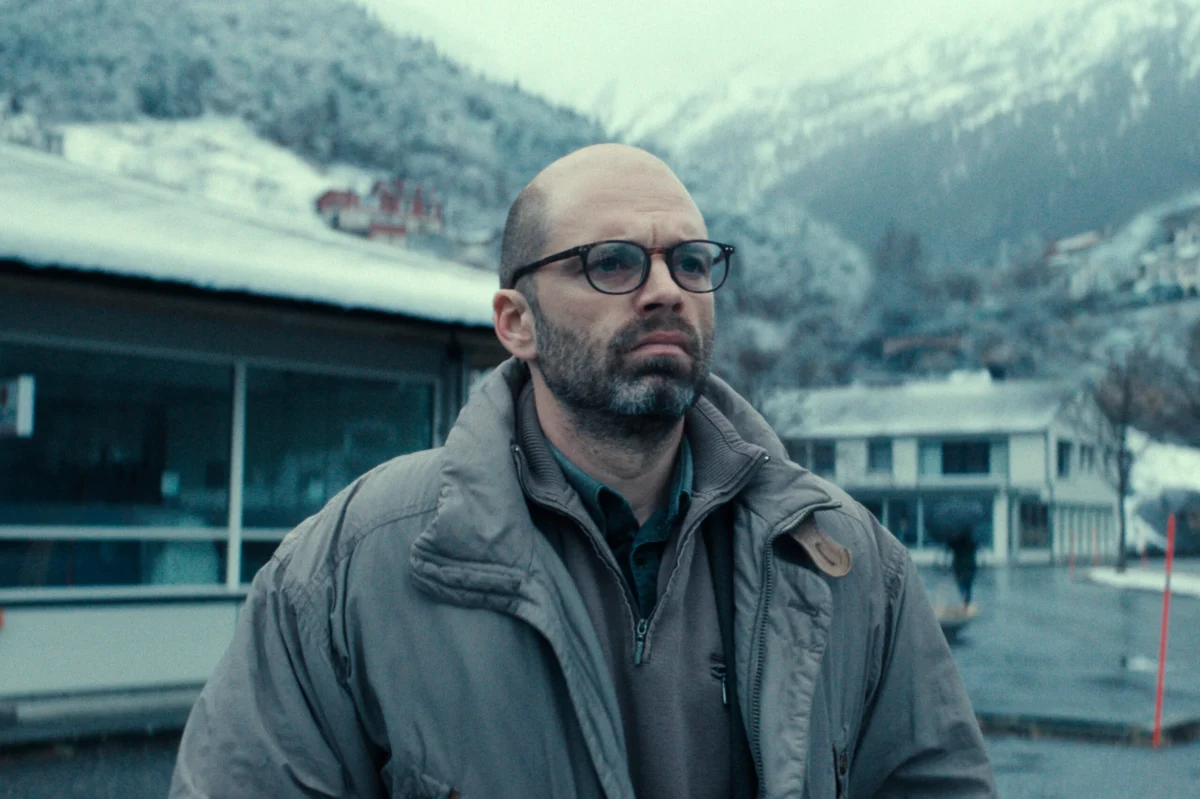
At its core, Fjord is the film Sebastian Stan has spent his life waiting to make. Directed by acclaimed Romanian auteur Cristian Mungiu—a filmmaker Stan admits he tracked for years—the feature marks a major milestone for both men. It is Mungiu’s first English-language feature film and Stan’s first-ever role performed in his native Romanian language.
The project, which the actor and director circled for years before the right script materialized, is inspired by a real-life family whose children were seized by the state. In the film, Stan plays Mihai, a fundamentalist father grappling with the devastating loss of his kids. True to Mungiu’s signature cinematic style, the movie is shot in long, unbroken takes, utilizing a pointed refusal of standard close-ups to create a sense of observational detachment and moral ambiguity.
However, the film’s journey to the screen has not been without turbulence. Even before its wider release, Fjord has sparked fierce online debate. Social media commentators have occasionally slapped reactionary labels onto the picture, with some detractors prematurely dismissing it as a "MAGA movie"—a categorization Stan forcefully rejects.
Chronology: From a Boy Leaving Romania to a Career-Defining Homecoming
Stan’s connection to Fjord stretches back decades, rooted in his childhood as an immigrant moving from Eastern Europe to the United States.
- The Early Years: Growing up in Romania before emigrating as a young boy, Stan carried the heavy, often isolating self-awareness of being an outsider. His mother instilled a cautious survival philosophy: avoid making too many allies or enemies, and try to blend in.
- The Awakening (Ages 16–17): As Stan grew older and gained confidence in his identity, a shifting perspective took hold. By his late teens, he promised himself he would eventually return to his homeland to find a cinematic project that would allow him to reconnect with his roots and his mother tongue.
- Tracking the Auteur: For years, Stan kept a watchful eye on Cristian Mungiu’s career, admiring the moral complexity and rigorous framing of the director’s work. The two actors and filmmakers maintained a loose dialogue, searching for the intersection of their respective artistic visions.
- The Breakthrough Call: After years of false starts, Mungiu finally contacted Stan with a script in hand. The director offered him the lead role of Mihai, setting the stage for an intense, transnational collaboration that brought Stan back to the language and culture of his youth.
- The 2024 Zenith: The release of Fjord arrives on the heels of Stan’s career-defining 2024 awards season sweep, cementing his status as one of Hollywood’s most fearless, chameleonic performers.
Supporting Data: The Artistic Choices and Influences Behind Mihai
Portraying Mihai required Stan to deconstruct not only a specific religious belief system in rural Romania but also his own complicated familial history.
To prepare, Stan and the production team attended local church sermons to understand the psychological framework of fundamentalist communities. They observed an inherent, unshakeable trust that—regardless of earthly tribulations—divine intervention would ultimately set things right. For Stan, whose natural instinct as a father would be fierce resistance and panic, embodying this passive, unwavering faith presented a profound psychological hurdle.
Furthermore, Stan channeled the archetype of the classic Eastern European father figure: subdued, stern, guarded, and emotionally unreadable. Drawing from memories of his relationship with his own biological father, as well as the stabilizing presence of his stepfather who raised him (whom he publicly thanked during his Golden Globe acceptance speech), Stan crafted a character who resists the urge to emotionally explode.
"In real life, people don’t always have the tools for that," Stan reflects, contrasting his restrained performance in Fjord with the larger-than-life personas he inhabited in The Apprentice and A Different Man. "I knew Cristian likes to shoot these long one-takes… and it was a different challenge to do something more restrained—something that reminded me of the unpredictability I saw in men who don’t know how to express themselves."

Official Responses and Industry Context: Navigating the Comic Book Universe and Beyond
Beyond his indie and international dramatic pursuits, Stan occupies a rare and enviable position in modern franchise filmmaking: he is one of the very few actors with a verified foot in both the Marvel Cinematic Universe (MCU) and the DC Universe.
Stan admits he grew up idolizing Tim Burton’s Batman Returns—particularly the performances of Michelle Pfeiffer and Danny DeVito—and holds a soft spot for Joel Schumacher’s Batman Forever. When he first landed the role of Bucky Barnes (the Winter Soldier) in the MCU, he assumed the comic book divide was absolute.
"I thought, well, that’s it, there’s no way I can get to the other side. No one’s going to hire me; I’ll be Bucky," he recalls.
Yet, a convergence of events changed the trajectory of his career. Matt Reeves, fresh off the massive success of The Batman, saw and loved Stan’s work in The Apprentice and initiated a meeting. Simultaneously, Stan took the initiative to cold-call DC Studios co-CEO James Gunn to signal his availability and readiness for new challenges.
While Stan famously sidesteps direct confirmation of persistent internet rumors linking him to the role of Harvey Dent, his praise for the project is unrestrained. Having observed Reeves’ meticulous three-year development process, Stan offers high—and perhaps heretical—praise:
"I go to set sometimes and I look around and I’m like, I think we’re making fucking ‘The Godfather Part Two.’ I feel that highly about it."
When asked about the notorious secrecy surrounding these massive comic book productions, Stan expresses solidarity with fellow franchise veteran Tom Holland, noting that absolute secrecy has become nearly impossible in the digital age.
Implications: The Social Divide and the Future of Cinema
Stan’s dual trajectory—balancing gritty, high-stakes auteur-driven dramas like Fjord with massive, grounded studio pictures like Reeves’ upcoming DC projects—highlights a broader philosophy about his place in the industry. Now in his 40s and a father himself, Stan’s priorities have shifted dramatically. His primary creative directive is simple: he is "allergic" to repeating himself.
This ethos directly influences how he views the backlash surrounding Fjord. Addressing critics who labeled the film a "MAGA movie" sight unseen, Stan views the controversy as a symptom of a broader cultural malady.
"When did it become normalized to think that one side has all the answers and is completely faultless?" he asks. "A lot of those reactions come from people who haven’t seen the movie. It highlights why we need more films like this—to remind us there was a time when people could meet, disagree, and at least hear each other out."
Reflecting on the role of actors in contemporary society, Stan remains grounded. "We’re not doctors, we’re not on the front lines," he notes. "This is the only way we get to communicate." As he looks toward the future, balancing the quiet, confronting truths of European arthouse cinema with the sprawling canvases of Hollywood blockbusters, Sebastian Stan is proving that an actor can successfully transcend the trappings of modern overexposure—one deliberate, unpredictable choice at a time.