In the span of just a few years, the landscape of American journalism has undergone a seismic transformation. The days when citizens relied exclusively on the morning newspaper or the nightly television broadcast to understand the world are rapidly fading into history. Today, the digital ecosystem—specifically social media—has moved from a peripheral curiosity to the center of how the nation consumes, discusses, and interprets news.
According to a comprehensive new report from the Pew Research Center, conducted through the Pew-Knight Initiative, a clear majority of American adults—58%—now identify social media as an important vehicle for keeping up with current events. This shift represents a significant acceleration in digital dependency, signaling that for many, the platform that connects them to their friends and family is also their primary window into the complex realities of the global political and social climate.
The Evolution of Information Access: A Chronology of Change
To understand how profound this shift has been, one must look at the recent trajectory of media consumption. In 2022, when the Pew Research Center last surveyed the public on this specific metric, 43% of Americans characterized social media as an important source of news. At that time, only a marginal 5% identified it as their most important source.
The intervening four years have been marked by a rapid integration of news algorithms into the daily scrolling habits of the average user. Platforms that once focused on entertainment or social networking—most notably TikTok and Instagram—have evolved into robust, high-traffic news hubs.
- 2022: The "early" era of social-first news. While present, social media was largely viewed as a secondary or supplementary tool. Reliance was modest, and the "most important" category remained in the single digits.
- 2024: The mid-point of the transition. As global volatility increased and election cycles intensified, users began leaning more heavily on algorithmic feeds to provide real-time updates, bypassing traditional gatekeepers.
- 2026 (The Current Snapshot): We have entered a new era of digital reliance. With 58% of adults now citing social media as an important news source, and 13%—more than double the 2022 figure—labeling it as their primary, most important source, the trend line is clear: social media is no longer an alternative to traditional news; for many, it is the standard.
Supporting Data: The Demographic Divide
The data reveals that this shift is not uniform across all segments of the population. The divide between generations is perhaps the most striking indicator of where the future of journalism is headed.

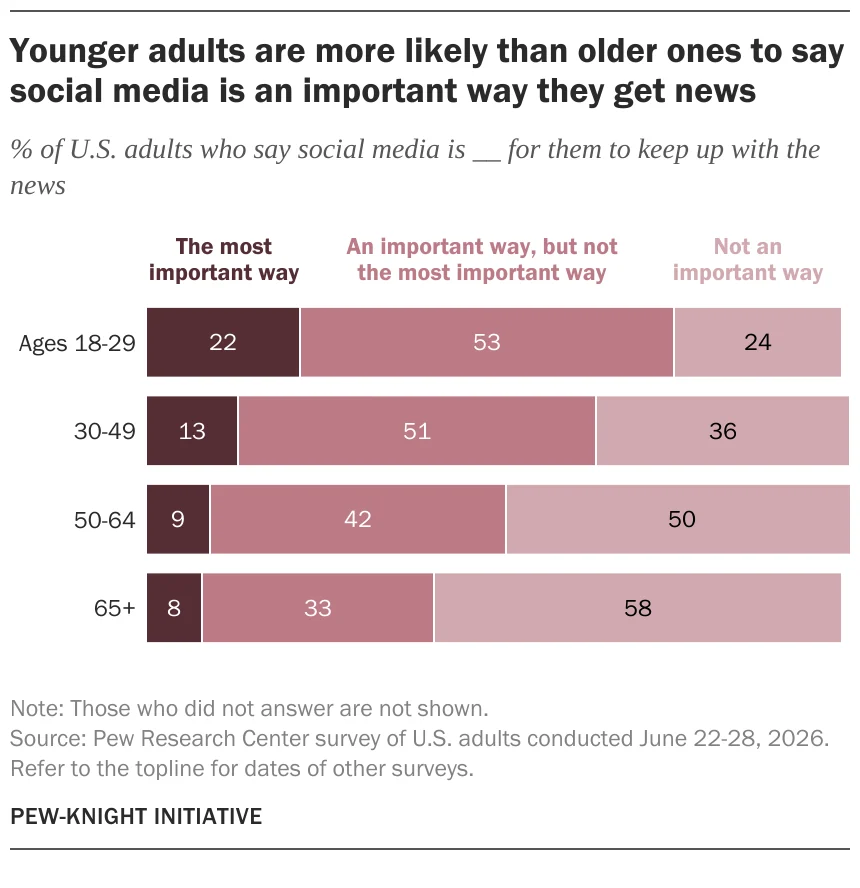
Among the youngest cohort of adults—those aged 18 to 29—social media is the dominant force in their information diet. A staggering 76% of these young adults report that social media is an important way they keep up with the news. Furthermore, more than one in five (22%) state that it is their single most important source. This cohort is not merely glancing at headlines on social platforms; they are actively curating their worldviews through the content delivered to them by the platforms’ algorithms.
The contrast with older generations is stark. For those aged 65 and older, while 41% still find social media to be an important news source, the majority (58%) report that it is not important to them at all. This creates a "bifurcated information reality" where different generations are inhabiting fundamentally different media ecosystems, leading to varying levels of public discourse and understanding of current events.
Furthermore, the data points to a growing level of trust among the youth. Approximately half of all adults under the age of 30 express at least some trust in the information they encounter on social media. This willingness to trust platform-native content, regardless of its origin, presents a unique challenge for traditional news organizations that have historically relied on institutional credibility to retain their audience.
The Methodology: Understanding the "Pew-Knight" Perspective
The findings are derived from a robust, scientific survey of 3,488 U.S. adults, conducted between June 22 and June 28, 2026. Participants were drawn from the Center’s American Trends Panel, a nationally representative group designed to capture the nuance of the American public’s shifting attitudes.
The goal of this research, spearheaded by the Pew-Knight Initiative, goes beyond mere frequency of use. By asking about the importance of social media as a news source, the researchers have managed to capture the psychological shift in how Americans value information. As Michael Lipka, an associate director at the Pew Research Center, has noted, the project aims to explore the deep, structural changes in how the American public absorbs information, forms identities, and engages with civic life.

The Pew-Knight Initiative, a partnership between the Pew Charitable Trusts and the John S. and James L. Knight Foundation, serves as a "fact tank," operating with a nonpartisan mandate to provide the public with the raw, empirical data necessary to navigate an increasingly polarized and fast-paced information environment.
The Implications: A New Civic Frontier
The implications of this shift are far-reaching and touch upon the very foundations of democratic participation. As traditional newspapers shutter and legacy broadcast networks face declining viewership, the "social media news" model presents both opportunities and hazards.
The Democratization of Content
On the positive side, social media allows for a more democratic and participatory form of journalism. Citizen journalism, real-time reporting from the ground, and a wider variety of voices that were historically excluded from mainstream media can now reach millions. The barrier to entry for reporting is lower than it has ever been in human history.
The Crisis of Credibility
Conversely, the reliance on social media as a primary news source introduces significant challenges regarding accuracy, bias, and misinformation. Unlike traditional newsrooms that adhere to strict editorial standards, fact-checking processes, and ethical guidelines, social media feeds are often curated by engagement-based algorithms. These algorithms prioritize content that triggers emotional responses, which can lead to the rapid spread of misinformation, inflammatory rhetoric, and "echo chambers" that insulate users from diverse viewpoints.
The Future of Civic Engagement
If a majority of Americans are increasingly informed by platforms that are not designed to inform, but to maximize time-on-site, the quality of civic discourse is at risk. A well-informed electorate is essential for a healthy democracy. If that electorate is getting its information from fragmented, algorithmic, and often unverified sources, it becomes increasingly difficult to maintain a shared set of facts upon which to base political debate.

Conclusion: Adapting to a New Reality
The recent findings from the Pew-Knight Initiative serve as a wake-up call for stakeholders across the media, policy, and educational landscapes. We are no longer in a period of transition; we are in a new, established reality where social media is a primary pillar of the American news infrastructure.
As we look toward the future, the challenge will be to bridge the gap between the speed and accessibility of social media and the depth and accuracy required for a functioning democracy. For media organizations, the mandate is clear: they must find ways to meet the audience where they are—on the social platforms they trust—without compromising the integrity of the news itself.
For the American public, the findings highlight a growing responsibility to cultivate media literacy. As the sources of our news shift from institutional entities to algorithmic feeds, the individual’s role in verifying, questioning, and cross-referencing information has never been more critical. The digital age has provided us with more information than ever before, but it has also placed the burden of discernment squarely on the shoulders of the reader.
Ultimately, while the platforms through which we receive our news may continue to evolve, the necessity for accurate, independent, and reliable information remains the constant heartbeat of an engaged society. The data from 2026 makes one thing clear: the future of news is digital, it is social, and it is here to stay.