
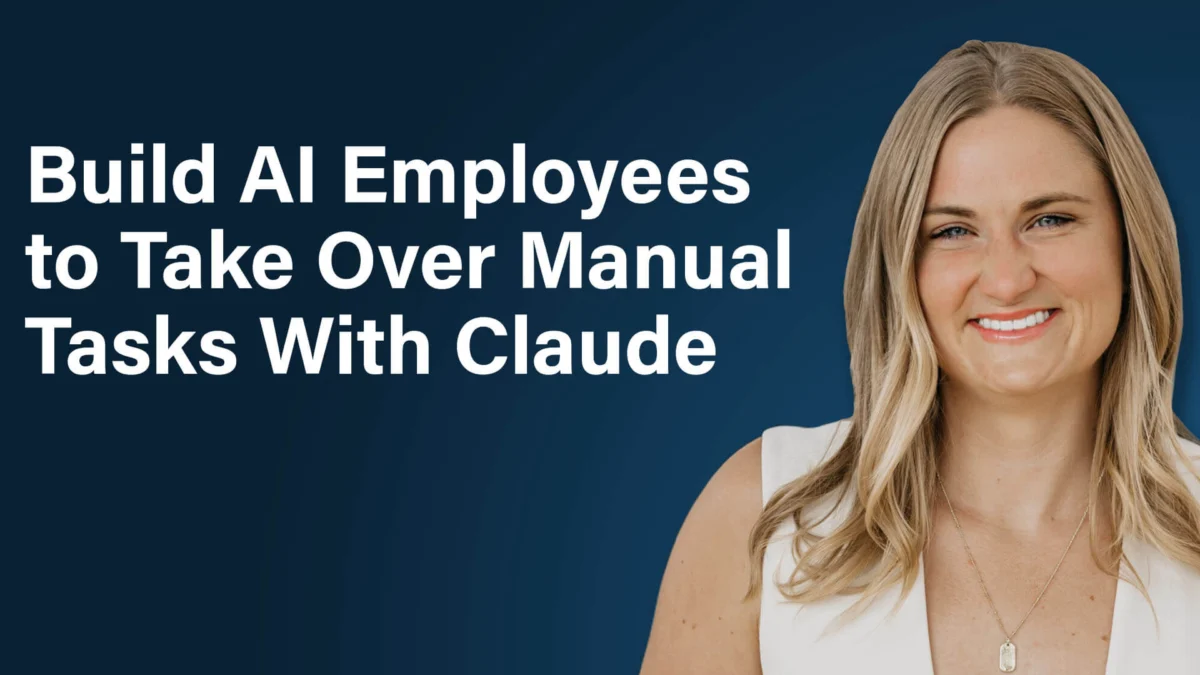
Executive Summary: In the rapidly evolving landscape of enterprise technology, basic AI prompting is rapidly becoming obsolete. While millions of workers open chat windows daily to draft a quick email or summarize a document, this ad-hoc usage barely scratches the surface of artificial intelligence’s true enterprise capability. According to recent insights from business leaders and operational experts, the next paradigm shift belongs to "AI employees"—trained, reusable, autonomous systems that execute specialized business functions with elite consistency. This article explores the strategic frameworks, practical blueprints, and organizational implications of moving from casual AI experimentation to deploying fully autonomous digital workforce systems.
Main Facts: The Evolution from Ad-Hoc Prompts to Autonomous Systems
The fundamental disconnect in modern corporate AI adoption lies in repetition. When a sales representative utilizes a tool like ChatGPT or Claude to draft a proposal, they frequently engage in an hour-long conversational loop, achieve a solid result, and then close the window. The next time a proposal is required, the employee repeats the exact same manual process from scratch. They fail to save a reusable instruction set, preserve a knowledge base of winning approaches, or train the AI into a repeatable, systemic asset.
Callan Faulkner, an executive at The Uncommon Business—a firm pacing toward roughly $40 million in revenue with a lean staff of approximately 50 human employees—defines an AI employee distinctively. Rather than a simple prompt template, an AI employee is a trained, reusable software system that performs a specific operational function as well as, or better than, a human counterpart. Crucially, these systems are designed not to replace human labor, but to elevate human workers out of repetitive, low-margin tasks and into high-level strategy and creative direction.
The competitive divide is stark. Companies that fail to train their workforce in advanced AI integration find their employees struggling to keep pace. In contrast, organizations that systematically deploy AI employees report exponential productivity gains—in some cases, producing tenfold increases in daily output compared to non-trained counterparts.
Chronology: The Journey to Building a Digital Workforce
Successfully integrating AI employees into an organization requires a methodical, step-by-step operational progression. Industry pioneers outline a four-stage chronological roadmap for transitioning from manual labor to autonomous execution.
Phase 1: Establish the Foundational Concepts and the "Business Brain"
Before deploying a single automated workflow, organizations must embrace a new operational ethos: shortcut-seeking is the modern work ethic. Historically, professionals proved their value by grinding through manual labor. Today, finding the fastest, most efficient path to an "A-plus" output is the ultimate competitive advantage.
Furthermore, businesses must aggregate their "Business Brain"—a centralized, meticulously organized repository of brand voices, pricing structures, historical wins, ideal client profiles, and standard operating procedures. Just as a brilliant human hire needs comprehensive documentation to get up to speed in minutes, an AI employee requires a robust, structured data environment to operate effectively.
Phase 2: Execute the Self-Audit and the AI Interview Method
The building process begins with a granular time audit. Leaders and team members must identify every daily, weekly, or monthly task that generates revenue but drains energy, or tasks that fall below a high hourly valuation threshold.
Once a target task is selected—such as drafting sales proposals or generating content outlines—creators utilize the AI Interview Method. Instead of blindly typing commands, a user opens a chat interface, defines their role and company context, and instructs the AI to conduct an interactive interview. By asking five high-impact questions, the AI extracts the human expert’s precise methodology. Utilizing voice-to-text tools like Wispr Flow during this stage accelerates the process, capturing natural nuances and conversational details that typed self-editing often strips away.
Phase 3: Transform Chats into Reusable Skills and Projects
After refining the conversational output to an elite standard, the interaction is packaged into a reusable skill. In advanced workspaces like Claude, a skill functions as a "prompt on steroids"—a single, saved command that triggers a complex, trained operational sequence.
Next, users construct a dedicated project workspace. By embedding background files (such as past winning proposals, pricing sheets, and objection-handling guides) alongside system connectors linked to external software like CRMs and email clients, the AI evolves from a basic chat interface into a fully operational digital employee.
Phase 4: Rigorous Testing and Autonomous Scheduling
Building the skill is only half the battle; the subsequent phase demands rigorous quality testing. Creators must push back against mediocre outputs, demanding that the AI refine its work until it meets strict brand standards. Every correction is fed back into the skill file with explicit instructions on what error to avoid in the future.
Once perfected, these skills can be transitioned to autonomous execution. Utilizing desktop automation and scheduled task features, organizations can program their digital employees to run automatically at predetermined intervals—such as executing competitor market research every Monday morning at dawn or compiling meeting transcripts into centralized knowledge bases hourly.
Supporting Data: The Current State of AI Adoption
Market research highlights a glaring paradox in modern corporate technology adoption. According to comprehensive industry surveys:
- The DIY Dilemma: Approximately 85% of modern marketers and business professionals are learning artificial intelligence entirely through independent experimentation.
- The Training Deficit: A mere 7% of professionals report receiving formal, structured AI training from their employers.
- Financial Self-Reliance: More than half of corporate knowledge workers utilize their own personal funds to purchase and test software subscriptions, underscoring a widespread corporate lag in infrastructure deployment.
Organizations that bridge this gap by establishing internal AI skill repositories—tracked via databases in platforms like Notion and evaluated during quarterly employee performance reviews—gain an insurmountable efficiency advantage over competitors relying on ad-hoc, individual experimentation.
Official Perspectives and Expert Insights
Industry leaders emphasize that the integration of AI employees fundamentally redefines professional roles rather than destroying them.
"Building an AI employee is a different skill set entirely… every AI employee works for a human, activating them to their higher potential, moving people out of repetitive tasks and into strategic, creative work that lights them up." — Callan Faulkner, Executive at The Uncommon Business
Experts note that resistance to this technological shift stems from a fundamental misunderstanding of the tool. When organizations hire marketing or operational talent, the expectation is no longer that the human will execute every mechanical keystroke from scratch. Instead, the modern professional acts as a strategic director, editor, and visionary, managing a stable of specialized digital assistants that execute the heavy lifting at unprecedented speeds.
Strategic Implications for the Enterprise
The widespread transition toward autonomous AI employees carries profound implications for organizational design, talent acquisition, and economic scaling.
1. The Compression of Team-to-Revenue Ratios
Historically, scaling a business toward the $40 million revenue threshold demanded aggressive human headcount expansion, often requiring hundreds of administrative, marketing, and operational employees. By leveraging trained AI systems to handle repetitive execution, modern enterprises can achieve historic revenue-per-employee metrics. This does not necessarily imply mass layoffs; rather, it allows lean teams to scale enterprise output without linear increases in overhead costs.
2. Shifts in Hiring and Talent Evaluation
Job descriptions across sales, marketing, and operations are undergoing rapid transformation. Hiring managers no longer evaluate candidates solely on their ability to execute manual production tasks (such as writing basic copy or formatting sales decks). Instead, recruiters look for "prompt architects" and strategic directors—individuals who possess the communication skills and creative resourcefulness required to train, audit, and manage AI systems effectively. Workers who refuse to adopt these methodologies face displacement, not by the technology itself, but by human competitors who utilize AI to outperform them tenfold.
3. The End of Fragmented Knowledge Management
The operational discipline required to build effective AI employees forces organizations to abandon messy, decentralized file systems. Because digital workers are entirely dependent on structured, accessible data, companies must invest heavily in clean knowledge management—centralizing brand voices, historical data, and operational frameworks into unified digital architectures. This administrative cleanup yields secondary benefits, drastically improving onboarding speed and operational clarity for human employees as well.
Conclusion
The era of casual, conversational AI prompting is giving way to the age of the autonomous digital workforce. By treating AI integration not as a novelty, but as a rigorous discipline involving self-audits, structured interviews, reusable skill files, and automated scheduling, businesses can successfully offload manual labor. Organizations that embrace this transition will unlock unprecedented levels of speed, creativity, and enterprise scale, while those that cling to legacy manual workflows risk being left permanently behind.