The streaming landscape is undergoing a profound identity crisis. What began as a consumer-friendly rebellion against the bloated, rigid, and expensive world of traditional cable television has, in many ways, come full circle. The latest price hikes from Disney-owned Hulu + Live TV underscore a sobering reality: the "cord-cutting" promise of cheap, flexible television is rapidly evaporating.
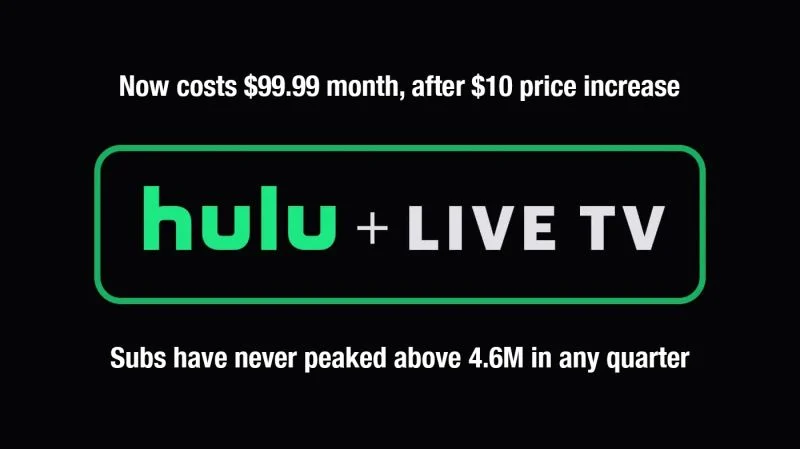
With a recent $10 monthly price increase, Hulu + Live TV now commands a $100 price tag for its standard tier, while the premium ad-free SVOD bundle has surged to $109.99. These figures are no longer "disruptive" alternatives to cable—they are, in many markets, more expensive than the traditional bundles they were designed to kill. As costs climb and subscriber growth stagnates, the industry is forced to ask: Is the live linear streaming model sustainable, or is the era of the "vMVPD" (Virtual Multichannel Video Programming Distributor) nearing its inevitable end?
The Chronology: From $40 Disruptor to $100 Heavyweight
To understand the current frustration among consumers, one must look back at the origins of the service. When Hulu + Live TV launched in May 2017, the market was primed for a revolution. The selling proposition was clear, concise, and incredibly compelling: $40 per month for a robust selection of live channels, no long-term contracts, no equipment rental fees, and no installation headaches.
At the time, the average cable bill—including hidden broadcast fees, DVR surcharges, and regional sports fees—often exceeded $120 to $150. For three years, the $40 entry point acted as a beacon for millions of Americans eager to sever their ties with legacy providers.
However, the "golden age" of cheap streaming was short-lived. Over the last nine years, the cost of the service has more than doubled. Through a series of incremental, often annual, price hikes, Disney has systematically raised the barrier to entry. This mirrors the trajectory of traditional cable, where content licensing fees—driven largely by the exorbitant costs of carrying regional sports networks and major broadcast affiliates—have been passed directly to the consumer. The irony is not lost on analysts: by attempting to replicate the cable bundle over the internet, Hulu has inherited the very same inflationary pressures that destroyed the traditional cable business model.
Supporting Data: A Plateau in Growth
The financial data paints a bleak picture for the long-term viability of the product. For a service that was once hailed as the future of television, the growth metrics are surprisingly flat.
In Q1 2021, Disney reported that Hulu + Live TV had reached approximately 4 million subscribers. Fast forward four years to Q4 of fiscal 2025, and that number has inched upward to only 4.4 million. In the intervening years, the subscriber count has remained trapped in a narrow band, never once peaking above 4.6 million in any single quarter.
When a subscription service fails to grow for four years despite heavy marketing spend and a massive content library, it signals a structural problem. The market for "live linear streaming" is not expanding; it is merely churning. Consumers are signing up for a specific event—perhaps a sports season or a major awards show—and then canceling as soon as the next price increase hits. This "churn-and-burn" cycle makes it nearly impossible for a platform to achieve the scale required to negotiate better carriage deals with media conglomerates.
Implications: The Strategic Pivot and the Fubo Connection
The most significant development in this saga is not just the price hike, but the strategic silence surrounding it. Disney has ceased breaking out Hulu + Live TV subscriber numbers in its quarterly earnings reports, instead opting to fold them into broader categories or obfuscate them behind combined metrics. This shift in transparency is rarely a sign of a healthy, growing business unit.
Industry insiders have begun to speculate that Disney is preparing to wind down its own live linear service. The logic is sound: if the margins are razor-thin and the subscriber base is static, why continue to fight a losing battle?
The most compelling piece of evidence for this theory lies in the recent executive leadership shuffle. In July, Alisa Bowen, the former President of Disney+, transitioned to the role of CEO at Fubo. This is a high-level migration of talent that suggests a deeper integration or perhaps a future consolidation between the two platforms.
If Disney were to effectively "offload" its live linear requirements to a partner like Fubo, it would allow the House of Mouse to focus entirely on its core competency: the SVOD (Subscription Video on Demand) model via Disney+ and Hulu. In this scenario, the $100 price tag on Hulu + Live TV might be an intentional "soft exit" strategy—a way to nudge remaining subscribers toward other platforms or to harvest maximum revenue from the most loyal, price-insensitive customers before the service is eventually sunsetted.
The "Cable-fication" of Streaming: A Professional Analysis
The transformation of Hulu + Live TV is a case study in the "Cable-fication" of streaming. When streaming services first arrived, they were lean, agile, and curated. Today, they are becoming bundles of bundles. By bundling Disney+, Hulu, ESPN+, and live linear channels, Disney has recreated the "Triple Play" of the 2000s, albeit with a digital interface.
The Problem of Content Costs
The primary driver of these price hikes is the cost of content. Disney must pay carriage fees to local affiliates, cable networks (like HGTV, CNN, and Discovery), and sports leagues. As the NFL, NBA, and other major sports properties demand higher rights fees, those costs flow downhill to the consumer. Because Hulu + Live TV offers a wide array of channels, it is inherently susceptible to the same "bloat" that plagued cable. Consumers are forced to pay for channels they never watch just to gain access to the few they do.
The Consumer Response
Consumers are becoming increasingly savvy. The rise of "FAST" (Free Ad-Supported Streaming TV) channels like Pluto TV, Tubi, and Freevee offers an alternative that doesn’t cost $100 a month. As the price gap between Hulu + Live TV and traditional cable narrows, the perceived value proposition collapses. If a user is paying $100 a month, they often expect the reliability, user experience, and sports-broadcast quality of a premium satellite or cable provider—a standard that streaming services, with their buffering issues and latency, have struggled to consistently meet.
Official Responses and Industry Outlook
Disney has largely avoided specific commentary on the long-term future of its Live TV product, focusing instead on the "value" of the ecosystem bundle. In recent investor calls, the focus has remained on the profitability of the streaming segment as a whole, rather than the success of the live product. By emphasizing the "Hulu + Live TV Premium" bundle, Disney is attempting to pivot the conversation toward the value of ad-free on-demand content, rather than the live linear component.
Industry analysts are divided on the outcome. Some suggest that Disney will continue to run the service as a "cash cow" for as long as possible, milking the remaining 4.4 million subscribers until they eventually migrate to cheaper, on-demand-only options. Others argue that the regulatory environment and the shifting nature of regional sports broadcasting—which is currently in a state of total upheaval as regional sports networks (RSNs) collapse—will force a radical restructuring of all live linear services within the next 24 months.
Conclusion: The Road Ahead
The $100 price point for Hulu + Live TV is more than just a number; it is a signal. It signals that the "Wild West" era of streaming is over. The industry has matured, costs have been identified, and the honeymoon phase for consumers has officially ended.
As we look toward the future, the question is not whether the price will increase again, but rather how long consumers will be willing to pay "cable prices" for a "streaming experience." If the stagnation in subscriber growth is any indicator, the limit has already been reached. For Disney, the move toward a consolidated, on-demand-focused future seems inevitable. For the 4.4 million subscribers currently paying the bill, the search for the next "disruptive" alternative has already begun. The circle, it seems, is complete.