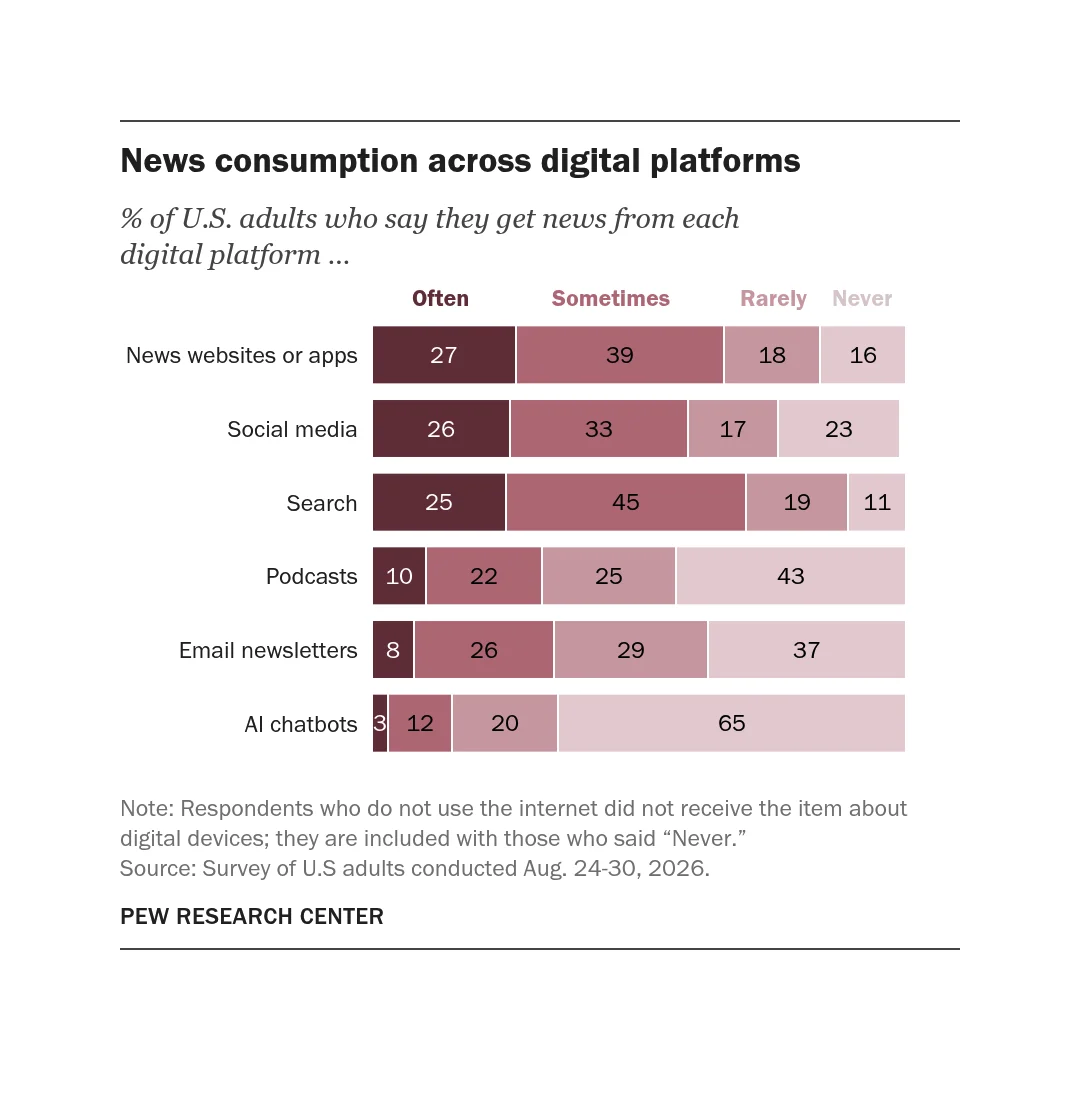
In the rapidly evolving landscape of digital media, the methods by which Americans consume news are undergoing a profound transformation. As platforms compete for dwindling user attention, the architecture of information discovery is shifting from curated, source-specific models toward algorithmic, interest-based "For You" feeds. This transition, most recently highlighted by Reddit’s strategic pivot, signals a broader trend in how the public interacts with both information and online community life.
Main Facts: The New Frontier of Information Discovery
The most significant development in this space is Reddit’s implementation of a "For You" feed. By blending content from communities a user actively follows with algorithmic recommendations tailored to their unique interests, Reddit is mirroring the engagement-heavy models pioneered by TikTok, Instagram, and X. This shift is not merely cosmetic; it fundamentally alters the "discovery" phase of the user experience, moving from a deliberate search for information to a passive consumption of curated feeds.
Parallel to these platform changes, new data from the Pew Research Center’s Pew-Knight Initiative reveals that social media has cemented its role as a cornerstone of the American news diet. A majority of U.S. adults now identify social media platforms as an important source for keeping up with current events. Perhaps most notably, the share of Americans who consider social media their most important source of news has more than doubled in just four years, rising from 5% in 2022 to 13% in 2026.
Chronology of Digital Consumption Trends
The trajectory of this shift can be traced through the following timeline:
- Pre-2020: Online news consumption was largely dominated by direct traffic to news outlets, social media referral links, and traditional search engines. Communities were silos, accessed intentionally by users looking for specific niches.
- 2020–2022: The rapid ascent of short-form, algorithmically driven video platforms like TikTok fundamentally changed user expectations. The "For You" page (FYP) concept moved from a novel feature to the industry standard, forcing competitors to adapt or risk irrelevance.
- 2022: Pew Research Center data established a baseline, showing that while social media was widely used, only 5% of Americans identified it as their primary news source, with the majority of the public still relying on more traditional gatekeepers or specific, non-algorithmic platforms.
- 2024–2025: A period of "algorithmic homogenization." Platforms like X (formerly Twitter) and Instagram aggressively pushed algorithmic feeds over chronological ones, leading to a decline in organic discovery of news outside of one’s immediate bubble.
- October 2026: Reddit, long considered a bastion of community-moderated, chronological, and topic-specific content, fully embraces the "For You" feed model. This marks a symbolic end to the era of "intentional" community browsing, solidifying the algorithmic paradigm across the major social web.
Supporting Data: A Nation Inscribed by Algorithms
The data supporting these shifts paints a picture of a populace that is increasingly reliant on machine-learning-driven curation.
The Importance of Social Media in News Habits
According to the Pew Research Center’s latest analysis, the transition toward social media as a primary news vehicle is statistically significant. In 2022, 56% of U.S. adults stated that social media was "not an important way" for them to keep up with news. By 2026, that figure dropped to 42%. Conversely, those who label social media as an "important way" (including those who deem it the most important) have grown from 44% to 58%.
The Role of Online Communities
Reddit’s move is particularly impactful because of how Americans utilize these spaces. Nearly four-in-ten U.S. adults are active members of at least one online community. For these users, the community is not just a place for social interaction, but a vital information hub. 86% of these members explicitly cite "staying informed" as a primary reason for visiting their most-frequented communities. While only 15% of the total population belongs to a discussion forum like Reddit, the intensity of engagement among these users makes them significant drivers of online discourse. Furthermore, 9% of all Americans report getting their news regularly from Reddit, a number that jumps to 18% among adults under 30, suggesting that the platform’s pivot will have an outsized impact on younger demographics.
Official Perspectives and Expert Analysis
Industry analysts view these platform changes as a defensive maneuver in a saturated market. By adopting "For You" feeds, platforms aim to increase "time-on-site" metrics—the gold standard for digital advertising revenue.
Pew Research Center’s researchers note that these changes are not happening in a vacuum. The Pew-Knight Initiative’s recent survey regarding civic personality underscores that news consumption is deeply tied to broader civic and religious engagement. When platforms change how content is surfaced, they are not just changing the user experience; they are effectively re-engineering the public square.

In response to these findings, media critics have raised concerns about the "filter bubble" effect. If users are increasingly funneled toward content that matches their existing interests and engagement patterns, the capacity for cross-partisan dialogue or the discovery of challenging, objective information may be significantly diminished.
Implications for the Future of Information
The shift toward algorithmic news discovery carries profound implications for society:
1. The Decline of Serendipity
When users seek out information, they often encounter diverse perspectives. When information is delivered via an algorithm designed to maximize engagement, the system favors content that triggers emotional responses or reinforces existing beliefs. This reduces the serendipitous discovery of diverse viewpoints.
2. The Transformation of Community
Reddit has historically functioned as a collection of thousands of individual, distinct communities (subreddits) with their own internal norms and moderation styles. By prioritizing a unified "For You" feed, the platform risks homogenizing these unique cultures. The distinct identity of a community may become secondary to the "content" that can be extracted from it to feed the global algorithm.
3. News Outlet Vulnerability
News organizations have long relied on social media for reach. However, as these platforms favor internal, algorithm-generated content over external links to news websites, the traditional business model of digital journalism faces a crisis. If news organizations cannot guarantee that their content will reach the "For You" feed, their ability to drive traffic and build a loyal audience is severely compromised.
4. Civic Engagement and the "Civic Personality"
The Pew Research Center’s recent study on "civic personality" suggests that how we interact with news is a reflection of our deeper values. If the primary gateway to news becomes a platform that optimizes for clicks rather than civic literacy, the long-term impact on the health of American democracy could be substantial. As news becomes just another form of entertainment within a bottomless feed, the line between factual reporting and engagement-driven narrative continues to blur.
Conclusion
The transition toward algorithmic, interest-based news consumption represents a fundamental departure from the decentralized web of the past. While platforms like Reddit argue that these changes improve discovery and user experience, the data suggests that we are entering a new phase of media consumption where the gatekeepers are no longer editors, but lines of code designed to keep us scrolling. As we navigate this new environment, the challenge for the American public will be to maintain a diverse, informed, and critical engagement with the world around them, even as the platforms they use make it increasingly easy to do the exact opposite.
For those interested in understanding their own place in this digital landscape, the Pew Research Center has released a Civic Personality Quiz, which serves as a valuable tool for self-reflection in an era where the news we see is often as much about us as it is about the world.