In a move that promises to reshape the landscape of digital media and connected television (CTV), Fox Corporation has officially confirmed its acquisition of Roku Inc. The blockbuster deal, valued at approximately $22 billion in enterprise value, marks one of the most significant consolidations in the history of the streaming era.
The agreement, which has been the subject of intense market speculation for months, will see Fox acquire Roku for $160 per share. The transaction structure is a hybrid, consisting of 60% cash and 40% Fox common stock. To facilitate the massive cash outlay, Fox has secured $12 billion in fully committed bridge financing from Morgan Stanley, signaling a bold move into a debt-leveraged expansion strategy.
The Financial Framework and Deal Structure
The acquisition represents a strategic pivot for Fox, transitioning from a traditional broadcast and cable powerhouse into a vertically integrated streaming giant. Upon the anticipated closing of the deal in the first half of 2027, the ownership structure of the combined entity will see current Fox shareholders holding a 73% stake, while Roku shareholders will retain a 27% interest.
Fox leadership has emphasized the financial logic behind the purchase. Projections indicate that the deal will be accretive to free cash flow per share by the second full year post-closing. Furthermore, the companies have identified approximately $400 million in run-rate cost synergies, with additional revenue upside expected through enhanced advertising technology integration. Wall Street analysts have noted that the deal values Roku at roughly 24 times its fiscal year 2027 estimated EBITDA, a valuation that reflects both the premium paid for the platform’s scale and the growth potential of its advertising engine.
A Historical Retrospective: From Early Investor to Owner
The relationship between the two entities is not new. Fox was an early believer in the Roku vision, participating in a pre-IPO investment round back in 2013. Watching Roku grow from a hardware-focused streaming device manufacturer into the dominant aggregator of streaming content has provided Fox with a front-row seat to the platform’s evolution.
The journey of Roku’s stock price has been a volatile bellwether for the broader streaming industry. During the pandemic-driven streaming boom of 2021, Roku’s valuation soared, reaching an all-time high of $479.50 per share. However, as the market corrected and competition intensified, the stock plummeted to under $100 within a year. From April 2022 through December 2025, the stock struggled to regain significant momentum, often lingering in a stagnant range. For Fox, the $160 per share offer represents a calculated bet that the platform’s long-term utility as a gatekeeper of the living room outweighs its recent market volatility.
Operational Strategy: Maintaining the Open Ecosystem
One of the primary concerns for investors and regulators regarding such a large-scale acquisition is the potential for "walled garden" tactics. To mitigate these fears, Fox has explicitly stated that Roku will remain an open platform. Content from third-party streaming services will continue to be supported and prioritized, maintaining the platform’s core aggregation strategy.
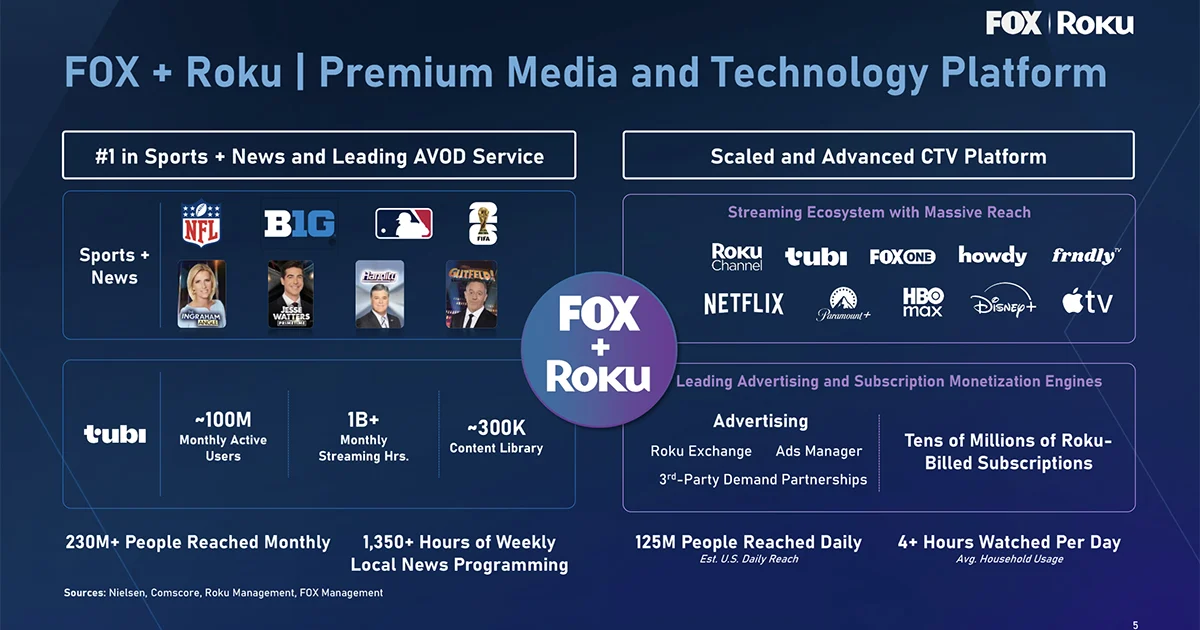
Furthermore, Fox plans to keep its own free, ad-supported streaming service, Tubi, and The Roku Channel as distinct entities. While there is approximately a 33% overlap in their respective audiences, management believes that keeping the brands separate allows for a broader market capture. By maintaining distinct identities, Fox can leverage Tubi’s deep library of movies and television shows alongside The Roku Channel’s unique mix of live news, sports, and original content, maximizing reach across different demographic segments.
Supporting Data: Why Roku Remains the Prize
The deal is fundamentally an advertising play. While the average consumer associates Roku with its streaming sticks and smart TV interface, the real value lies in the data and ad-targeting capabilities of the platform.
Breaking Down the Revenue Streams
Roku’s Q1 earnings report provides a clear window into why Fox found the company so attractive. The platform has successfully transitioned its revenue base away from hardware dependence:
- Advertising Revenue: $613 million (up 27% YoY).
- Subscription Revenue: $519 million (up 30% YoY).
- Total Revenue: $1.248 billion (up 22% YoY).
- Net Income: $85.7 million.
- Device Sales: $118 million (down 16%, representing less than 10% of total revenue).
With 38.7 billion streaming hours recorded in Q1—an 8% year-over-year increase—the platform’s stickiness is undeniable. Crucially, Roku ended the quarter with $2.38 billion in cash and zero long-term debt, providing a stable foundation for the integration process.
Official Responses and Leadership Changes
Anthony Wood, the founder, chairman, and CEO of Roku, has been a central figure in the streaming revolution. As part of the acquisition agreement, Wood will transition to the Fox board of directors, ensuring that his institutional knowledge of the platform and its technological trajectory is retained.
In the official investor presentation released alongside the announcement, Fox executives emphasized the synergy between their existing news and sports programming and the high-engagement environment of the Roku ecosystem. The combination of live, appointment-based viewing—which is the bedrock of Fox’s portfolio—and the on-demand, algorithmic discovery of Roku is viewed by the board as the "holy grail" of modern media distribution.
Implications for the Streaming Industry
The acquisition of Roku by Fox signals a massive shift in the power dynamics of the television industry. For years, content owners have been at the mercy of platform gatekeepers. By bringing the platform in-house, Fox effectively secures its future distribution channel, minimizing the risk of carriage disputes or reduced discoverability in an increasingly crowded app store environment.
1. The Death of the "Neutral" Aggregator?
While Fox has promised to keep Roku an open platform, industry observers remain skeptical. If Fox uses the platform to preferentially promote its own content, the regulatory landscape could become hostile. The Federal Trade Commission (FTC) and other international regulators will likely subject this deal to intense scrutiny, particularly regarding data privacy and competition in the digital advertising space.
2. Consolidating the Ad Market
The combination of Fox’s inventory and Roku’s ad-tech stack creates a formidable competitor to the likes of Google, Amazon, and Disney. By controlling both the content and the conduit through which that content is viewed, Fox can offer advertisers highly granular, cross-platform targeting that is difficult to replicate.
3. The Future of Hardware
With hardware sales shrinking as a percentage of total revenue, the question remains: will Fox continue to subsidize Roku’s device business, or will it pivot entirely to software licensing and OS integration? The deal suggests that the hardware is simply a "loss leader" to ensure that the Roku OS remains the primary interface in millions of living rooms.
Looking Ahead to 2027
The road to the 2027 closing date is likely to be filled with regulatory hurdles and complex integration challenges. Successfully merging the corporate culture of a legacy media giant like Fox with the agile, software-first mentality of Roku will be a significant test for the leadership teams of both organizations.
However, the logic of the deal is clear: in an era where attention is the most valuable commodity, owning the platform that commands the viewer’s first click is the ultimate strategic advantage. As Fox and Roku prepare for this marriage, the rest of the media world is on notice. The era of the standalone platform may be drawing to a close, replaced by a new generation of vertically integrated media titans designed to capture, retain, and monetize the viewer at every stage of the digital experience.
For the investor, the analyst, and the casual viewer alike, the next 24 months will be a period of profound transition. Whether this $22 billion bet pays off will depend on Fox’s ability to maintain the trust of its users while aggressively pursuing the advertising efficiencies that make Roku such a coveted asset in the modern media marketplace.