In an era where "AI productivity" has become synonymous with quick-fix chatbot prompts, many entrepreneurs are hitting a wall. They experiment with one-size-fits-all agents, only to find the output generic, the process disjointed, and the time saved negligible.
Keith Moehring, CEO of L2 Digital, suggests a radical pivot: stop looking for a "magic button" and start building a bespoke system of AI agents that function as an extension of your specific business logic. By moving away from off-the-shelf templates and toward a custom-architected ecosystem, Moehring has successfully automated 60% of his total workload—transforming two-week-long project cycles into a single hour of oversight.
This article explores the methodology behind his success, detailing how to map your business, build a robust technical foundation, and orchestrate agents that act as a "second brain" for your organization.
The Hard Truth: Why Templates Fail
The internet is saturated with "build an agent in six steps" tutorials that promise instant efficiency. Moehring’s first word of caution is that true automation is not a shortcut; it is an architectural project.
"If you want an agent that performs a specific task exactly how you would do it, you have to provide the context," Moehring explains. "You must define the process, refine the outputs, and ensure the system is built for your workflow, not someone else’s."
The investment is substantial, but the payoff is transformative. An agent capable of handling 80% of a recurring task provides immediate value, leaving the final 20% for human nuance and quality control. Furthermore, these agents serve an auxiliary function as a "second brain." Because every action is logged, consolidated, and queryable, the system acts as an institutional memory. When a project deadline or a specific client interaction is forgotten, the answer is always a query away.
Chronology of a System: From Task to Orchestration
AI agents thrive on specificity. According to Moehring, the most effective way to integrate them is through a layered, three-tier progression:
1. Entry Level: The Task-Specific Agent
At the foundational level, you build agents to handle individual, high-friction tasks. These are the repetitive actions—data entry, report generation, or scheduling—that drain your energy. Each agent is purpose-built to execute one, and only one, function with total reliability.
2. Intermediate Level: Coordination
Once you have several task-level agents, you move to the intermediate stage. Here, you build agents that coordinate the lower-level bots. By stringing their outputs together, you create cohesive workflows that move a task from initiation to completion without manual intervention.
3. Advanced Level: Orchestration
The pinnacle of this system is the "Orchestration Agent." In Moehring’s case, this is "Leo." At the start of every month, Moehring triggers Leo with a single prompt: "Set up all the client tasks and start executing on the work for all distributor clients this month."
Leo knows exactly which sub-agents to trigger, the order of operations, and the required output formats. It drafts emails, populates ClickUp tasks, and initiates project folders. What used to be a two-week administrative slog is now a 60-minute review session.
Supporting Data: The Anatomy of the Meeting Follow-Through
One of the most powerful implementations of this system is the automated post-meeting follow-through. Moehring previously struggled with "meeting fatigue," where critical action items were lost in the shuffle between calls.

He now utilizes a sophisticated stack involving Granola for meeting transcription and Cursor for agent execution. The workflow is as follows:
- Standardization: Every meeting is labeled with a strict naming convention (e.g.,
ClientCode_meetingtype). - Categorization: The AI reads the first line of the transcript to determine if the content is a strategy session, project update, or internal check-in.
- Retrieval: The agent pulls all meeting notes from the previous week, cross-references them against a master client directory, and segments the data into relevant folders.
- Execution: It extracts action items, assigns them to the correct owner in ClickUp, and provides full context, ensuring that no task is created in a vacuum.
Official Methodology: Building Your Own Architecture
To replicate these results, one must move through a structured, rigorous development process.
Phase 1: The Accountability Chart
Before touching any software, you must map your business. Moehring recommends an accountability chart that mirrors your org chart. Identify your core functions (Marketing, Sales, Operations, Finance), define the roles, and list the recurring tasks under each.
If you are a solo entrepreneur, this exercise is even more vital. Use tools like Ninety.io or Claude to visualize your structure. Once you have a clear map of your responsibilities, pick one, and only one, recurring task to automate.
Phase 2: The Tech Foundation
A stable system requires three pillars:
- The Brain (AI Model): While Claude is currently preferred for its coding logic, the system is model-agnostic. The key is the ability to swap models based on task complexity.
- The Interface (Cursor): Cursor is a code editor that connects your AI model directly to your local file system. It allows the AI to see your documents, templates, and history, making it far more capable than a standalone browser-based chat window.
- The Context Layer: Organize your local files into a dedicated "Ops" folder. By giving the AI access to your "Reference," "Templates," and "Client" folders, you provide the "mental map" it needs to operate autonomously.
Phase 3: Drafting the Playbook
"Playbooks" are the Standard Operating Procedures (SOPs) for your agents. They are not for humans; they are technical documentation for the AI.

- Document the Task: Write out your current approach.
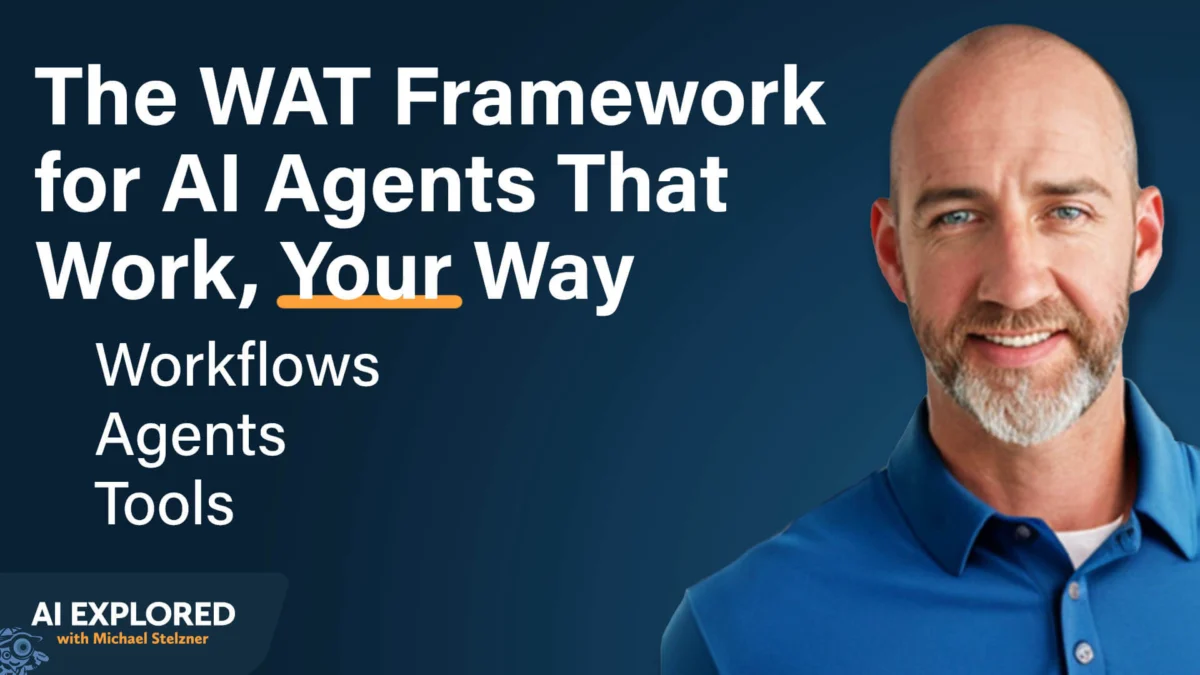
- The WAT Framework: When instructing the AI, use the Workflows, Agents, and Tools framework. Clearly define the workflow (the steps), the agents (the roles), and the tools (APIs, connectors, and software) needed to execute the work.
- Refinement: Use the AI to draft the build document, review the plan for errors, and iterate until the logic is flawless.
Implications: The Shift Toward Agentic Management
The implications for business owners are profound. By offloading 60% of the workload, you are not just saving time; you are changing the nature of your role. You shift from being a "doer" to an "orchestrator."
However, there are risks to this transition. Over-automation of complex, nuanced tasks without proper oversight can lead to "hallucinated" outcomes. This is why the "bottom-up" approach is essential. By building simple, reliable agents first, you create a foundation of trust. Only when the foundational agents are proven, stable, and predictable should you layer on an orchestration agent.
Furthermore, the automation of triggers—using tools like Cursor Automations or cron jobs—means that your business begins to operate on a continuous loop. This creates a "business-as-a-product" mindset, where the operations themselves are treated as software that requires maintenance, updates, and debugging.
Final Thoughts: The Path Forward
The journey to building a custom AI agent system is not for the faint of heart. It requires the discipline to document your processes, the patience to iterate on agent logic, and the willingness to learn the fundamentals of how these models interface with your data.
As Keith Moehring demonstrates, the reward for this effort is a significant increase in both output and mental clarity. By treating your business processes as a system that can be architected, you can move away from the frantic pace of manual execution and toward a more controlled, automated, and scalable future.
Whether you are a solo founder or leading a mid-sized team, the first step is the same: find your most repetitive, low-value task, and start building. The path to a 60% reduction in workload begins with a single, well-defined agent.