By CJR Staff
Published by the Columbia Journalism Review
Main Facts: A Defining Career in a Changing Media Landscape
In the volatile world of international journalism, few careers illustrate the unpredictable nature of breaking news quite like that of Razia Iqbal. What began as a routine office elevator ride in 1990—while Iqbal was merely holding a temporary, six-month subeditor contract at the BBC—instantly altered the trajectory of her professional life. Within days of that chance conversation, she found herself thrust into a high-stakes foreign assignment in Pakistan, substituting for a correspondent who had vacated the post at short notice.
What was initially anticipated to be a quiet diplomatic and cultural posting quickly escalated into a baptism by fire. Shortly after her arrival in Islamabad, then-Prime Minister Benazir Bhutto was dramatically dismissed from office, triggering a profound political and constitutional crisis. Despite having virtually no prior experience in broadcast journalism, Iqbal was thrust onto the front lines of history, delivering rolling, real-time coverage across television and radio for the vast global audience of the BBC World Service.
That pivotal moment launched a celebrated thirty-year career that would cement Iqbal’s status as one of the most recognizable, trusted, and accomplished journalists of her generation. Over the subsequent decades, she reported from the epicenter of historic conflicts, including Sri Lanka during the harrowing height of its civil war in the 1990s. She went on to anchor BBC Newshour, the broadcaster’s flagship global current affairs radio program, and established herself as a formidable cultural and arts journalist.
After leaving the British Broadcasting Corporation in 2023, Iqbal transitioned into academia and public intellectualism. She currently serves as a visiting professor at Princeton University and brings her wealth of reporting experience to the editorial board of The Nation.
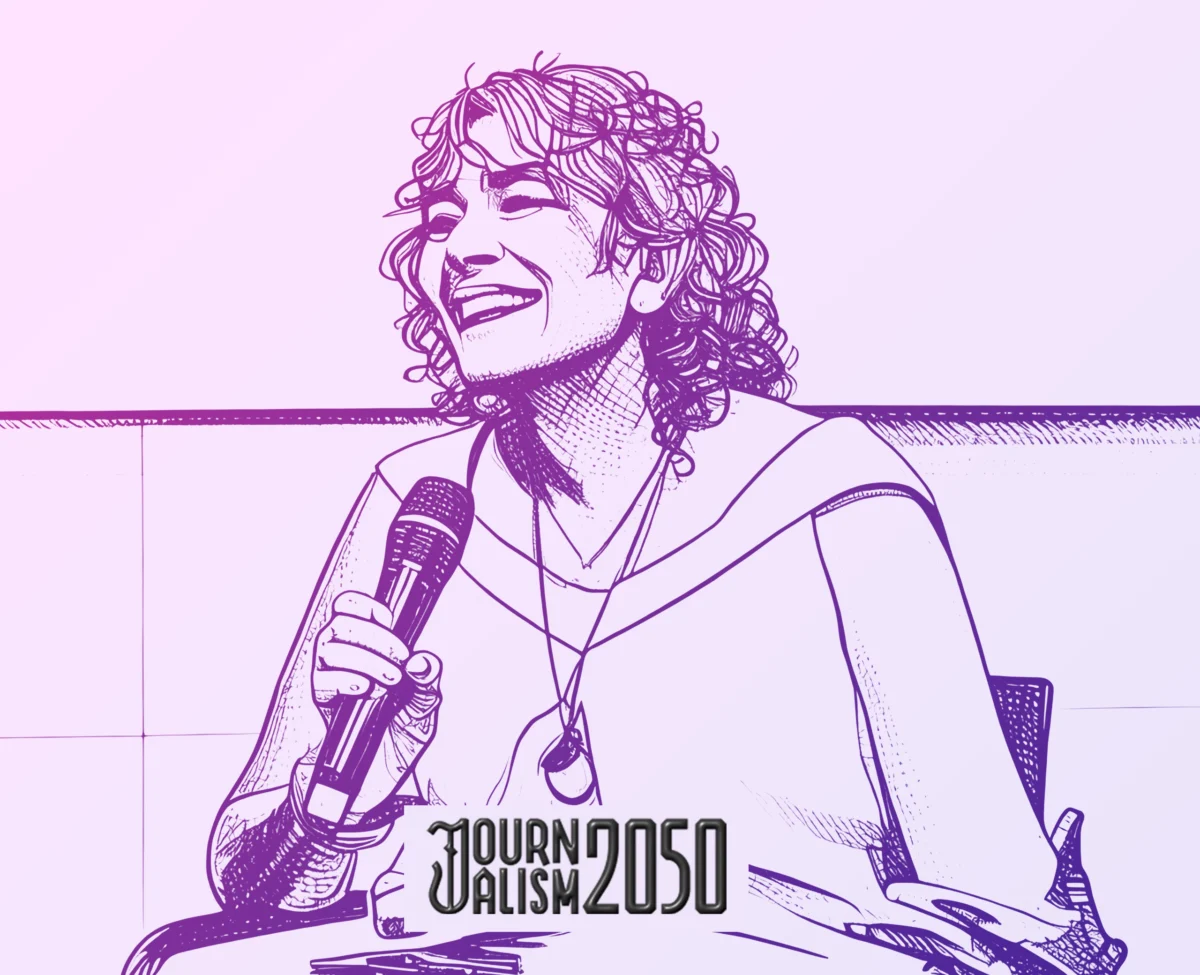
Recently, Iqbal sat down for a wide-ranging conversation on an episode of Journalism 2050—recorded live this past June at the Zeg Storytelling Festival in Tbilisi, Georgia. Co-hosted by media scholars Emily Bell and Heather Chaplin, the discussion offered a retrospective look at Iqbal’s storied career, while grappling with the systemic crises currently facing the global journalism industry. Surveying the landscape she has monitored for decades, Iqbal offered a sobering assessment of the modern media ecosystem: "I feel like we are in a clarifying moment where you need to take a stand, if you believe in journalism. I still only just believe in journalism."
Chronology: The Evolution of a Foreign Correspondent and Cultural Critic
To understand Iqbal’s perspective on the fragility and necessity of contemporary media, one must trace the chronological milestones that defined her three decades inside and outside the BBC’s institutional machinery.
1990: The Accidental Broadcaster
At the start of the final decade of the twentieth century, Iqbal was an entry-level subeditor operating on a fragile six-month contract within the BBC. The media landscape of 1990 was vastly different from today: it was an era defined by traditional broadcast monopolies, heavy analog infrastructure, and a slower, more deliberate cycle of international news production.
The chance elevator encounter led to her sudden deployment to Pakistan. In a matter of days, Iqbal transitioned from the quiet desk-bound editing of text to broadcasting live updates amid the chaotic ouster of Benazir Bhutto. Without the safety net of modern digital communication tools or expansive remote production teams, she learned the mechanics of live, international broadcasting through direct, high-pressure execution.
The 1990s and 2000s: Conflict Zones and Institutional Growth
Throughout the remainder of the 1990s and into the 2000s, Iqbal solidified her reputation as a resilient foreign correspondent. As the Sri Lankan civil war intensified, she provided nuanced, ground-level reporting that cut through state propaganda and humanized the civilian toll of the conflict.
As her career matured, Iqbal pivoted successfully between hard geopolitical news and cultural critique. This dual competency allowed her to navigate the BBC’s complex institutional hierarchy, eventually leading her to the anchor chair of BBC Newshour. In this role, she helped shape the daily global conversation, interviewing world leaders, dissidents, artists, and intellectuals, while witnessing the early tremors of the digital disruption that would soon shake legacy media to its foundations.
2023–Present: Academic Transition and Industry Critique
After more than thirty years of continuous service at the public broadcaster, Iqbal stepped away from the BBC in 2023. This departure coincided with a broader industry-wide reckoning regarding editorial independence, institutional neutrality, and the economic viability of public service journalism.
Her transition to Princeton University as a visiting professor and her appointment to the editorial board of The Nation marked a new chapter. No longer bound by the rigid impartiality guidelines of a state-funded broadcaster, Iqbal has increasingly used her platform to analyze the structural decay of the press and advocate for a renewed sense of ethical purpose among media practitioners. Her appearance at the Zeg Storytelling Festival in Tbilisi in June marked a continuation of these critical reflections, placing her life’s work in direct dialogue with the existential questions facing the next generation of storytellers.
Supporting Data: The Transformation of Global News and Public Trust
Iqbal’s career serves as a longitudinal case study for the dramatic structural shifts that have reshaped the news industry over the past thirty years. When she entered the profession in 1990, the global news ecosystem was dominated by a handful of elite public service institutions and legacy print newspapers. These organizations enjoyed high barriers to entry, stable advertising-based or state-funded revenue models, and a near-monopoly on public trust.
Data compiled over the subsequent decades by media research organizations—including the Reuters Institute for the Study of Journalism and Columbia University’s Tow Center for Digital Journalism (directed by Journalism 2050 co-host Emily Bell)—illustrate the steep decline of these traditional anchors:
- The Erosion of Trust: Public trust in mass media has experienced a steady, secular decline across Western democracies. According to long-term tracking data, trust in news institutions has fallen to historic lows, driven by hyper-partisanship, the proliferation of misinformation, and institutional missteps by legacy outlets.
- The Economic Collapse of Local and Foreign Bureaus: Over the last twenty years, the economic model of commercial journalism has fractured. The migration of advertising revenue to major technology platforms starved newsrooms of vital capital. Consequently, international news budgets were slashed, leading to the systematic closure of foreign bureaus—the very institutions that launched Iqbal’s career.
- The Rise of Algorithmic Disintermediation: Today’s journalists do not simply compete with rival networks; they operate at the mercy of opaque social media algorithms that prioritize engagement, outrage, and speed over nuance, verification, and depth.
It is against this bleak quantitative backdrop that Iqbal’s observation—that we are living in a "clarifying moment"—carries significant analytical weight. The financial and technological pressures facing the industry have stripped away the illusions of perpetual institutional stability, forcing journalists to either actively defend the core tenets of their craft or watch its complete erosion.
Official Responses and Industry Perspectives
The conversation between Iqbal, Emily Bell, and Heather Chaplin on Journalism 2050 touched upon broader debates occupying newsrooms, journalism schools, and media policy circles worldwide.
The Crisis of Objectivity vs. Moral Clarity
For decades, mainstream Western journalism—typified by institutions like the BBC—clung fiercely to a doctrine of strict institutional neutrality, often described as "view-from-nowhere" objectivity. However, speakers on the podcast noted that this framework has proven ill-equipped to handle modern threats such as democratic backsliding, authoritarian propaganda, and climate denialism.
Iqbal’s assertion that practitioners must "take a stand, if you believe in journalism" reflects a growing counter-movement within the industry. Proponents of this view argue that neutrality in the face of systemic assaults on truth and democracy is not objectivity; it is complicity.
The Role of Academic and Independent Institutions
With legacy commercial newsrooms downsizing and public broadcasters facing intense political interference and budget cuts, the burden of media criticism and training has increasingly fallen upon academic institutions and independent publications.
Emily Bell, speaking through her leadership at the Tow Center for Digital Journalism, has consistently emphasized the danger of allowing private technology monopolies to dictate the terms of public discourse. Similarly, Heather Chaplin’s work through the Journalism + Design program at The New School focuses on interdisciplinary problem-solving to help journalists adapt to systemic uncertainty. Iqbal’s integration into these academic spaces—bridging the gap between active foreign reporting and critical institutional analysis—underscores the growing symbiosis between universities and the press in defending democratic norms.
Implications: What the Future Holds for Journalism in 2050
The reflections shared by Razia Iqbal in Tbilisi carry profound implications for the future of global news dissemination, institutional credibility, and the survival of the democratic public sphere.
1. The Survival of Independent Reporting Under Threat
If the business model of international journalism continues to rely on precarious freelance contracts, shrinking newsrooms, and algorithm-driven distribution, the pipeline that produced journalists like Iqbal—who could be dispatched on a moment’s notice to cover a seismic geopolitical shift—will effectively dry up. Without sustained financial investment in deep, on-the-ground reporting, the public will remain increasingly blind to international crises.
2. Redefining Journalistic Authority
The shift from institutional gatekeeping to decentralized digital communication means that traditional journalists no longer hold a monopoly on storytelling. As Iqbal noted, survival requires a return to foundational values. Journalists must prove their worth not through the prestige of their mastheads, but through rigorous verification, ethical transparency, and an explicit willingness to defend the truth against bad-faith actors.
3. A Call to Action for the Next Generation
Ultimately, Iqbal’s cautious affirmation—"I stil only just believe in journalism"—serves as both a warning and an invitation. It acknowledges the immense damage inflicted upon the industry by economic failure, political pressure, and technological disruption. Yet, it insists that the underlying mission remains indispensable. As media scholars, educators, and veteran reporters chart a path toward the year 2050, Iqbal’s career stands as a testament to the fact that while the tools of the trade will inevitably transform, the fundamental human need for courageous, independent truth-telling remains unchanged.
Credits and Production Notes
- Journalism 2050 Episode: "Journalism in the Age of the Quick Take"
- Producer: Sarah Myles
- Research: Samuel Earle
- Production Assistant: Hana Joy
- Art: Katie Kosma
- Music: Henry Crooks
- Hosts: Emily Bell (Director, Tow Center for Digital Journalism, Columbia University; former Director of Digital Publishing, The Guardian) and Heather Chaplin (Founding Director, Journalism + Design program, The New School).