In the noisy ecosystem of professional networking, LinkedIn has become a battleground for attention. While the platform boasts millions of active users, a staggering reality remains: only 1% of the user base actually creates content. For the remaining 99%, this creates a massive "content gap"—a supply-and-demand imbalance that rewards those willing to show up with high-quality, intentional contributions.
However, simply posting with frequency is no longer a viable strategy for growth. As algorithms evolve and audience skepticism rises, creators are finding that generic, AI-generated, or self-serving posts are increasingly ignored. To cut through the clutter, creators must move beyond vanity metrics and adopt a strategic, human-centric approach.
Kasey Brown, a LinkedIn growth strategist and founder of Digital Kairos, argues that the secret to long-term success lies in a structured, three-part methodology known as the "Triple S" framework: Stop, Stay, and Share.
The Foundation: Strategy Before Syntax
Before a single word is written, creators must establish a rock-solid foundation. According to Brown, most LinkedIn efforts fail because they lack clarity in three specific areas:
1. Defining the "Ideal Client Profile" (ICP)
Your ICP cannot be a vague, demographic-based sketch. To be effective, an ICP must be precise enough that a virtual assistant could use it to identify specific prospects in a search query.
- The Wrong Approach: "People who want to build a brand online."
- The Right Approach: "Speakers, coaches, and consultants earning at least $20,000 per month who need organic content systems to scale their business."
2. The Transformation Component
Every piece of content must be tethered to a specific transformation. Ask yourself: "What will my reader walk away with after 30 days of following me?" If your content does not serve as a bridge from the reader’s current problem to a future solution, it is merely noise.
3. The Reader-First Mandate
The most common trap for professional creators is the "ego-post." When content is written to showcase how smart the creator is or to boast about client wins without context, engagement stalls. When the focus shifts to what the reader gains, the engagement becomes sustainable and compoundable.
The Triple S Framework: A Tactical Breakdown
With the foundations set, the Triple S framework provides a actionable roadmap for creating content that performs.
Phase 1: Stop – The Art of the Pattern Interrupt
The first objective of any post is to halt the user’s scroll. Brown identifies two primary levers here: the visual asset and the opening hook. Together, these elements account for roughly 80% of a post’s impressions.
Visual Differentiation:
Most users stick to professional headshots or polished corporate photos. To stand out, you must be different, not just better. Brown’s own data illustrates this: a low-resolution, 0.5x wide-angle selfie taken from a stage generated 3,000 leads, whereas a high-resolution, professionally lit shot of the same event yielded only 200. Vertical images that occupy more screen real estate and reveal authentic, "behind-the-scenes" environments are statistically more likely to trigger curiosity.
The Power of the Hook:
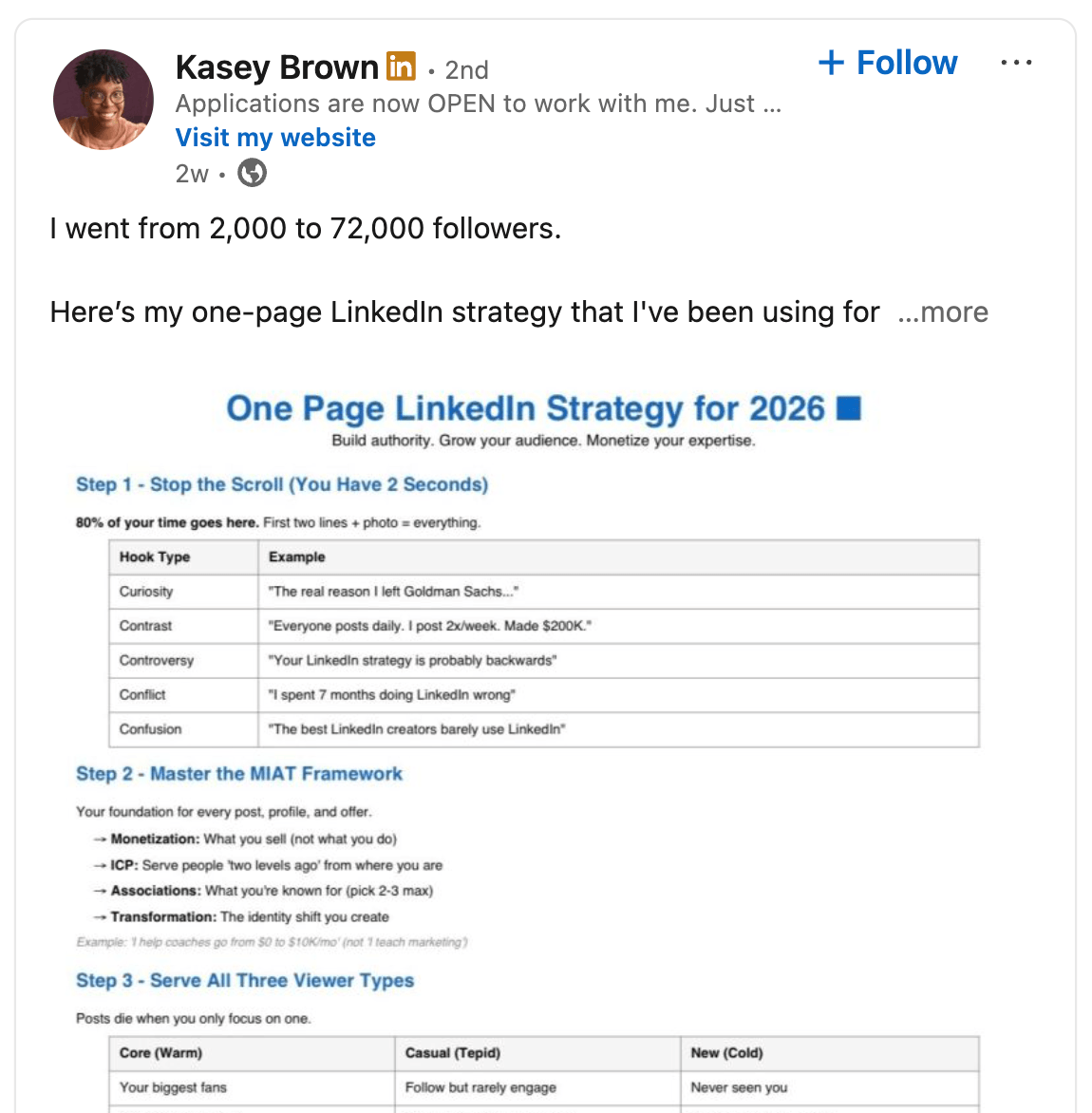
The first two lines of text must compel the reader to click "see more." Brown employs the "Five Cs" of psychology—Curiosity, Contrast, Contradiction, Controversy, and Confusion—to craft these lines.
- Example: A bland caption like "I’m on vacation in Bali" fails the test.
- The "Five Cs" approach: "I was at a job I hated. 2021. / 2026. I just spent $30K to come here…" This creates immediate tension, contradiction, and curiosity.
Phase 2: Stay – Earning the Right to Attention
Once you have stopped the scroll, you must earn the reader’s time. This is where the "re-hook" becomes critical.
The Re-Hook Strategy:
The third line of the post—the one immediately following the "see more" click—should not provide a conclusion. Instead, it must deepen the tension. If you solve the problem immediately, you give the reader no reason to stay. If you continue the narrative by describing the obstacles or the emotional stakes, you force the reader to keep reading to reach the resolution.
Formatting for Readability:
Design impacts consumption. Brown suggests a rhythm of "short-long-short":
- 3–4 single-sentence lines to drive speed.
- A 2–3 sentence block to develop the concept.
- A return to short, punchy lines to land the key takeaway.
Before publishing, creators should verify the reading level—aiming for 4th to 7th-grade simplicity—using tools like the Hemingway App. Furthermore, because 70% of LinkedIn consumption happens on mobile, utilizing preview tools like "Authored Up" is essential to ensure formatting doesn’t collapse into unreadable "walls of text."
Phase 3: Share – The Ultimate Metric of Value
The "Share" (or Repost) is the highest form of validation on LinkedIn. It signifies that the content was valuable enough for a user to associate their personal brand with your message.
The "Goodie Bag" Approach:
Shares are driven by concrete, actionable takeaways. At the end of every post, the reader should feel they are leaving with a "goodie bag"—a step-by-step framework, a checklist, or a clear roadmap. If a post is merely a story without a takeaway, it will rarely be shared. Brown notes that any post achieving a share-to-impression ratio of 0.5 or higher should be recycled into a rotation every 60 to 90 days.
Implications for the Modern Professional
The shift toward this "Triple S" framework reflects a broader trend in digital marketing: the return of the human narrative. As AI tools become ubiquitous in content generation, the market is becoming saturated with perfectly written, yet perfectly soulless, corporate messaging.
The implication for professionals is clear: Authenticity is now a competitive advantage.
By prioritizing the reader’s transformation, using raw and unpolished visuals, and respecting the rhythm of mobile reading, creators can bypass the limitations of the algorithm. LinkedIn is not just a digital resume; it is a platform for teaching and connection. Those who treat it as such, by providing genuine value and removing the barrier of ego, will find that the platform remains one of the most effective tools for business growth in the modern era.
Summary of Best Practices
- Audit your ICP: If your target audience is too broad, your content will resonate with no one.
- Prioritize mobile: If your post looks like a dense essay on a phone, it will be skipped.
- Track your ratios: Don’t obsess over "likes." Focus on shares-per-impression as the true north star of your content’s effectiveness.
- The "Goodie Bag" Rule: Never conclude a post without leaving the reader with something tangible they can use immediately.
In an era of artificial intelligence, the most "human" content—content that shares real stories, real failures, and real, actionable lessons—will inevitably win the day. By adopting the Triple S framework, creators can ensure they aren’t just adding to the noise, but actually building a business-driving asset.
Kasey Brown is a LinkedIn growth strategist and the founder of Digital Kairos. Her work focuses on helping executives, founders, and consultants build organic content systems that scale. You can follow her insights on LinkedIn or explore her detailed video breakdowns on YouTube.