The landscape of American public life is undergoing a profound transformation, defined less by a uniform decline in participation and more by a fundamental shift in how that participation occurs. A comprehensive new report from the Pew-Knight Initiative reveals that while the pillars of democracy—voting, community volunteering, and news consumption—remain essential, the pathways to these activities have diverged sharply along generational lines.
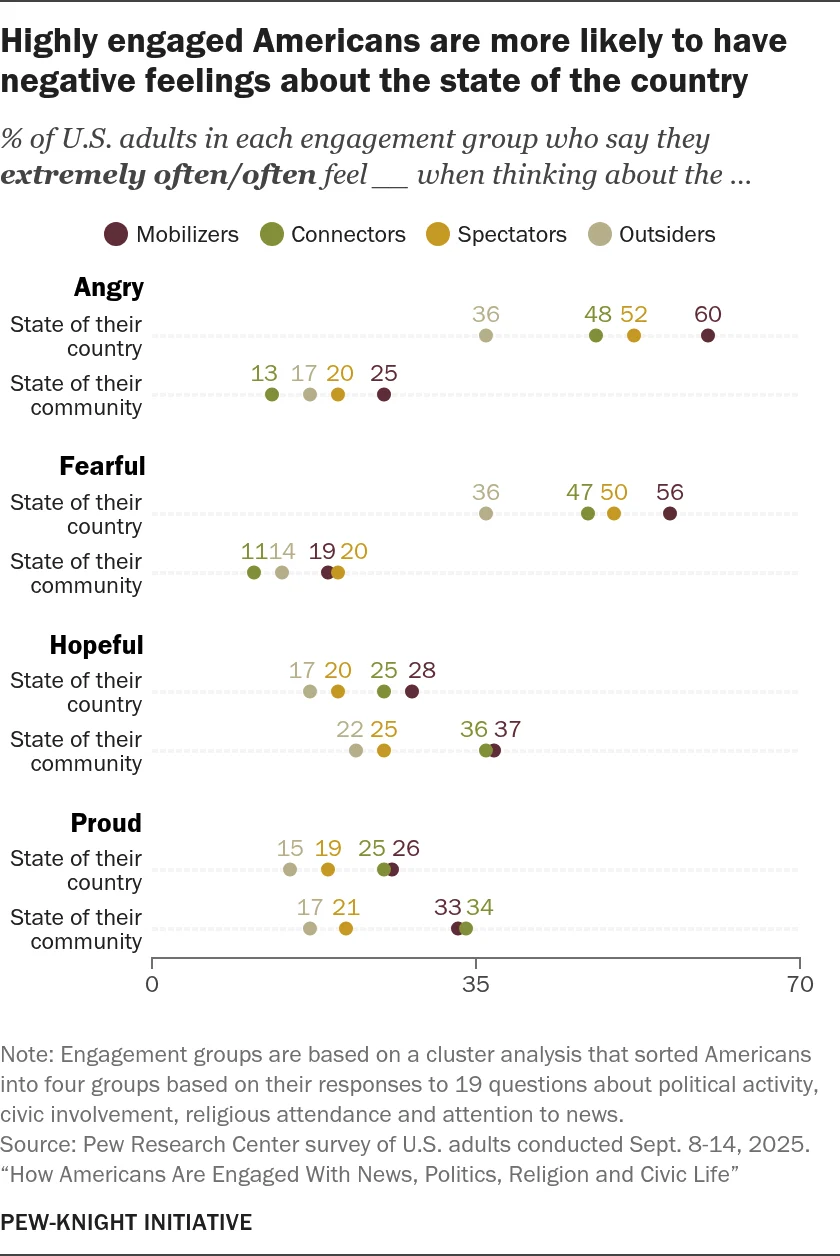
By analyzing 19 distinct measures of participation, ranging from political activity and civic involvement to religious attendance and digital news consumption, researchers have identified four distinct "engagement groups" within the U.S. population. The findings suggest that the traditional model of the "engaged citizen" is being challenged by a younger generation that prefers digital interaction over institutional participation, and an older generation that remains the backbone of conventional civic infrastructure.
Understanding the Four Pillars of Engagement
To provide an integrated picture of how Americans interact with their communities, the Pew-Knight Initiative conducted a massive, multi-method study between July and December 2025. By performing a cluster analysis on over 5,000 respondents, the researchers categorized the public into four distinct profiles based on their behavioral patterns:

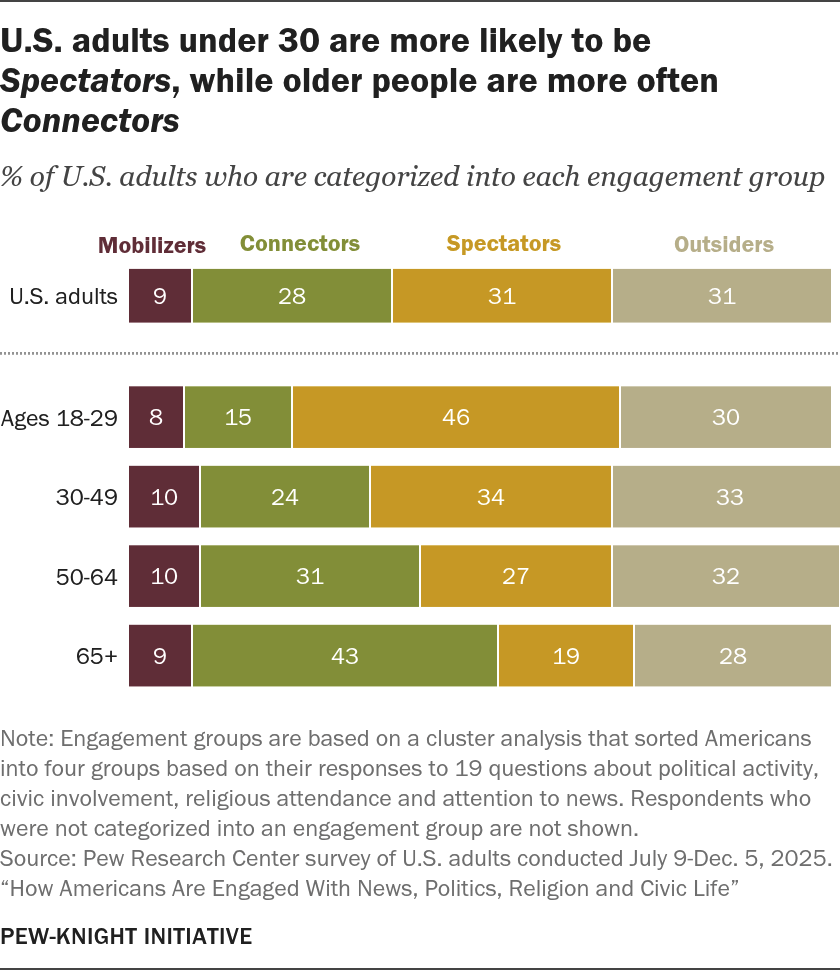
- The Mobilizers: Comprising about 9% of the population, these individuals are the "do-it-all" cohort. They are the most active across every category, showing high levels of engagement in politics, civics, news, and religion.
- The Connectors: Making up 28% of the public, this group is highly active in community life, including volunteering and making donations, yet they are significantly less likely than Mobilizers to be involved in high-stakes political activities.
- The Spectators: This is a large segment of the population (31%) that remains informed by following the news at high rates but opts out of direct, hands-on civic participation.
- The Outsiders: Representing 31% of the public, this group reports the lowest level of engagement across the board, including lower rates of voting, news consumption, and community involvement.
The study serves as a critical diagnostic tool for understanding the health of American civil society, moving beyond the binary "voter vs. non-voter" narrative to capture the nuance of modern life.
The Chronology of Civic Participation
The research was specifically timed to capture behavior during a high-intensity period, including the 2024 presidential election. This context is vital: the data reflects a specific point in the political cycle, meaning that patterns of political activity may fluctuate during non-election years.
However, the survey’s longitudinal design—which utilized both a large-scale cross-sectional survey and the American Trends Panel (ATP)—provides a robust, representative look at the habits formed over the preceding 12 months. By reaching out to respondents through online, paper, and telephone channels, the researchers were able to capture voices often missing from traditional polling, including those who are typically less likely to participate in public life and, consequently, less likely to answer survey questions.
Generational Divergence: Traditional vs. Digital
The most striking revelation of the study is the chasm between the "Connectors" (who are disproportionately older) and the "Spectators" (who are disproportionately younger).
The Traditionalists: Older Americans
For those aged 65 and older, civic life is anchored in institutions. Roughly 43% of this age group are classified as "Connectors." Their engagement is characterized by high rates of:
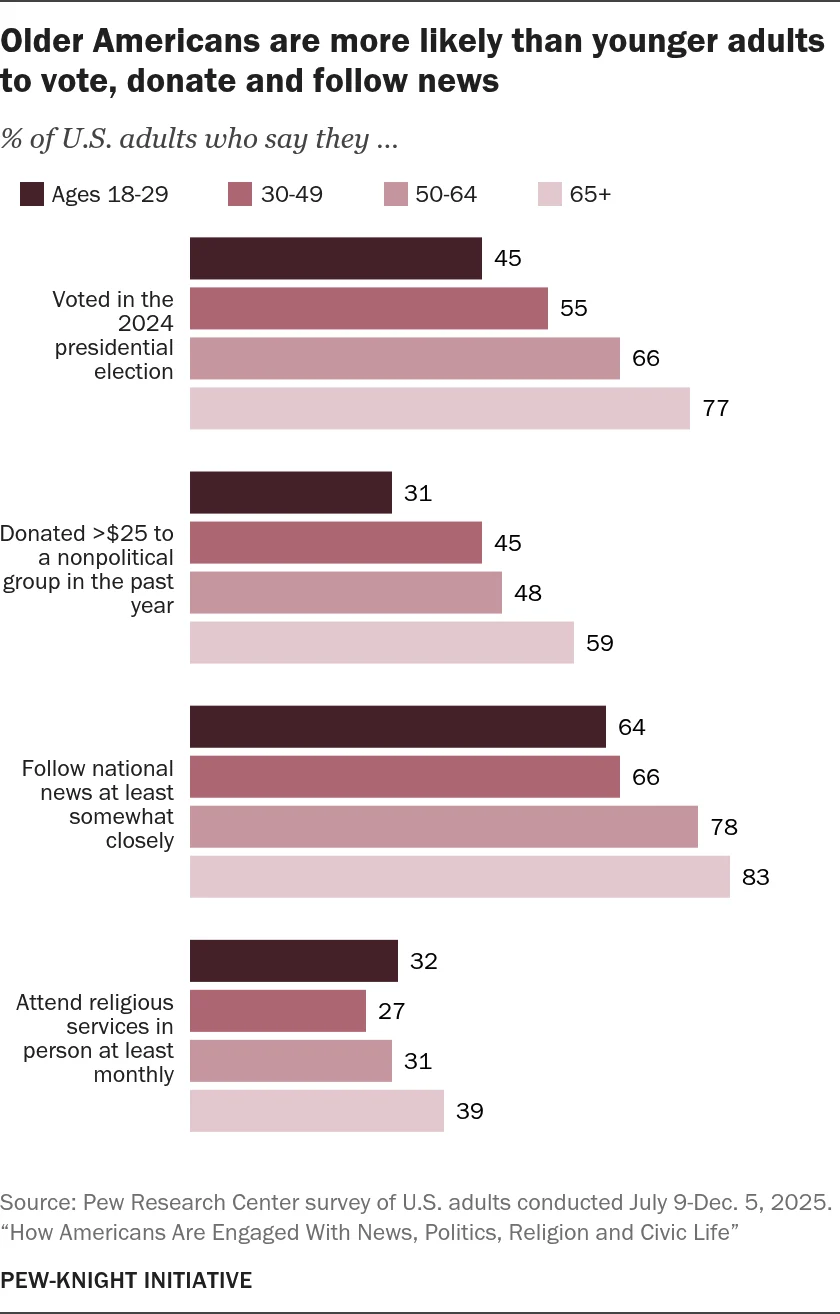
- Voting: 77% of those 65+ reported voting in the 2024 presidential election, compared to only 45% of those under 30.
- Philanthropy: 59% of the oldest age group donated more than $25 to a nonpolitical organization in the last year, compared to 31% of the youngest cohort.
- Religious Attendance: 39% of those 65+ attend religious services at least monthly, a key hub for social and community networking.
The Digital Observers: Younger Americans
Conversely, the "Spectator" profile is dominated by those under 30. Nearly half (46%) of this demographic falls into this category. They are not "checked out" in the traditional sense; rather, their engagement is curated through digital interfaces.

Younger adults are significantly more likely to:
- Like or save online news posts: 59% of 18-to-29-year-olds do this weekly, compared to 32% of seniors.
- Privately share news: This cohort is more likely to engage in private chats about news via messaging apps, signaling that their political discourse has moved from public forums to private, digital "echo chambers."
Supporting Data: The Engagement Divide
The data highlights that while younger people are less likely to participate in high-friction activities like long-term volunteering or institutional voting, they show high levels of specific, low-friction digital participation.
Interestingly, there is a "volunteerism anomaly" that defies the age-gap trend. About 32% of those under 30 engage in volunteer work, a figure that is higher than the 25% reported by those 65 and older. This suggests that younger Americans are not necessarily disengaged from altruistic causes, but they prefer decentralized, perhaps more sporadic or project-based volunteering over the long-term, institutionalized membership model that characterizes older generations.
Official Perspectives and Methodology
The Pew-Knight Initiative designed this study to address the "missing link" in current research: how different domains of life—religion, news, politics, and civic work—interact within the individual. By using a cluster analysis, the authors successfully moved away from studying these behaviors in silos.
The researchers acknowledged the potential for survey bias, noting that "some surveys can struggle to reach Americans who are less likely to participate in public life." To mitigate this, the study utilized multiple outreach waves and diverse response methods. The methodology was further bolstered by using the American Trends Panel to assess levels of civic knowledge, ensuring that the study didn’t just measure what people do, but how much they understand about the systems they are—or aren’t—interacting with.
The Broader Implications for Democracy
The findings of this report carry profound implications for the future of American democracy. If the "Connectors" (older, institutionally active citizens) are eventually replaced by "Spectators" (younger, digitally observational citizens), the very nature of civic infrastructure may be at risk.

Political parties, non-profits, and religious organizations that rely on traditional, high-touch engagement methods may find their strategies increasingly ineffective with younger populations. The shift from public posting/commenting to private, peer-to-peer sharing of news also suggests a potential fragmentation of the public square. When news is consumed and discussed in private, encrypted, or algorithmically sorted digital spaces, the "common ground" required for democratic deliberation becomes harder to find.
Furthermore, the prevalence of "Outsiders"—those who are largely disengaged from all forms of public life—presents a long-term challenge to social cohesion. If 31% of the population feels disconnected from the mechanisms of society, the potential for political volatility increases.
Conclusion
The Pew-Knight Initiative’s research paints a portrait of a nation in transition. The "old guard" of civic participation is still highly active, but their methods are increasingly out of sync with a younger population that treats public life as a digital feed to be watched, saved, and shared privately.

To bridge this gap, the study suggests that we must rethink what it means to be a "good citizen" in the 21st century. If we define engagement solely by the metrics of the 20th century—voting and institutional volunteering—we risk misreading the potential for civic action among the youth. However, if we fail to encourage the transition from "spectating" to "participating," we risk a decline in the social capital that keeps the American democratic project functioning. The path forward requires finding ways to translate the high-volume digital interest of younger Americans into the high-impact, real-world action that has historically sustained the nation.