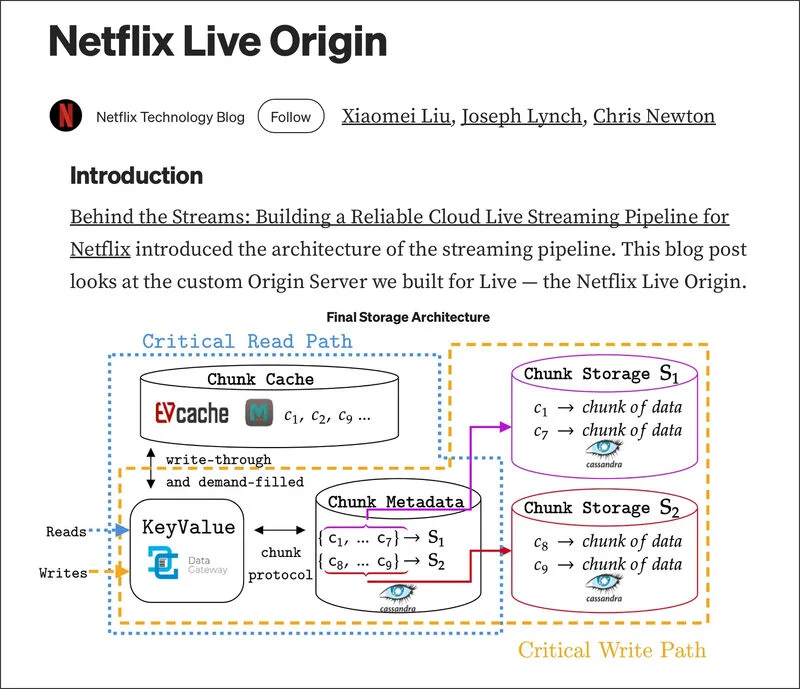
For years, skeptics in the streaming industry held onto a singular, pervasive narrative: Netflix, the titan of Video-on-Demand (VOD), was fundamentally ill-equipped to conquer the world of live broadcasting. The argument was rooted in architectural determinism—the belief that because Netflix’s infrastructure was meticulously engineered for the asynchronous, predictable nature of on-demand content, it could never pivot to the volatile, real-time demands of live events.
Netflix has officially dismantled that narrative. In a landmark 3,200-word technical manifesto, the streaming giant has pulled back the curtain on its custom Origin Server, revealing a sophisticated engineering feat that didn’t require throwing away its legacy platform. Instead, Netflix achieved the impossible by evolving it. By extending Nginx’s proxy-caching functionality, the company has successfully bridged the gap between VOD stability and live-streaming agility, proving that scale is not just about raw power—it’s about intelligent traffic management.
The Architectural Shift: From VOD to Live
The core of Netflix’s live strategy centers on a pivot that many engineers deemed impossible. Rather than abandoning its VOD-centric infrastructure, Netflix doubled down on it. The company’s engineers chose to extend the existing Nginx proxy-caching architecture, transforming a system designed to serve static libraries into one capable of handling the instantaneous, high-concurrency spikes inherent to live sports and cultural spectacles.
This shift was not merely a cosmetic change; it was a fundamental reconfiguration of how data flows through the Netflix ecosystem. By leveraging its proprietary microservice platform, Netflix implemented a "priority rate limiting" feature. This allows the Origin Server to distinguish between live edge traffic and standard DVR requests. During periods of peak load, the system prioritizes the "live" experience, ensuring that viewers watching in real-time receive packets before those accessing the DVR functionality.
Chronology of an Engineering Evolution
The path to this breakthrough did not happen overnight. The development of the current Live Origin solution is the culmination of years of iterative testing, starting with early experiments in interactive content and culminating in the high-stakes, multi-million-viewer events that have defined the company’s recent trajectory.
- The VOD Foundation: Netflix spent over a decade perfecting an infrastructure built for massive, distributed caching via its Open Connect network.
- The Live Experimentation Phase: Netflix began testing live-streaming components through smaller events, identifying the limitations of second-granularity caching.
- The Infrastructure Pivot: Recognizing that HTTP Cache Control was insufficient for two-second segment intervals, engineers began the process of custom-building "millisecond-grain" caching within Nginx.
- The Scale Trials: Over the past 18 months, Netflix stress-tested its redundant cloud pipelines, moving from regional tests to global, high-concurrency events, including high-profile boxing matches and live variety shows.
- The Current State: The system is now fully operational, handling tens of millions of concurrent viewers with a resilience strategy that operates entirely server-side to minimize client-side complexity.
Supporting Data and Technical Innovations
The depth of the Netflix technical reveal provides a rare look at the mechanisms that keep the stream running when millions of users hit "Play" at the exact same second.
Millisecond-Grain Caching
Standard HTTP Cache Control is limited to one-second granularity—a lifetime in the world of high-definition streaming, where video segments are generated every two seconds. Netflix’s engineers hacked Nginx to support millisecond-level precision. This granular control allows the origin to manage segment availability with extreme accuracy, preventing the "thundering herd" problem where thousands of clients request the same segment simultaneously.
Traffic Surges and HTTP 503 Mitigation
To handle traffic surges, Netflix utilizes a sophisticated throttling strategy. When the origin identifies high-load scenarios, it instructs its Open Connect appliances to slow down, caching identical requests for a five-second window (max-age = 5s). During this period, the system returns an HTTP 503 error code to secondary requests. This effectively dampens the surge, ensuring that the origin server is not overwhelmed by redundant requests for the same video segment.
Redundant Pipeline Orchestration
Reliability is baked into the architecture through a dual-pipeline system. Netflix operates two completely independent streaming pipelines across distinct cloud regions, contribution feeds, and encoder deployments. These pipelines utilize "epoch locking" at the cloud encoder level, allowing the origin server to dynamically select a clean segment from either pipe. If one pipeline encounters a defective segment, the system fails over at the server side, ensuring that the client remains completely unaware of the disruption.
Official Stance: Performance Over Price
In an era where tech companies are often obsessed with optimizing cloud spend, Netflix has taken a refreshing stance. The blog post candidly admits that the current Live Origin solution is "significantly more expensive" to run than a standard VOD setup. However, the company is explicit in its priorities: minimizing cost was never the objective. Instead, the focus was squarely on low latency and high availability.
This commitment to performance explains the company’s aggressive, redundant, and resource-heavy approach. By prioritizing the user experience over cost-efficiency, Netflix has established a "gold standard" for live streaming that sets a high bar for competitors, many of whom are still struggling to achieve the same level of stability during high-concurrency events.
Implications for the Streaming Industry
The success of Netflix’s Live Origin project has profound implications for the future of digital entertainment.
The Death of the "It Wasn’t Built for Live" Argument
For years, the industry excuse for streaming failures during live events was that the underlying architecture was "legacy" or "not built for live." Netflix has effectively killed this argument. By showing that a VOD architecture can be extended and adapted, they have provided a blueprint for other platforms to follow. The implication is that any sufficiently robust distributed system can handle live traffic if the engineering team is willing to invest in deep, infrastructure-level modifications.
Shifting Complexity from Client to Server
One of the most notable aspects of Netflix’s strategy is the decision to handle failover and redundancy on the server side. In the early days of streaming, much of the intelligence was placed on the client device (the player). Netflix has reversed this, keeping the player "dumb" and the network "smart." This is a significant advantage, as it ensures that the live-streaming experience is consistent across disparate devices—from high-end smart TVs to older, low-memory mobile devices.
Future-Proofing for Mass-Market Live Events
As Netflix continues to acquire rights for more live sports and entertainment, the "Live Origin" serves as a scalable backbone that can grow with the company. With the ability to hide "problematic segments" through enhanced cache invalidation and origin masking, Netflix has created a self-healing system that protects millions of viewers from the inevitable glitches of live production.
Conclusion: The New Benchmark
Netflix’s transition into a live-streaming powerhouse is not just a success story for the company; it is a masterclass in software engineering. By choosing to evolve their existing systems rather than chasing the "perfect" new architecture, they have demonstrated a pragmatic, high-impact approach to technical debt and innovation.
For the streaming industry, the message is clear: the infrastructure of the future is not about building new systems from scratch, but about the intelligent, granular extension of the ones we already have. Netflix has proven that with enough ingenuity, even the most complex VOD-centric platform can be transformed to host the world’s biggest live moments, without a single frame dropped. As they continue to scale, the rest of the industry will undoubtedly be looking to their "Live Origin" as the new gold standard for reliability in an increasingly real-time digital world.