The landscape of live sports broadcasting underwent a subtle but profound transformation during Super Bowl LX. As millions of viewers tuned in to witness the pinnacle of American football, Comcast quietly debuted a new delivery architecture dubbed "RealTime4K." By merging high-bitrate, high-fidelity video with ultra-low-latency transport protocols, Comcast is attempting to solve the "streaming paradox"—the struggle to balance 4K image quality with the near-instantaneous delivery required for high-stakes live sports.
Main Facts: Decoding RealTime4K
At its core, RealTime4K is not a single technology but a sophisticated pipeline designed to minimize the "time-to-glass" delay that has historically plagued IP-based video. Despite the consumer-facing branding of "4K," it is essential to distinguish between the delivery format and the source material. While the service provides a 30 Mbps stream that supports Dolby Vision HDR and Dolby Atmos, the original source feed is 1080p HDR.
The system relies on an HEVC encoding pipeline using Dolby Vision Profile 8.1. For set-top box users, Comcast employs Low-Latency DASH (LL-DASH) to eliminate the buffer-heavy delays typically introduced by segment packaging. The result is a viewing experience that feels as immediate as traditional broadcast cable, but with the visual enhancement of HDR and immersive audio.
The service is currently compatible with a specific hardware ecosystem:
- Xfinity X1: XG1v4 or Xi6 TV Boxes.
- Xfinity Flex: XiOne streaming TV Box.
- App-based access: The Xfinity Stream app supports the 30 Mbps stream on devices like the Xumo Stream Box, Apple TV, Fire TV, Roku, and various smart TVs (Samsung and LG), though these devices do not currently support the "ultra-low-latency" functionality inherent to the proprietary set-top boxes.
Chronology: From Concept to Super Bowl LX
The development of RealTime4K was a multi-year effort that culminated in the most-trafficked day in the history of Comcast’s network infrastructure.
Pre-Event Preparation: Leading up to February 8, 2026, Comcast engineers refined the encoding pipeline, integrating the latest Dolby Vision improvements—an evolution from the technology utilized during the previous year’s Super Bowl. The goal was to eliminate the "double-compression" bottleneck.
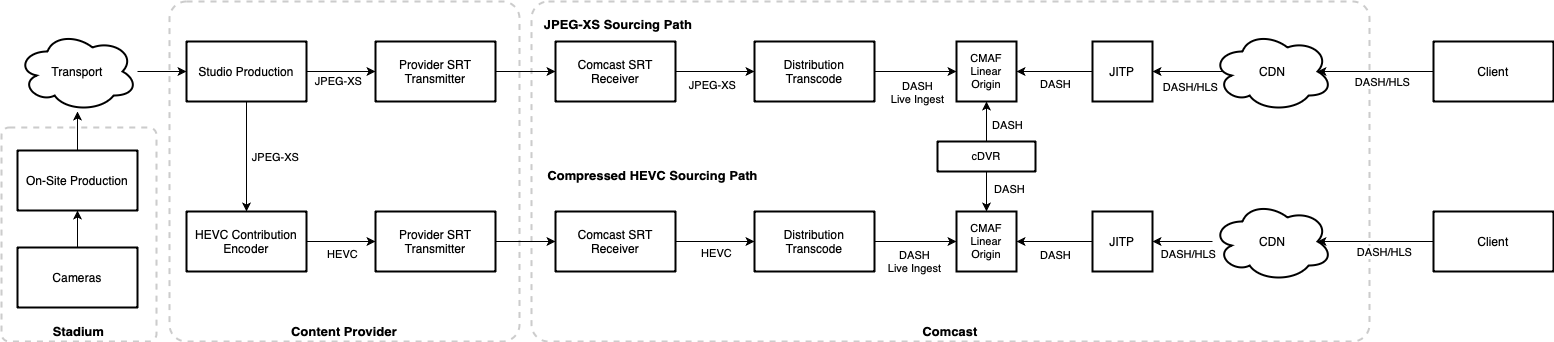
The Super Bowl LX Implementation: In partnership with NBCUniversal, Comcast shifted its ingestion strategy. By utilizing a JPEG-XS source feed—which carries data at over 300 Mbps—Comcast bypassed a generation of HEVC encoding. This step alone shaved approximately five seconds off the production pipeline, drastically reducing the total latency from the stadium to the living room.
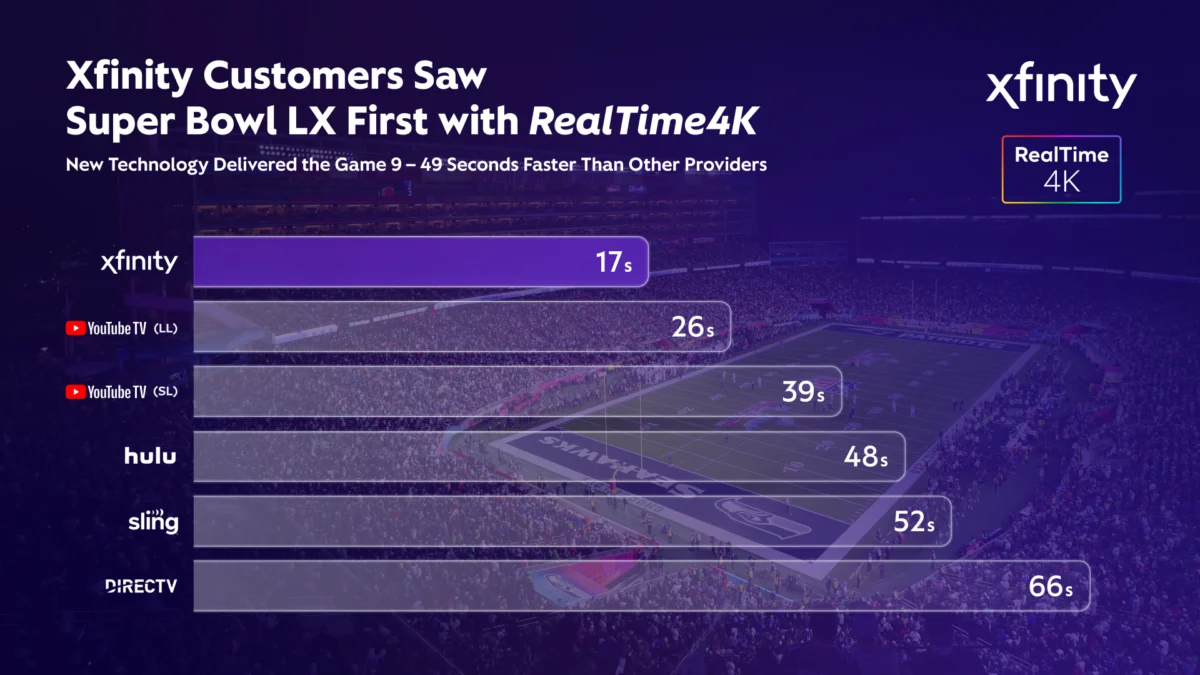
The Traffic Surge: Sunday, February 8, proved to be a "stress test" for the ages. As the network managed a convergence of Super Bowl coverage, ongoing Olympics broadcasts, and massive traffic on the Peacock platform, the RealTime4K architecture maintained its integrity. Internal data indicates that the system performed exceptionally well, delivering latency between 9 and 49 seconds faster than leading vMVPD (Virtual Multichannel Video Programming Distributor) streaming services.
Supporting Data: The Architecture of Speed
The technical architecture behind RealTime4K represents a shift toward a more agile, software-defined distribution model.
The Pipeline Mechanics
The workflow begins with a DASH live ingest. A MediaKind-powered transcoder accepts the high-bandwidth JPEG-XS input (or an HEVC mezzanine when necessary) and creates the required renditions. These are then sent to a custom-built CMAF (Common Media Application Format) linear origin.
By publishing media chunks as they are encoded, Comcast allows its Just-In-Time Packager (JITP) to serve the content to both live viewers and Cloud DVR systems with minimal friction. While the Super Bowl LX feed was primarily managed via an on-premises CDN, the underlying architecture is designed to be extensible, allowing for the integration of public CDNs like Akamai and CloudFront to scale the technology for broader applications.
Bitrate and Fidelity
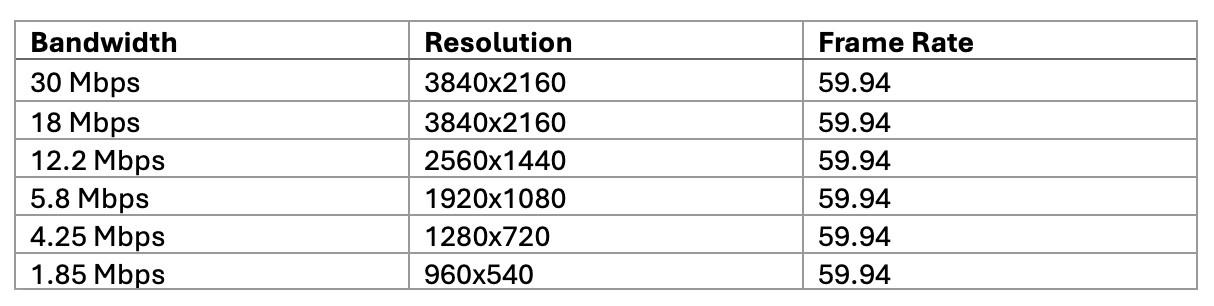
The bitrate ladder for RealTime4K is aggressive. By capping at 30 Mbps and supporting 4K resolution on the top two rungs of the ladder, Comcast ensures that viewers with high-bandwidth connections receive the highest possible fidelity. The audio component is equally prioritized; by delivering Dolby Atmos at 768 Kbps (DD+JOC), Comcast ensures that the auditory experience matches the visual spectacle of the event.
Official Responses and Strategic Positioning
Comcast has been clear that RealTime4K is not a "one-off" showcase event. The company is actively positioning this architecture as the new gold standard for its live sports distribution.
"We are moving toward a future where the distinction between broadcast and streaming disappears," noted a representative for the company. Comcast has confirmed that they are currently in negotiations with various programming partners to integrate RealTime4K into their standard live event broadcasts throughout the remainder of the year.
To ensure maximum adoption, Comcast has removed the primary barrier to entry: hardware. Customers who do not currently possess 4K-capable Xfinity equipment are eligible for free device swaps. By encouraging users to visit local Xfinity stores to upgrade their boxes, Comcast is effectively future-proofing its base for a more bandwidth-intensive era of television.
Implications: The End of the "Spoiler" Era?
The most significant implication of the RealTime4K launch is the potential end of the "spoiler" effect in live sports. In the era of social media, receiving a notification about a touchdown five seconds before it appears on one’s screen has become a common annoyance for streamers.
Competitive Landscape
By outperforming vMVPDs by up to 49 seconds, Comcast is essentially reclaiming the competitive advantage that traditional cable once held over internet-delivered content. This has massive ramifications for the betting industry, where latency is the enemy of fair play. If a streaming service is 45 seconds behind a sports betting app, the integrity of the "live" wager is compromised.
Future Outlook
As we look toward the remainder of 2026, the success of the RealTime4K rollout serves as a bellwether for the industry. The focus on reducing the number of encoding steps—specifically by leveraging JPEG-XS—highlights a broader trend in media engineering: the move toward "mezzanine-quality" delivery to the home.
However, the technology is not without its limitations. The reliance on specific hardware means that the "ultra-low-latency" experience remains a gated garden for those within the Xfinity ecosystem. For the average consumer using third-party apps or smart TVs, the latency gap remains a hurdle that Comcast has yet to fully bridge.
Nevertheless, as the industry moves toward higher resolutions and more immersive formats like 8K or high-frame-rate (HFR) video, the foundational work done by Comcast in optimizing the CMAF linear origin will likely become the blueprint for other providers. The era of "RealTime" video has officially arrived, and it is setting a standard that competitors will be forced to match if they hope to retain the loyalty of the modern sports fan.
As the technology continues to mature, we expect to see further refinements in throughput and even greater integration with cloud-based delivery systems. For now, the takeaway is clear: Comcast has successfully weaponized its infrastructure to ensure that when it comes to the "big game," the stream is as close to live as the laws of physics allow.