
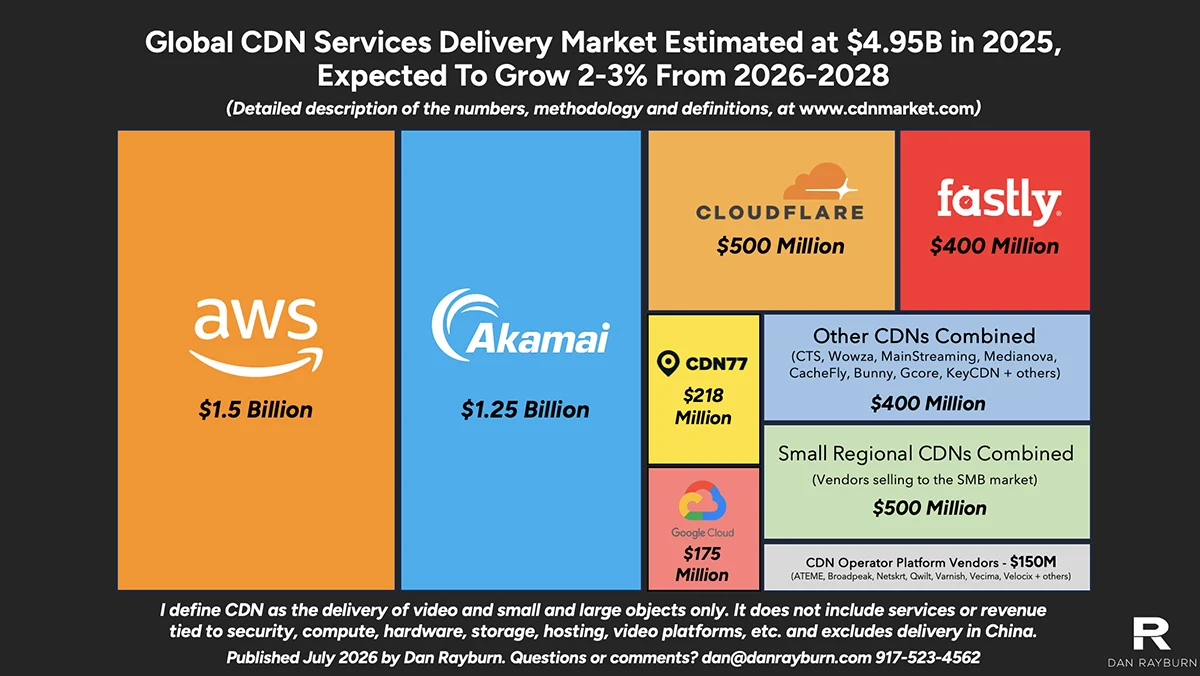
The global Content Delivery Network (CDN) market, once characterized by explosive growth and a “build it and they will come” philosophy, has entered a period of profound recalibration. Following the peak pandemic years, the industry is currently navigating a landscape defined by consolidation, aggressive infrastructure optimization, and the reality that the much-hyped “bit-growth” era has largely plateaued.
As of 2026, the CDN market is not just changing—it is fundamentally restructuring. With major players like Edgio and StackPath exiting the stage and Lumen retreating from the space, the market has seen a significant contraction in the number of vendors. Yet, despite this consolidation, total industry revenue for delivery services remains effectively flat, with recent data suggesting a slight decline of approximately 2%.
The Chronology of Consolidation: A Market in Flux
The past three years have served as a harsh stress test for the CDN industry. Between 2023 and 2026, the vendor pool shrunk significantly.
- 2023: The market began to feel the cooling effects of post-pandemic demand. Large OTT providers, having scaled rapidly during the lockdown era, began a rigorous process of infrastructure optimization.
- 2024: The industry saw the bankruptcy of Edgio and the total closure of StackPath. Lumen, a titan of the infrastructure world, exited the CDN business, opting to sell select contracts rather than assets to Akamai.
- 2025: The year marked a tipping point for cost-conscious delivery. As hardware, power, and chip costs surged, the era of “cheap, abundant bandwidth” came to an abrupt end.
- 2026: The market has solidified into a model where high-volume, low-margin delivery is no longer a viable standalone strategy for many, forcing vendors to prioritize efficiency over sheer scale.
The Myth of Perpetual Growth: Why Traffic Stalled
For years, market analysts predicted that the rise of 4K streaming, Augmented Reality (AR), and Virtual Reality (VR) would drive an exponential increase in CDN traffic. However, these projections failed to materialize at scale.
Encoding Optimization
Streaming services, facing pressure to improve margins, have mastered the art of "bitrate ladders." By refining encoding processes, platforms are delivering superior visual quality using significantly fewer bits than in 2022. The industry has effectively defaulted to 1080p HDR as the gold standard for most live events, rendering the anticipated "4K revolution" a non-event in terms of aggregate bit volume.
The Agentic Fallacy
Wall Street has frequently touted "agentic traffic"—data generated by autonomous AI agents—as the next great engine for CDN growth. This perspective reveals a fundamental misunderstanding of delivery technology. AI agents do not consume high-bitrate video or download massive software patches, which constitute the overwhelming majority of global CDN traffic. Consequently, the assumption that AI-driven web applications would surge CDN usage has proven to be a technical miscalculation.
The Concentration of Revenue
A defining characteristic of the CDN market is its extreme concentration. A mere 50 customers account for approximately 75% of total third-party CDN revenue. This creates a volatile environment where the strategic pivots of a few massive entities—Amazon, Disney, TikTok, or Microsoft—can send shockwaves through the entire ecosystem.
Vendor-Specific Exposure
The reliance on a handful of "super-customers" is well-documented:
- Limelight Networks: In Q1 2023, just seven customers accounted for over $181 million in revenue.
- Akamai: Historically, a small cohort of media customers has accounted for nearly 20% of its media-specific revenue.
- Fastly: Recent filings indicate that their top 10 customers contribute roughly 34% of total revenue.
This concentration explains why large platforms are increasingly opting for "DIY" (Do-It-Yourself) CDN strategies. Amazon’s integration of Prime Video traffic into CloudFront and TikTok’s reliance on its internal delivery infrastructure serve as stark warnings to third-party providers: if a customer grows large enough, the vendor becomes an unnecessary middleman.
Pricing Realities: The End of the "Race to the Bottom"
For those waiting for the annual, inevitable 20% price drop in CDN services, the wait is over. The "race to the bottom" is a narrative perpetuated by those who lack access to actual contract data.
In reality, pricing for the largest global customers has stabilized. With the rising costs of power, specialized hardware, and global infrastructure, vendors are no longer in a position to absorb costs. Akamai’s decision to implement a 3% monthly surcharge in Q2 2026 is emblematic of a broader shift. Across the industry, we are seeing a movement toward price floors. In recent high-value RFPs, major providers like Fastly, CloudFront, Google Media CDN, and CDN77 have submitted quotes within fractions of a cent per GB, proving that the market has reached a point of maturity where predatory pricing is no longer sustainable.
The Role of Carrier and ISP Platforms
The narrative surrounding "Telco CDNs"—where ISPs build their own delivery networks—has also faced a reality check. Revenue-share models, once touted as the future of ISP-based delivery, have largely failed.
Vendors specializing in CDN platforms for carriers, such as Broadpeak, Qwilt, and Varnish Software, have seen revenue decline as ISPs realize that their primary goal is cost-reduction, not revenue generation. ISPs are focused on minimizing transit costs rather than attempting to compete in the complex, low-margin business of global content delivery. The total revenue for this sector in 2025 was estimated at roughly $150 million, a modest figure that underscores the limited success of the "ISP-as-a-CDN" model.
Implications for the Future: Quality, Not Quantity
As we look toward 2027 and beyond, the CDN market is expected to grow at a sluggish 2-3% rate. This growth will be driven not by volume, but by price corrections and a shift toward value-added services.
1. Data Sovereignty and Compliance
New data sovereignty laws in Europe are forcing CDNs to serve content from within specific national borders. This is increasing operational complexity and forcing providers to become more selective about the markets they enter. If a region does not offer a clear path to profitability, vendors are increasingly willing to walk away from business.
2. The Death of "Build it and They Will Come"
The era of speculative capacity expansion is over. CDN providers now require guaranteed bandwidth or revenue commitments before building out infrastructure. We are seeing a "Miami-to-LATAM" model, where content is served from central hubs rather than expensive, under-utilized local caches.
3. The Myth of Bundling
A common misconception is that CDNs "give away" delivery to land high-margin security contracts (WAF, DDoS mitigation). While bundling exists, it is not a "giveaway." Delivery is a distinct, high-capex business that must stand on its own financial merits. Any suggestion that providers are subsidizing delivery at a loss to gain security clients is, by all industry metrics, factually incorrect.
Conclusion: A Mature, Disciplined Market
The global CDN market has reached a state of maturity that requires a new playbook. The growth trajectory that characterized the last decade has been replaced by a focus on margins, operational efficiency, and a deep understanding of customer concentration.
For stakeholders, the takeaway is clear: the era of speculative, high-growth, low-barrier entry is finished. We are left with a landscape where the primary players are those who can successfully manage high-capex infrastructure while navigating the complex demands of a small, highly influential group of global content giants. The future of content delivery will not be defined by how many bits are moved, but by how efficiently those bits are managed, priced, and secured.
For those seeking to understand the true size and health of this industry, it is essential to ignore the hype-driven narratives found on social media and focus on the cold, hard data of service-level agreements, regional capacity costs, and the evolving financial reporting of the major players. The CDN market is no longer a gold rush; it is a utility, and it is behaving exactly like one.