The promise of the streaming revolution was simple, seductive, and seemingly revolutionary: liberate the consumer from the tyranny of long-term contracts, hidden equipment fees, and the bloated, overpriced cable bundles that defined the television landscape for decades. For a brief, golden moment, live linear streaming services—often dubbed "vMVPDs" (virtual Multichannel Video Programming Distributors)—seemed to be the silver bullet for cord-cutters.
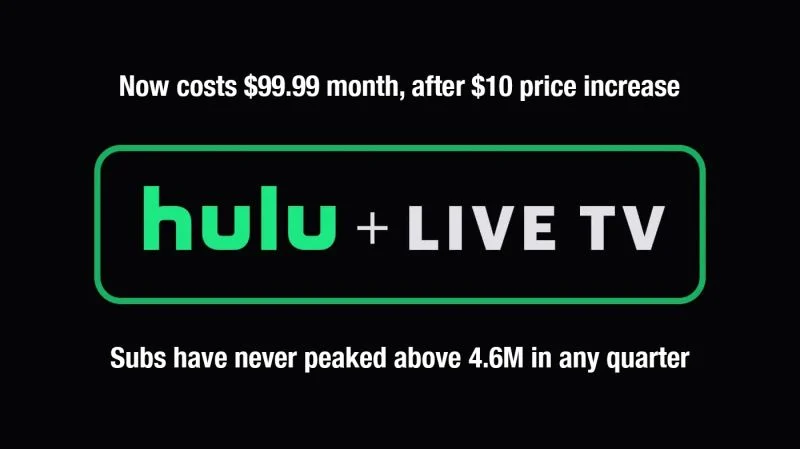
Yet, as the calendar turns toward 2025, that vision has soured. Disney’s recent decision to hike the price of Hulu + Live TV to $100 per month—with the ad-free premium tier hitting a staggering $109.99—marks a significant turning point in the industry. The service that once promised affordable, flexible television is now effectively as expensive, if not more so, than the traditional cable packages it was designed to disrupt.
The Cost of Convenience: A New Price Floor
The recent $10 price increase across Hulu + Live TV offerings is not merely a line-item adjustment; it is a structural shift that forces consumers to re-evaluate the utility of digital-first television. With the base package now sitting at a triple-digit monthly price point, the "value proposition" has evaporated.
For the average household, $100 per month is a significant commitment. When you add the inevitable taxes, regional sports fees (where applicable), and the underlying cost of the internet service required to stream these channels, the total "cost of connectivity" for a cord-cutter is now arguably higher than a legacy bundle. This creates a dangerous paradox for Disney: by pricing itself into the same bracket as premium cable, it loses the only competitive advantage it ever truly held: price.
A Chronology of Creep: From $40 to $100
To understand how we arrived at this juncture, one must look at the trajectory of Hulu + Live TV since its inception.
The Early Days (2017–2019)
When Hulu + Live TV launched in May 2017, the digital landscape was vibrant and optimistic. The service entered the market with a starting price of $40 per month. At the time, this was hailed as a "cord-cutter’s dream." It offered the local news, sports, and major cable networks that viewers craved, without the $150-plus monthly bills associated with Comcast, Spectrum, or AT&T U-verse.
The Era of Incremental Hikes (2020–2023)
As the platform matured, the "cheap and contract-free" narrative began to erode. Disney, like its competitors, found that licensing fees for sports—particularly regional sports networks and major broadcast carriage deals—were skyrocketing. To maintain margins, Disney began a series of incremental price hikes. Each increase was met with consumer outcry, yet the subscriber base remained relatively stable, leading management to believe that the audience was "sticky" and price-insensitive.
The "Stagnation" Phase (2021–2025)
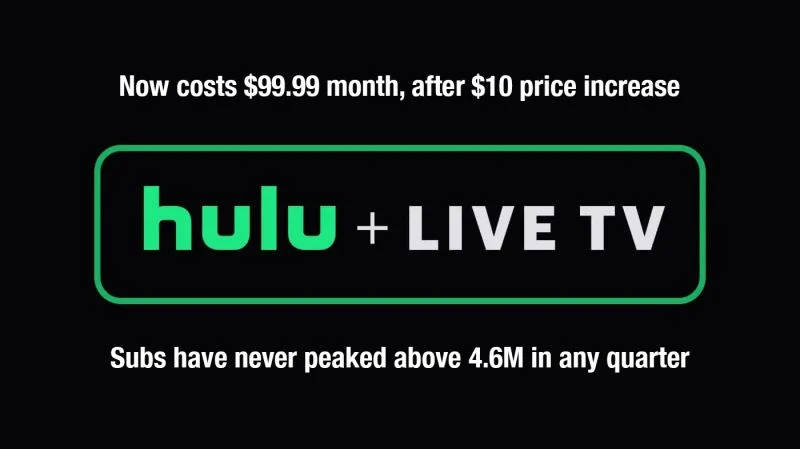
Data reveals a sobering reality for Disney. In Q1 2021, the company reported 4 million subscribers for Hulu + Live TV. By Q4 of fiscal 2025, that number had crawled to just 4.4 million. In four years of operation, the service effectively added fewer than half a million net new subscribers. In no quarter during this period did the service peak above 4.6 million users. This represents a period of extreme stagnation, suggesting that the service has reached a saturation point where the high price of entry is actively repelling potential new customers.
Supporting Data: The Shrinking Value Proposition
The financial data paints a clear picture: the growth engine for Hulu + Live TV has stalled. While Disney has stopped explicitly breaking out these figures in its quarterly earnings reports—instead opting to obfuscate them within broader segments—the trend lines are unmistakable.
Comparison of Market Dynamics
When compared to the broader pay-TV market, Hulu + Live TV is no longer a "deal." In many suburban markets, legacy cable providers have begun offering "skinny" bundles or promotional pricing that, when bundled with high-speed internet, actually undercuts the $100-a-month threshold of Hulu’s live service.
Furthermore, the consumer’s relationship with content has changed. As the "Golden Age of Streaming" shifts toward a focus on profitability over subscriber growth, companies are passing every penny of content inflation directly to the user. The reality is that the cost of live sports rights—the primary driver of the live linear bundle—has increased exponentially, and the consumer is now footing the entire bill for these rights in a way that was previously subsidized by the mass-market nature of traditional cable.
Official Responses and Strategic Shifts
Disney has remained tight-lipped regarding the specific logic behind these recent price hikes, sticking to standard boilerplate language about "investing in the content our subscribers love." However, analysts see a much deeper, more calculated strategy at play.
The most telling development in recent months was the hiring of Alisa Bowen, the former President of Disney+, as the new CEO of Fubo. This move has set the rumor mill into overdrive. Fubo has long been a specialized player in the live linear space, focusing heavily on sports. With the subscriber growth for Hulu + Live TV effectively dead, many industry observers believe Disney is preparing to wind down its own live linear service.
By pushing prices to the $100-plus mark, Disney is essentially "managing the decline" of the product. They are milking the remaining 4.4 million subscribers for maximum revenue while simultaneously preparing for a transition. The end goal? A potential partnership or migration strategy that funnels these users toward Fubo, allowing Disney to exit the expensive, low-margin business of maintaining a live linear distribution platform while still collecting revenue from the content it owns.
Implications: The Death of the "Skinny Bundle"
The implications for the average consumer are profound.
- The Return of Fragmentation: We are moving away from the era of the "all-in-one" app. As these live services become too expensive, consumers are reverting to "antenna + niche apps" models. The convenience of a single interface for all channels is being sacrificed for the sake of the household budget.
- Sports as the Last Stand: The only reason these live linear bundles exist is sports. As the cost of rights for the NFL, NBA, and MLB continues to climb, the "base" of the bundle—the news and entertainment channels—is being squeezed out. We are likely looking at a future where "Live TV" is synonymous with "Live Sports," and non-sports entertainment moves exclusively to on-demand platforms.
- The Consolidation of Distribution: If Disney does indeed offload its live linear audience to a third-party platform like Fubo, it signals the end of the "tech-giant" era of TV distribution. Instead of every studio having its own live streaming platform, we may see a return to a few centralized, specialized distributors.
Conclusion: A Failed Experiment?
Looking back at the trajectory of Hulu + Live TV, one must ask: was the entire project a failure?
If the goal was to capture a massive, long-term audience, the numbers suggest it was. Four years of stagnation in a market that was supposed to be the "future of TV" is a damning indictment. The service has become a victim of its own success—or, more accurately, a victim of the very economic forces that forced cable companies to raise their rates in the first place.
For the consumer, the lesson is clear: there is no such thing as a "free lunch" in the media landscape. Whether the bill comes from a cable company or a Silicon Valley streamer, the cost of licensing, producing, and delivering live television is high. By crossing the $100 threshold, Hulu has stripped away the illusion of the modern cord-cutting revolution. We have come full circle, arriving back at the same high prices and restrictive bundles we sought to escape—only this time, we’re paying for them with our own internet data.
As we look toward the next five years, the question is no longer how to save money on TV, but rather how much content we are actually willing to live without. The "skinny bundle" is dead; long live the subscription fatigue.