The dust has barely settled on the 2026 midterm elections, yet the political discourse is already dominated by a high-stakes confrontation between a former president and the most influential media outlet in conservative America. As the Democratic Party secures control of both the House and the Senate, the fallout is manifesting not just in legislative maneuvering, but in an increasingly volatile relationship between political leaders and the news organizations tasked with covering them.
The Collision: Trump and the Fox News Factor
Following a disappointing performance for the Republican Party in this week’s midterm elections, President Donald Trump has leveled sharp, public criticism at Fox News, accusing the network of being a contributing factor to the GOP’s electoral losses. In a series of posts on Truth Social, Trump explicitly stated that the network "bears responsibility" for the outcome, specifically citing the airtime provided to Democratic candidates as a strategic misstep that hampered Republican momentum.
The hostility intensified around midnight on election night when the former president called into the network’s live coverage to challenge its proprietary polling data, effectively turning a platform that has long served as the primary megaphone for his agenda into a target of his political ire.
This public distancing from Fox News marks a significant inflection point in the right-wing media ecosystem. For years, the network has functioned as a dominant, almost singular, news source for the American right. According to a 2025 Pew Research Center survey, 57% of Republicans and GOP-leaning independents identified Fox News as a regular news source—a figure that dwarfed all other media outlets by a 30-point margin. Furthermore, in the lead-up to the 2024 presidential election, nearly 70% of Republicans characterized the network as a major or minor source of their political information.
The network’s leadership, however, has sought to downplay the significance of its recent viewership fluctuations. While October figures indicated a dip compared to the previous year, Fox CEO Lachlan Murdoch has attributed the slump to "viewer fatigue" rather than any fundamental shift in editorial direction or political alignment.
Chronology of Tensions: A Relationship in Flux
The current friction is not an isolated event but rather the culmination of years of shifting expectations regarding the role of conservative media.
- 2024–2025: Fox News remained the primary information conduit for the Republican base. Throughout the 2024 election cycle, record percentages of the party faithful relied on the network for daily updates and political analysis.
- Late 2025: Early signs of audience fatigue began to emerge in internal viewership data, a trend recognized by the network’s executive team but dismissed as a cyclical phenomenon common in the post-election landscape.
- August 2026: Pew Research Center polling revealed a growing skepticism among the public regarding media influence, with a majority of Americans expressing concerns about the extent to which corporate and political interests shape news coverage.
- November 3, 2026: Midterm election results confirmed Democratic control of Congress.
- November 4, 2026: Within hours of the final tallies, President Trump issued his critique via Truth Social, followed by his late-night call-in to Fox News, setting the stage for a period of heightened antagonism between the former president and the network.
Supporting Data: The Paradox of Public Trust
Despite the intense rhetoric, the broader American public appears to be moving in a different direction. A new survey from the Pew Research Center reveals that trust in news organizations—both national and local—has seen a measurable increase over the past twelve months.
Currently, 62% of U.S. adults report having at least some trust in information provided by national news organizations, a rise from 56% in 2025. The uptick is even more pronounced at the local level, where 75% of Americans now express confidence in their local news outlets, up from 70% the previous year.
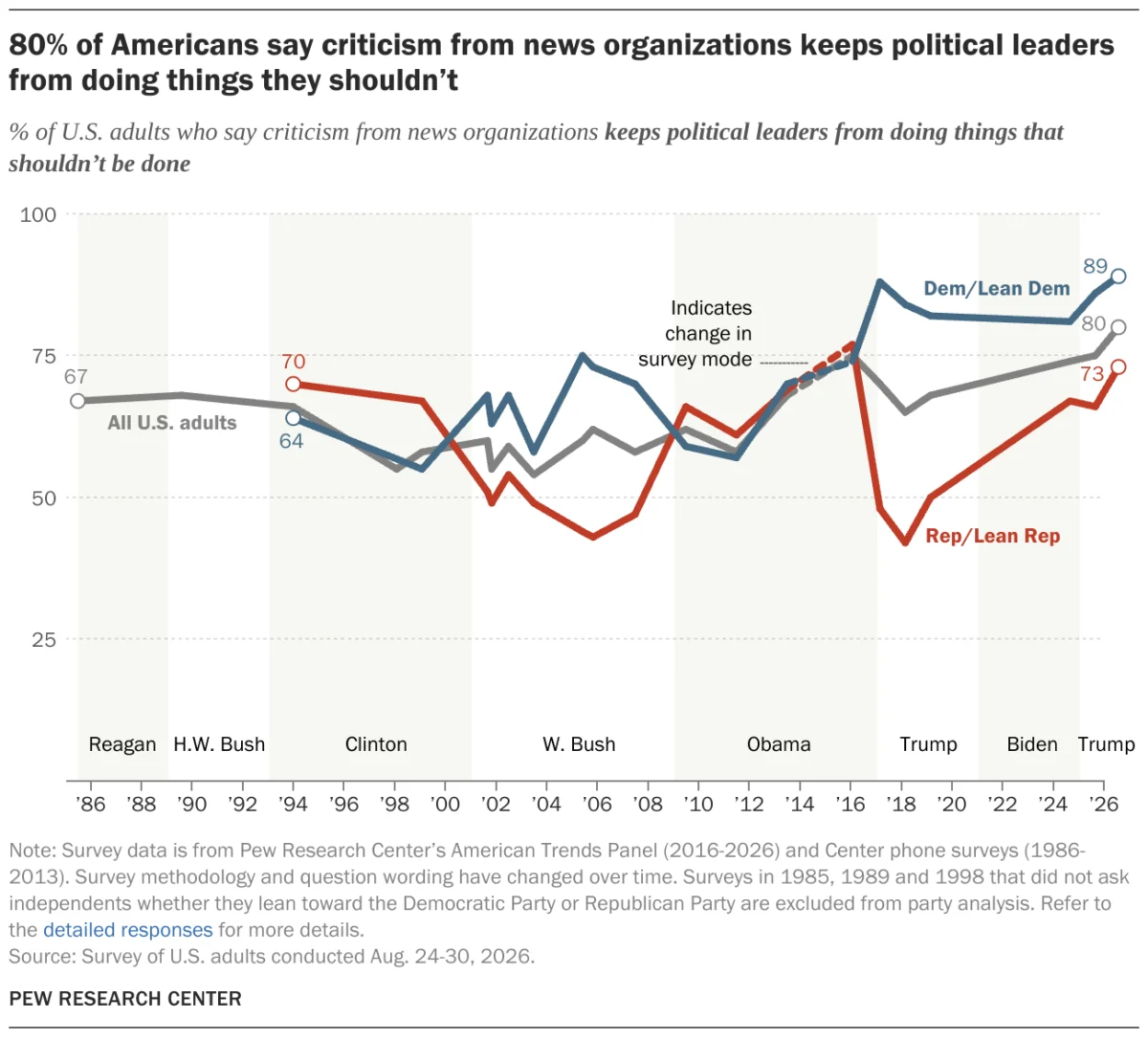
While partisan divides persist—with Democrats remaining significantly more trusting of institutional journalism than their Republican counterparts—the data suggests a broad-based acknowledgment of the media’s necessity. This trend is further supported by findings regarding the "watchdog" function of the press. An impressive 80% of U.S. adults believe that criticism from news organizations is an essential check on political leaders, preventing them from engaging in unethical or illicit activities.
Remarkably, this sentiment has transcended party lines. Among Republicans, the belief that the media serves an important check on power has climbed to 73%, up from 67% in 2024. This trend is particularly notable because it bucks a historical pattern where supporters of a sitting president typically grow more distrustful of the media during their party’s tenure in the White House.
Official Responses and Corporate Scrutiny
The political fallout is not limited to social media feuds. As Democrats prepare to take control of both chambers of Congress, early reports suggest that the new legislative agenda will include a rigorous investigation into the entanglements between the Trump administration and major media conglomerates.
Democratic lawmakers have signaled an intent to scrutinize government oversight of the media sector, specifically regarding recent high-profile mergers and acquisitions involving companies like Paramount and TikTok. Additionally, the Federal Communications Commission (FCC) may face renewed pressure to justify its review processes for broadcast licenses.
The timing of these potential investigations aligns with widespread public anxiety. A June 2026 survey conducted by the Pew-Knight Initiative highlighted that a majority of Americans are wary of the influence exerted by outside forces on the news. Roughly 54% of respondents believe that news organizations are influenced "a great deal" by corporate and financial interests, while 49% feel the same about government and political pressure. These findings suggest that any congressional inquiry into media ownership will likely find a receptive, albeit cynical, audience among the electorate.
Implications for the Future of American Journalism
The friction between political leadership and the media is entering a new, more unpredictable phase. The central question is whether the "watchdog" function of the press can survive in an environment where the line between news reporting and political theater is increasingly blurred.
1. The Fragmentation of the Right-Wing Information Ecosystem
If the leader of the Republican Party continues to publicly campaign against his most reliable historical ally, the conservative media landscape may fragment further. We may see a migration of viewers from traditional cable news toward alternative platforms that offer a more sycophantic or ideologically aligned viewpoint, further insulating portions of the electorate from mainstream reporting.
2. Regulatory Risk for Media Moguls
The prospect of congressional oversight into broadcast licensing and media mergers introduces a new layer of risk for media companies. If the legislative branch uses its investigative powers to target perceived bias or corporate influence, it could lead to a chilling effect on journalistic independence, or conversely, a renewed push for transparency in media ownership.
3. The Resilience of Local News
The data regarding the rise in trust for local news is perhaps the most hopeful finding for the industry. While national outlets are frequently caught in the crosshairs of partisan vitriol, local news organizations continue to be viewed as more reliable and less beholden to the polarizing national narrative. This suggests that the future of institutional credibility may lie in community-based reporting rather than the high-octane commentary of cable news.
4. A Re-evaluation of the Watchdog Role
The fact that 80% of Americans now recognize the importance of a critical press suggests that the public is not yet ready to abandon the concept of the "Fourth Estate." However, as public trust in social media continues to languish, the burden is on legacy organizations to prove that their coverage is not merely a tool for political or corporate gain.
As the 2026 post-election landscape unfolds, the battle for the "truth" is likely to move from the ballot box to the hearing room and the boardroom. Whether this results in a more accountable media or a further breakdown in the shared reality necessary for democratic discourse remains to be seen. What is clear, however, is that the relationship between the political class and the press has been fundamentally altered, and the repercussions of this shift will be felt for years to come.