July 9, 2026
The American media landscape is undergoing a period of profound transformation. As broadcast networks grapple with increasingly stringent regulatory scrutiny, the traditional definition of "news" continues to blur in the minds of the public. Meanwhile, the emergence of artificial intelligence as a primary source of political information, coupled with shifting trust in local institutions, has created a volatile environment for both journalists and voters. This week, we examine the intersection of federal oversight, public perception, and the technological forces reshaping how we consume information.
The FCC and the "Equal Time" Controversy: A Test for Broadcast News
Earlier this year, the Federal Communications Commission (FCC) launched a significant inquiry into the broadcast licenses of ABC, specifically scrutinizing the network’s daytime staple, The View. At the heart of the investigation is the "equal time rule," a longstanding regulatory requirement that mandates broadcast programs provide equivalent airtime to opposing political candidates for public office.
The Core Conflict
The FCC’s inquiry has sent ripples through the broadcast industry. Critics argue that The View, which frequently hosts political figures, has tipped the scales in favor of specific candidates, thereby failing to meet the statutory obligations of a licensee. According to recent analysis by Semafor, the fallout from this inquiry has been immediate: the show has notably throttled back on booking guests involved in competitive midterm races, suggesting that the network is attempting to mitigate regulatory risk by avoiding potentially litigious political appearances.
Conversely, ABC has mounted a vigorous defense, citing the FCC’s own historical precedent. The network maintains that The View operates under the designation of a "bona fide news program." This classification is crucial, as it provides a statutory exemption from the equal time rule, allowing the program to curate its guest list based on editorial judgment rather than strict mathematical parity.
The Subjective Nature of "News"
The tension surrounding The View highlights a broader, more existential problem for the media industry: the lack of a universal definition for what constitutes "news." A landmark 2025 study conducted by the Pew Research Center suggests that the definition of journalism has become deeply personal.
For the modern American consumer, the classification of content as "news" is no longer strictly defined by professional journalistic standards or institutional affiliation. Instead, it is a malleable concept shaped by:
- Topical Relevance: Whether the information pertains to the user’s immediate community or personal interests.
- Source Credibility: The perceived trustworthiness of the platform, which is increasingly tied to the source’s alignment with the user’s worldview.
- Identity and Attitude: A psychological framework wherein individuals filter information through their own political and cultural identities, often subconsciously determining the validity of a story based on whether it reinforces their existing beliefs.
This fragmentation of the news definition makes it increasingly difficult for regulatory bodies to enforce standards, as the public’s expectations for "fairness" and "accuracy" are no longer tethered to a shared set of professional norms.
Local News: A Declining Pillar of Trust
While the national media landscape is embroiled in debates over regulation and definition, the state of local news—long considered the most trusted tier of American journalism—is also showing signs of decay. Data from the Pew-Knight Initiative reveals a quiet but concerning shift in how citizens perceive their local outlets.
Historically, local news enjoyed a unique status as a non-partisan, community-focused institution that garnered trust from both sides of the political aisle. However, the latest data indicates that this consensus is fracturing. There has been a measurable decline in the share of Americans who view local news organizations as highly important to the well-being of their communities. This erosion of trust, while gradual, mirrors the wider decline in institutional confidence seen across American society, suggesting that the "local" shield may no longer be sufficient to insulate newsrooms from the broader culture of skepticism.
The AI Frontier: Voters, Chatbots, and the Future of Decision-Making
As the 2026 midterm cycle intensifies, a new participant has entered the political fray: the AI chatbot. As noted in recent reports by The New York Times, an increasing number of voters are turning to large language models and generative AI tools to assist in their decision-making processes.

The Convenience vs. Accuracy Dilemma
For many voters, the appeal of AI is rooted in the "convenience and efficiency" of the technology. In a political environment where many citizens find it difficult or time-consuming to navigate the complexities of candidate platforms and policy records, a chatbot offers a synthesized, immediate response.
However, this convenience comes with significant caveats:
- Bypassing Safeguards: While major AI developers have programmed their models to remain neutral or decline to answer sensitive political questions, users have demonstrated a high level of ingenuity in "jailbreaking" these systems to extract partisan-leaning information.
- The Accuracy Gap: The risk of hallucinations—where AI generates plausible but entirely incorrect information—remains a primary concern. Unlike traditional newsrooms, which (in theory) operate under editorial hierarchies and fact-checking protocols, chatbots are often opaque in their reasoning.
- Public Skepticism: The electorate is acutely aware of these dangers. In a 2024 Pew Research Center survey, only 9% of Americans expressed a belief that AI would have a positive impact on U.S. elections over the next two decades. Conversely, 51% predicted a negative impact, highlighting a deep-seated anxiety regarding the role of algorithms in the democratic process.
Data Analysis: The Social Media Ban Debate
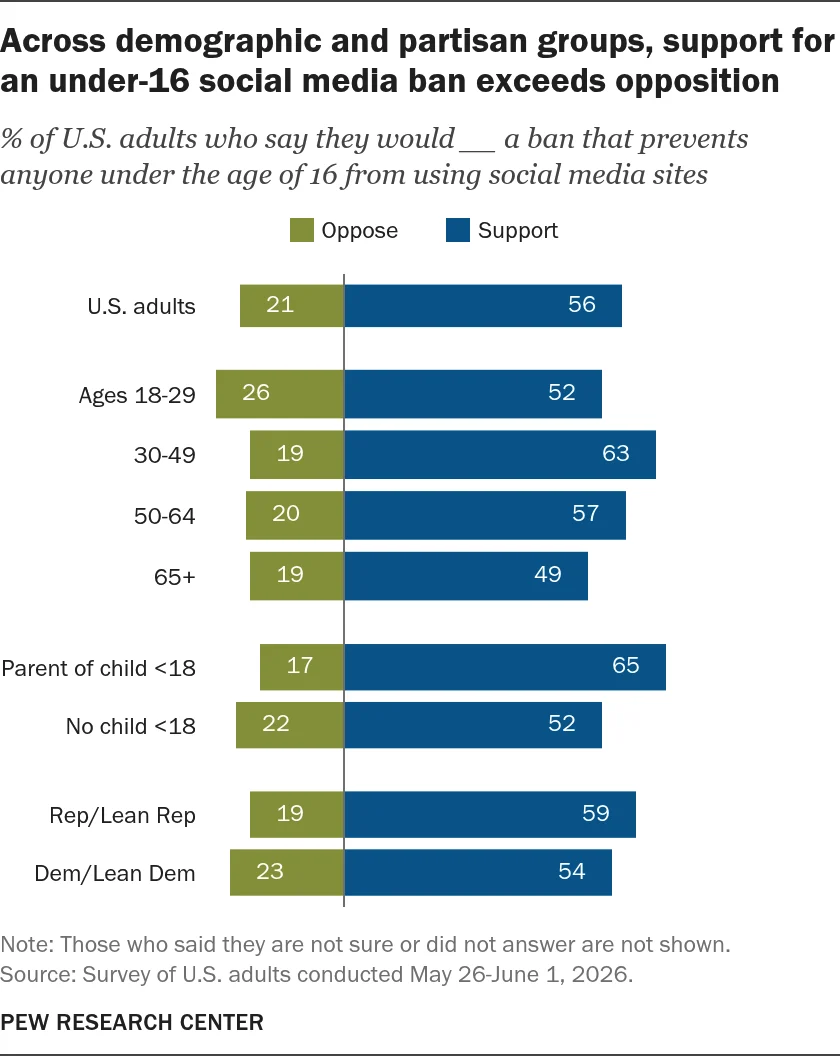
One area where partisan agreement remains unexpectedly high is the regulation of social media for minors. According to a July 2026 analysis by the Pew Research Center, a clear majority of American adults (56%) support a ban on social media use for children under the age of 16.
Public Support by Demographic
The support for such a ban cuts across traditional divides, suggesting a rare moment of societal consensus:
- Parental Concern: Parents of children under 18 are the most likely to favor a ban, with 65% in support, reflecting a growing anxiety over the impact of digital platforms on youth mental health and social development.
- Age-Based Differences: Support is highest among those aged 30–49 (63%), whereas the 65+ demographic shows slightly lower, though still significant, support (49%).
- Bipartisan Consensus: While political polarization typically dominates domestic policy debates, in this instance, both Republicans (59%) and Democrats (54%) show a clear preference for restriction over unfettered access.
This data suggests that while the American public is increasingly divided on how to consume news and which sources to trust, there remains a cohesive appetite for government intervention when it comes to the safety of the digital environment for the next generation.
Implications for the Future
The convergence of these trends—regulatory friction at the federal level, the erosion of local news credibility, and the encroaching influence of AI—presents a complex roadmap for the remainder of the decade.
The FCC’s investigation into The View serves as a canary in the coal mine; it signifies that the government is prepared to challenge the boundaries of what is considered "news" in an era of infotainment. If the legal definitions of journalism are forced to adapt to a digital-first world, we may see a significant restructuring of how broadcast networks operate.
Furthermore, as voters continue to struggle with information overload, the demand for accessible, AI-driven summaries will likely increase, regardless of the inherent risks to accuracy. The challenge for the next few years will be for legacy institutions to regain the trust of a skeptical public while simultaneously competing with the efficiency of machine-generated information.
As we look toward the 2026 midterms and beyond, one thing is certain: the relationship between the citizen, the news media, and the technology that facilitates their interaction is undergoing its most significant evolution since the dawn of the internet. Whether this leads to a more informed electorate or a more fractured reality remains the defining question of our time.
The Briefing is compiled by Pew Research Center staff, including Naomi Forman-Katz, Christopher St. Aubin, Emily Tomasik, Joanne Haner, and Sawyer Reed. It is edited by Michael Lipka and copy edited by Anna Jackson. For further inquiries, contact [email protected].