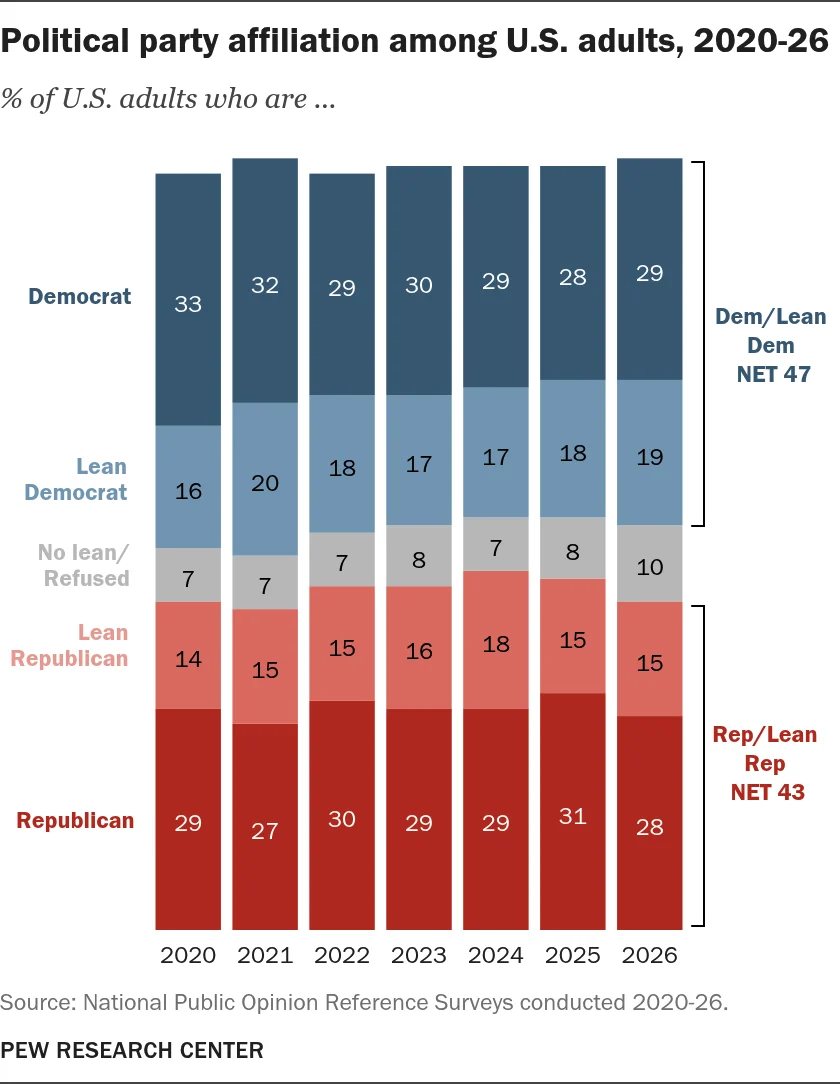
The American political landscape is undergoing a subtle yet significant recalibration. According to the latest National Public Opinion Reference Survey (NPORS) conducted by the Pew Research Center, the Democratic Party has regained a modest advantage in partisan affiliation among U.S. adults. As of mid-2026, 47% of Americans identify with or lean toward the Democratic Party, compared to 43% who align with the Republican Party.
This development marks a notable departure from the relative parity that characterized the American electorate between 2022 and 2025. While the current edge mirrors the political environment of 2020—the final year of Donald Trump’s first term—the nuances of this shift reflect deeper, ongoing changes in how Americans categorize their political identities.
The Core Dynamics of Modern Affiliation
At the heart of these findings is the critical role of "leaners." In contemporary American politics, fewer people identify strictly as rigid partisans. Instead, a significant portion of the population—44% of all adults—categorize themselves as independents or "something else."
However, political science research consistently demonstrates that these independents are rarely neutral. The Pew Research Center classifies these individuals as "leaners" if they express a preference for one of the two major parties. When these leaners are included in the analysis, the picture of American partisanship becomes far more defined. Data shows that leaners behave and vote in ways that mirror the core partisans they align with, justifying their inclusion in the broader tally of Democratic and Republican coalitions. Currently, 15% of all adults lean Republican, while 19% lean Democratic, providing the latter with their primary structural advantage.
A Chronological Look at Partisan Shifts (2020–2026)
To understand where the nation stands today, one must look back at the trajectory of the last six years. The NPORS data provides a granular look at how public sentiment has fluctuated:
- 2020: The landscape was defined by a 33% Democratic and 29% Republican base, with significant leaning populations. The Democratic advantage was clear as the nation navigated a presidential election year.
- 2021–2022: As the Biden administration took office, the country moved toward a period of equilibrium. The "evenly split" era saw Republican identification rise to 30% in 2022, effectively narrowing the gap to a margin of error range.
- 2023–2025: During this period, the nation remained largely deadlocked. The Republican Party saw a slight uptick in 2025, reaching 31% identification, while the Democratic base fluctuated between 28% and 30%.
- 2026: The current year represents a reversal. While Republican identification dipped to 28%, the Democratic base remained steady at 29%, bolstered by a rise in Democratic-leaning independents (19%).
Demographic Drivers: Gender, Race, and Education
The architecture of these two parties is being reshaped by distinct demographic forces. The "gender gap" remains one of the most persistent features of the American electorate. Currently, men are 11 percentage points more likely to identify with the GOP, while women are 9 points more likely to lean Democratic. While the Republican advantage among men has narrowed slightly since the 2022–2025 period, it remains firmly entrenched.
Race and ethnicity also play a pivotal role. While the Republican Party made measurable gains among Black, Asian, and Hispanic voters in previous years, the 2026 data indicates a modest shift back toward the Democratic Party within these groups. Conversely, White Americans continue to maintain a stronger affinity for the Republican Party, a trend that has remained largely consistent throughout the decade.
Perhaps the most dramatic shift is found in educational attainment. Once a less predictive factor, education is now a primary indicator of partisan alignment. Those with a four-year college degree or higher are increasingly moving into the Democratic fold. Meanwhile, those without a college degree are now almost evenly split between the two parties, a reality that complicates the traditional "working-class" narratives that dominated 20th-century political strategy.
Generational Cohorts and the Aging Electorate
The 2026 NPORS study highlights the difference between static age groups and generational cohorts. While U.S. adults under 50 currently tilt Democratic, those between 50 and 64 lean Republican, and those 65 and older remain a battleground of near-equal division.

However, when tracking specific generational cohorts—the same individuals as they age—the data reveals a more complex story. The cohort born in the 1990s (currently aged 27–36) and the 1980s (aged 37–46) have shown a renewed shift toward the Democratic Party. This suggests that as these generations enter their prime economic and political years, their partisan preferences are not necessarily "hardening" into conservatism, as older theories of aging might have predicted.
Researchers note that while shifts within age groups can be attributed to the changing composition of the population, the movement within these specific birth-year cohorts indicates real shifts in political attitudes that persist over time.
Methodological Integrity: Why the Data Matters
The validity of these findings rests on the rigorous methodology of the NPORS. Unlike traditional surveys that rely on telephone or online-only panels, the NPORS uses address-based sampling with a multi-mode approach—incorporating web, mail, and telephone interviews. This ensures that almost every U.S. adult has a statistically valid chance of participating, regardless of their technology access or willingness to pick up a phone.
The 2026 survey, conducted between January 30 and June 18, captured the voices of 5,511 U.S. adults. By weighting these responses to match the national population in terms of gender, race, education, and geography, the Pew Research Center provides a benchmark that remains the gold standard for understanding American political behavior.
Implications for the Future
The implications of this data are profound for the upcoming election cycles. A Democratic advantage in total affiliation does not guarantee electoral victory, as the American system is filtered through the Electoral College and state-level concentration. However, the data suggests that the Democratic Party has successfully stabilized its coalition after a period of instability.
The narrowing of the Republican advantage among men and the slight drift of minority voters back toward the Democratic column suggest that the "realignment" many pundits predicted may be more fluid than previously thought. The Republican Party’s challenge remains its reliance on non-college-educated voters, a group that is currently experiencing a tug-of-war between the two ideologies.
For the Democratic Party, the challenge lies in the "leaner" population. While they have successfully captured a higher percentage of these individuals, the loyalty of a "leaner" is fundamentally more volatile than that of a dedicated partisan. Should economic conditions or national sentiment shift, these voters are the most likely to swing, potentially erasing the current 4-point lead in a matter of months.
As the nation looks toward the next major political milestones, the 2026 NPORS data serves as a sobering reminder: the American public is not a monolith. It is a collection of shifting demographics, aging cohorts, and evolving educational priorities, all of which continue to reshape the map of American political power. Whether these trends represent a long-term return to Democratic dominance or merely a mid-decade correction will remain the central question for political analysts in the years to come.