
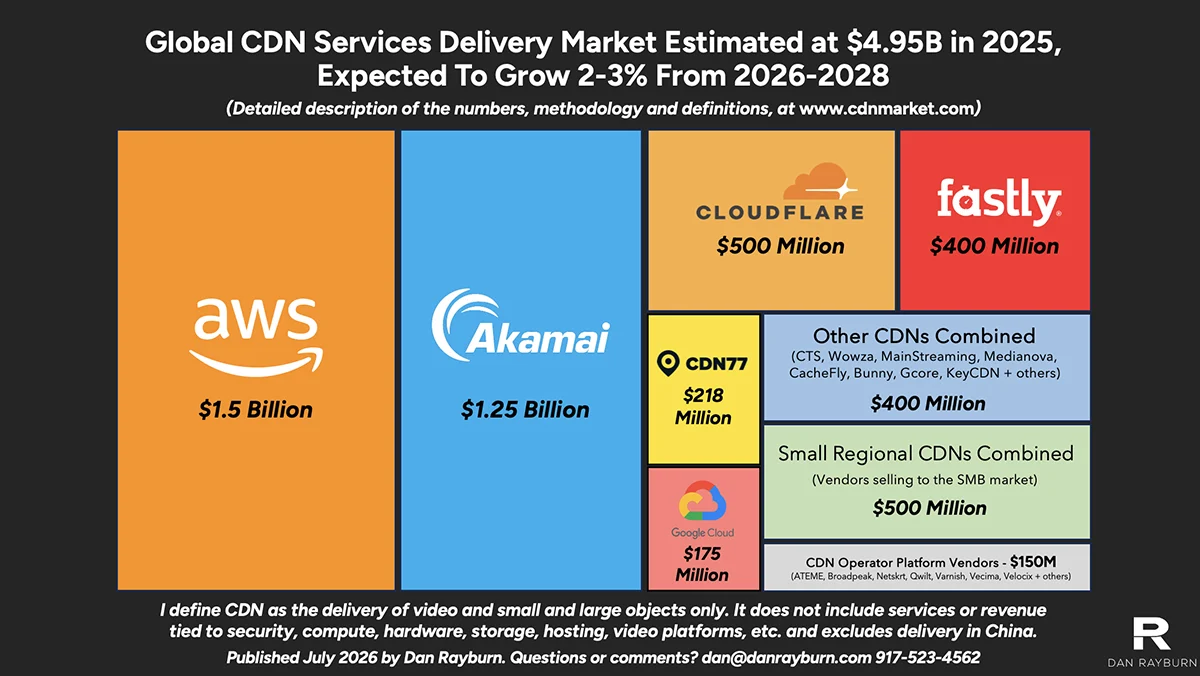
The Content Delivery Network (CDN) industry, once viewed as the high-growth backbone of the internet, is undergoing a profound structural shift. Between 2023 and 2026, the sector has transitioned from a landscape of aggressive expansion to one of consolidation and cautious capital management. As traffic growth plateaus and major content owners move toward in-house delivery, the era of unbridled, double-digit CDN growth has effectively ended.
The Chronology of Consolidation: A Sector in Flux
The past three years have been defined by a significant culling of the vendor herd. The most notable shifts include the bankruptcy of Edgio, the dissolution of StackPath, and Lumen’s strategic exit from the CDN market. In a move that signaled the maturity of the industry, Akamai stepped in to acquire select customer contracts—not assets—from these departing entities.
This consolidation has not, however, translated into a revenue windfall for the remaining players. While traffic has been redistributed among a smaller pool of providers, total industry revenue for delivery services has remained stagnant or experienced low single-digit declines (approximately -2%). The "market catalyst" that analysts once predicted would trigger a new wave of traffic growth—such as widespread 4K adoption or massive AR/VR deployment—has failed to materialize at scale.
The Drivers of Stagnation: Optimization Over Expansion
The current slowdown in CDN revenue is rooted in a fundamental shift in how video is delivered and consumed.
1. The Bitrate Efficiency Revolution
Post-COVID, the industry saw a rapid acceleration in encoding optimization. Streaming platforms have become significantly more adept at delivering high-quality video using fewer bits. The industry-wide pivot to 1080p HDR for live events, rather than the expected jump to 4K, has muted the growth in total bit volume. As a result, the "bit growth" that once fueled CDN revenue increases has slowed to a crawl.
2. The Rise of In-House Delivery
The largest content owners, once the lifeblood of third-party CDN providers, are increasingly opting for "Do-It-Yourself" (DIY) solutions. Amazon, historically one of the largest consumers of third-party CDN bandwidth for Prime Video, has significantly increased its reliance on its own internal CloudFront infrastructure. Similarly, TikTok has optimized its traffic distribution, relying more heavily on its own private delivery network and leveraging that scale to squeeze pricing from external vendors.
3. The "Agentic" Misconception
A recurring narrative on Wall Street has been that the rise of autonomous AI agents would inevitably drive a surge in CDN traffic. This perspective demonstrates a fundamental misunderstanding of delivery technology. AI agents operate differently than human users; they do not consume high-bandwidth streaming video or large file downloads—the primary drivers of CDN traffic. The expectation that "agentic" traffic would compensate for the plateauing of video consumption is, quite simply, a technical fallacy.
Supporting Data: The Concentration Risk
The CDN industry remains uniquely vulnerable due to its high reliance on a "whale" customer base. According to industry analysis, fewer than 50 customers account for approximately 75% of total revenue for third-party CDNs.
Revenue Concentration Breakdown:
- Limelight Networks: As of Q1 2023, just 20 customers out of 900 generated 75% of total revenue. Amazon and Sony alone accounted for 42%.
- Fastly: In Q1 2026, the company reported that its top 10 customers accounted for 34% of total revenue across all services.
- Akamai: Historically, the company disclosed that its top six media customers represented 18% of its media-specific revenue at the peak of that segment.
This high level of concentration means that when a major player like Disney, Warner Bros. Discovery, or Apple adjusts its distribution strategy, the impact on CDN vendors is immediate and often catastrophic for margins.
The Death of the "Race to the Bottom"
For years, market observers have forecasted a "race to the bottom" regarding CDN pricing. The reality is far more nuanced. The days of consistent, double-digit annual price declines are over.
Infrastructure Costs and Surcharges
The rising costs of power, specialized hardware, and global infrastructure have forced providers to reevaluate their pricing models. Akamai’s implementation of a 3% monthly surcharge for all clients in Q2 2026 is a testament to this shift. Infrastructure-heavy vendors are no longer willing to absorb rising costs, and in many cases, pricing is actually ticking upward.
The Regional Pricing Disparity
Global delivery is no longer priced as a commodity. Costs are highly localized:
- North America: The most cost-efficient region.
- LATAM: Pricing averages 2.8x higher per GB than in North America.
- Korea: Capacity is constrained, with costs reaching up to 10x the North American price point.
Consequently, many vendors are refusing to build out capacity in regions where the ROI is not guaranteed. Much of the traffic destined for Latin America is still being served from Miami, as the cost of building local edge infrastructure outweighs the potential market revenue.
Implications: A New Era of Financial Discipline
The "build it and they will come" philosophy is dead. Today’s CDN market is defined by strict capacity management, guaranteed bandwidth commitments, and a refusal to participate in unprofitable RFP (Request for Proposal) battles.
Vendor Perspectives on Bundling
While some industry commentators on platforms like LinkedIn suggest that CDNs are "giving away" delivery services to upsell higher-margin cloud security products, this is inaccurate. Bundling exists, but it is not a loss-leader strategy. In recent high-value RFPs (tens of millions of dollars annually), major players like Akamai, Fastly, and Google Media CDN have submitted bids within a margin of $0.0001 per GB, proving that price competition has reached a functional floor.
The Role of Carrier/ISP Platforms
Vendors providing CDN platforms to telcos (such as Qwilt, Varnish, and Broadpeak) have also struggled. The revenue-share model for ISPs has largely been abandoned as a failed experiment. Operators are now focused solely on reducing transit costs through localized caching rather than attempting to enter the competitive delivery services market. The estimated revenue from these platform vendors in 2025 stood at a modest $150 million.
Methodology and Market Sizing: A Call for Clarity
The current state of CDN market reports is, frankly, unreliable. Many industry analysts rely on misreadings of public financial disclosures, failing to distinguish between "Delivery," "Security," and "Compute" revenue.
Defining the Market
True CDN market sizing must exclude non-delivery services. For 2025, the total estimated revenue for third-party delivery services (excluding China) reached approximately $4.95 billion. This figure encompasses:
- The Top Six Global Providers: The dominant market entities.
- Regional/Specialized CDNs: A fragmented tier contributing roughly $500 million in aggregate revenue.
- Platform Vendors: Carriers and ISP-focused providers contributing roughly $400 million in cumulative delivery-related revenue.
It is critical to understand that vendor reports are often designed for legal and accounting purposes rather than transparent market analysis. When companies like Akamai shift revenue reporting from "Media" to "Delivery and other cloud applications," they are not providing an apples-to-apples comparison.
Conclusion: Looking Ahead (2026–2028)
As the CDN industry moves into the late 2020s, stakeholders should expect a period of slow, single-digit growth (estimated at 2-3% annually). The market has transitioned from a phase of explosive internet adoption to a phase of intense operational optimization.
The future of the CDN sector will not be driven by a sudden surge in traffic volume, but by the ability of vendors to manage the delicate balance between high-capex infrastructure costs and the tightening margins of their largest customers. For content owners, the era of commoditized, cheap delivery is being replaced by a reality of strategic, long-term commitments and a closer integration between the CDN and the core infrastructure of the business.
The industry is no longer about the quantity of bits, but the efficiency of the delivery and the value of the platform. Those who continue to peddle the narrative of a "race to the bottom" are ignoring the financial realities of a sector that has finally grown up.