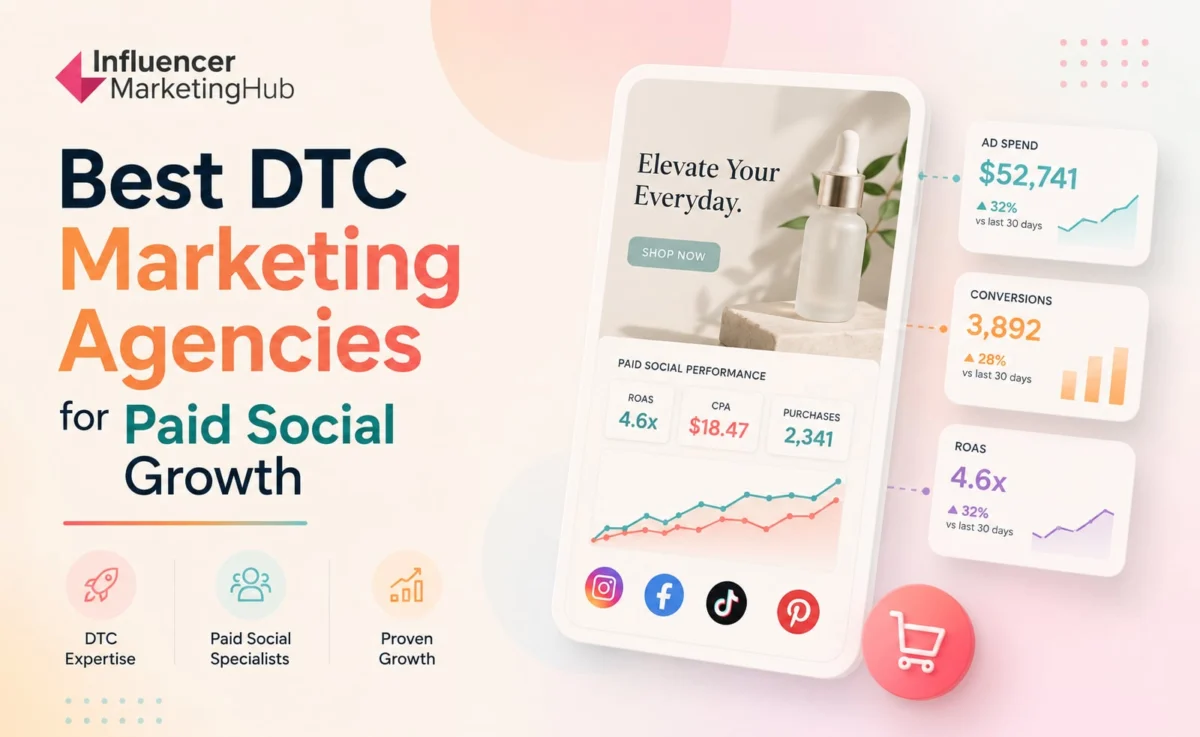
In the current digital ecosystem, direct-to-consumer (DTC) brands are navigating an increasingly volatile landscape. What was once a straightforward path to growth—fueled by low-cost advertising and high organic reach—has transformed into a complex challenge defined by creative fatigue, rising customer acquisition costs (CAC), and shifting data privacy regulations. As competition intensifies across paid social channels, scaling sustainably now requires more than just capital; it demands an expert-driven, data-backed approach to performance marketing.
To address these hurdles, we have conducted an exhaustive evaluation of the leading DTC marketing agencies currently shaping the industry. By leveraging the expertise of industry veterans—including Werner Geyser, Djanan Kasumovic, and Camille Kennedy—this report identifies the top-tier partners equipped to help brands thrive in 2026.
The Evolution of the DTC Growth Challenge
The fundamental challenge for modern DTC brands is the fragmentation of attention. Paid social platforms like Meta, TikTok, and YouTube remain the primary engines for customer acquisition, but the "plug-and-play" era of advertising has ended. Today, success is determined by the intersection of high-fidelity creative, granular attribution, and deep financial literacy.
The Shift Toward Performance Creative
Creative fatigue is no longer a minor inconvenience; it is the primary barrier to scalability. Algorithms on platforms like TikTok and Meta prioritize content that keeps users engaged. Agencies that fail to marry media buying with in-house creative production, user-generated content (UGC), and constant iterative testing are finding it increasingly difficult to lower CAC.
The Measurement Gap
As third-party tracking becomes restricted, brands are moving away from platform-reported metrics like ROAS (Return on Ad Spend) in favor of more holistic indicators. Leading agencies now emphasize Marketing Efficiency Ratio (MER), customer lifetime value (LTV), and contribution margin to ensure that every advertising dollar contributes to the bottom line, rather than just inflating vanity metrics.
Evaluating Excellence: The Methodology
Unlike conventional review platforms that rely on potentially biased user feedback, Influencer Marketing Hub employs a rigorous, expert-driven methodology. Our team conducts monthly evaluations of top-tier agencies like Y’all, Common Thread Collective, and MuteSix.
Our assessment criteria include:
- Strategic Capability Analysis: Evaluating proficiency in SEO, PPC, content marketing, and cross-channel strategy.
- Financial Rigor: Assessing how an agency ties marketing spend to real business outcomes, such as profitability and forecasting.
- Creative Velocity: Measuring the agency’s ability to produce high-performing creative assets at scale.
- Technical Infrastructure: Reviewing the agency’s ability to navigate attribution complexities and modern e-commerce technology stacks.
Top 5 DTC Marketing Agencies for 2026
1. Y’all: The Boutique Performance Powerhouse
Y’all stands out for its high-touch approach to performance creative. Designed for established brands investing $50,000+ monthly in media, Y’all bridges the gap between high-impact creative production and disciplined media buying.
- Why They Lead: Their integrated team functions as an extension of the brand, managing everything from short-form video and UGC to complex Google and YouTube ad strategies.
- The Difference: They don’t just optimize for clicks; they optimize for margin. By evaluating CAC and contribution margin alongside standard metrics, Y’all ensures that scaling is profitable, not just rapid.
2. Common Thread Collective: The Financial Strategists
For mid-market brands, Common Thread Collective is a gold standard. They are less of a "media buying shop" and more of a growth consultancy that happens to run ads.
- Why They Lead: Their proprietary forecasting frameworks help brands understand the financial trajectory of their marketing efforts.
- The Difference: They are the ideal partner for leadership teams that need to connect the dots between ad spend and overall business financial health. If you need a partner who understands the P&L as well as they understand the Facebook Ads Manager, this is your choice.
3. MuteSix: The Scaling Experts
A stalwart in the DTC space, MuteSix has solidified its reputation through sheer operational scale and deep expertise in the Meta ecosystem.
- Why They Lead: They provide a "full-funnel" service that covers the entire customer journey, from awareness-driving social ads to retention-focused email and SMS marketing.
- The Difference: Their sheer volume of experience across beauty, wellness, and apparel allows them to apply "best-in-class" strategies learned from one vertical to another, making them a safe and effective choice for established brands.
4. NoGood: The Experimentation Lab
Growth requires constant testing, and NoGood has built its business model entirely around the concept of "growth hacking."
- Why They Lead: Their approach is iterative. Rather than setting a strategy and hoping for the best, they utilize rapid-fire testing frameworks to determine which audiences and creatives actually drive conversion.
- The Difference: They are the perfect fit for brands that are in the "scaling" phase and have the budget to support aggressive experimentation across multiple channels, including emerging social commerce platforms.
5. Power Digital: The Enterprise-Scale Solution
For large-scale organizations, Power Digital offers a breadth of services that few boutique agencies can match.
- Why They Lead: They offer a truly full-service performance marketing infrastructure. Beyond paid social, they bring influencer marketing, SEO, and advanced analytics into a single, cohesive engine.
- The Difference: Their ability to coordinate multiple marketing disciplines under one roof reduces the friction of working with multiple specialized agencies, making them an excellent choice for complex, multi-channel brands.
Strategic Implications: How to Choose Your Partner
Choosing an agency is not about finding the "best" one; it is about finding the one that solves your specific business bottleneck.
- If CAC is your biggest pain point: Focus on agencies with strong performance creative capabilities. You need someone who can produce content that cuts through the noise and keeps the algorithm fed.
- If you are struggling with conversion: Look for agencies that emphasize conversion rate optimization (CRO) and landing page design. Traffic is worthless if your checkout flow doesn’t convert.
- If retention is stalling: Prioritize agencies with deep expertise in lifecycle marketing (email/SMS). Acquiring a customer is only half the battle; the real profit lies in the second and third purchase.
- If you are scaling rapidly: Choose a partner with strong forecasting and measurement capabilities. As you grow, the complexity of your attribution data will increase exponentially.
Frequently Asked Questions (FAQ)
Q: What exactly is a DTC marketing agency?
A: A DTC marketing agency is a specialized firm that focuses on the end-to-end growth of e-commerce brands. Unlike traditional agencies that might focus on brand awareness, these agencies are performance-oriented, focusing on metrics like CAC, LTV, and MER to drive direct revenue.
Q: How do these agencies differ from traditional marketing firms?
A: Traditional firms often prioritize creative awards or broad visibility. DTC agencies operate with a "math-first" mindset. Every creative asset, every campaign, and every strategy is designed to deliver a specific, measurable financial return.
Q: What is the typical cost structure for these agencies?
A: Most premium agencies use a custom pricing model. This is usually either a fixed monthly retainer, a percentage of ad spend, or a hybrid model involving performance incentives. Expect to pay more for agencies with higher levels of in-house creative production.
Q: At what stage should my brand hire an agency?
A: Many brands reach out when internal resources hit a ceiling. If you are struggling to manage creative production, or if your acquisition costs have plateaued and you lack the time to run constant split tests, it is time to bring in external expertise.
Conclusion: The Path Forward
The landscape of 2026 is unforgiving to brands that rely on legacy tactics. However, for those who partner with agencies that prioritize financial rigor, creative innovation, and rigorous testing, the opportunities for growth remain vast. By clearly defining your business’s most pressing constraint—be it creative, conversion, or retention—you can select a partner that acts as a true multiplier for your brand’s growth.
Dan Atkins is a veteran digital marketing consultant specializing in e-commerce strategy. With a deep background in SEO and paid social optimization, his work focuses on bridging the gap between technical execution and long-term brand equity.