The marketing landscape is undergoing a tectonic shift that goes far beyond the surface-level evolution of digital advertising. For years, the industry has focused on the "discovery" phase—how to capture a consumer’s attention in a crowded digital space. However, as of mid-2026, the real battleground has moved from discovery to decision-making.
Artificial Intelligence is no longer just a tool for content creation or automated ad buying; it has become an invisible, omnipresent layer that sits between a brand and its consumer. With over 60% of modern shoppers now utilizing AI to conduct product research, summarize reviews, and compare features, the path to purchase has been fundamentally altered. Brands that fail to optimize for this AI-mediated reality are finding themselves excluded from the conversation long before a potential customer ever lands on their website.
The Evolution of the Consumer Funnel
Historically, the marketing funnel was a linear progression: awareness, interest, desire, and action. Today, that model is obsolete. The modern customer journey is a fragmented, multi-screen, and AI-assisted web.
The traditional search engine is being replaced by AI-driven conversational interfaces and social-first discovery engines. Whether it is a Gen Z shopper hunting for the latest trends on TikTok, a Millennial comparing tech specs via ChatGPT, or a Boomer utilizing AI-powered shopping assistants on major retail platforms, the "decision" is increasingly being delegated to algorithms.
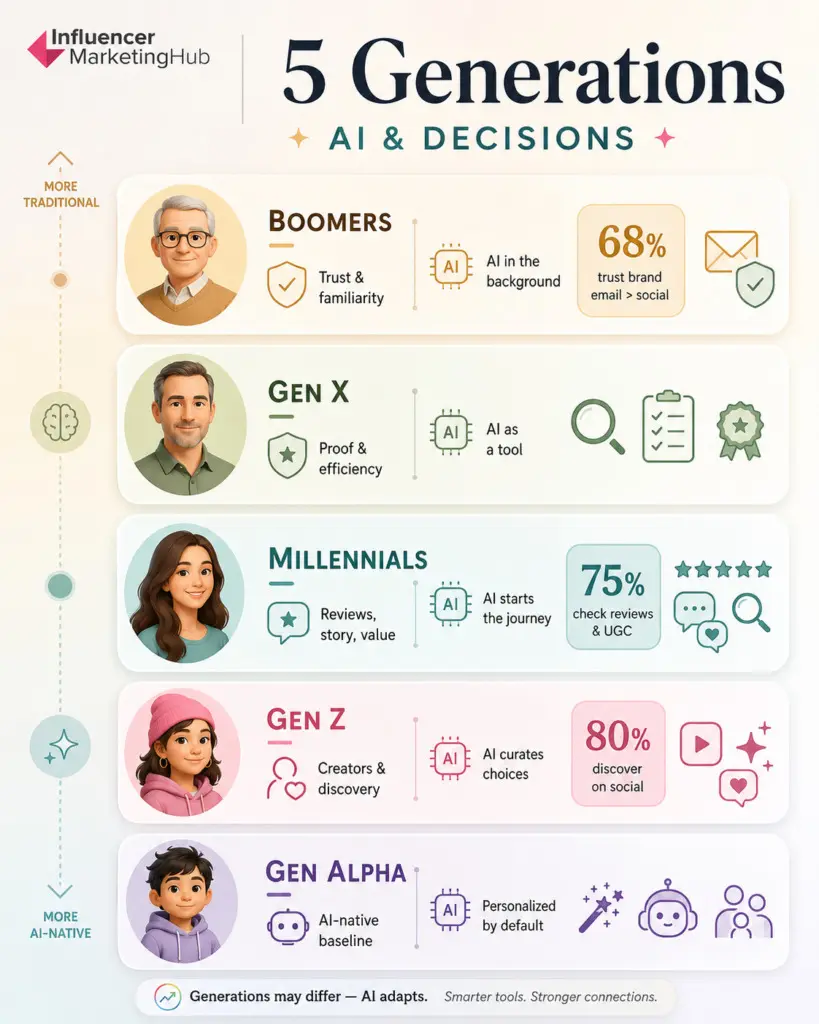
This is not a singular phenomenon; it is a generational divergence. While every age group is interacting with AI, they are doing so with vastly different levels of trust, technical proficiency, and reliance.
Generational Archetypes in the AI Age
To understand how AI is reshaping the market, one must look at how the five generations—Gen Z, Millennials, Gen X, Boomers, and the Silent Generation—approach this technology.
Gen Z: The Algorithmic Natives
For Gen Z, AI is not a "new tool"—it is a search engine. With 40% of this demographic preferring TikTok and Instagram over Google for discovery, their decision-making process is heavily curated by platform algorithms. They trust "social proof" filtered through AI-driven recommendations. If your brand isn’t appearing in the personalized "For You" feeds or within the AI-enhanced search results of these social platforms, you effectively do not exist.
Millennials: The Efficiency Seekers
Millennials are the primary drivers of the "AI-as-a-researcher" trend. They leverage large language models (LLMs) to synthesize information, condense complex product manuals, and compare prices across multiple retailers. For this group, the decision-making process is about maximizing utility and minimizing time. They want the AI to provide a definitive "best choice" based on their specific needs.
Gen X and Boomers: The Validation Seekers
These cohorts approach AI with a blend of curiosity and healthy skepticism. They are more likely to use AI to augment traditional search, looking for verification of facts or deeper context on brand reputation. Their decision-making process remains more tethered to established brand trust, but they are increasingly relying on AI to filter out the noise of modern digital marketing.
The Infrastructure of Discovery: Why the "AI Layer" Matters
Before a consumer visits your landing page, your brand has already been "interpreted" by an AI. This is the most critical realization for modern marketers: you no longer control the first impression.
When a user asks an AI tool for a recommendation, the system aggregates data from social sentiment, SEO rankings, and site performance to deliver an answer. If your brand’s metadata, reviews, and social signals are not optimized to feed these AI models, you are being edited out of the results.
The Multi-Screen Fragmentation
The consumer journey is now spread across a dizzying array of devices. A user might see a commercial on a Connected TV (CTV) device, search for it on a smartphone, verify the product on a social media app, and finally make a purchase through an email link.
Data indicates that 87% of consumers are using a "second screen" while watching television. This creates a hyper-fragmented environment where a brand must maintain total consistency across platforms. AI acts as the connective tissue here, synthesizing these disparate touchpoints into a cohesive narrative—or, if the brand is disorganized, a confusing one.
Supporting Data: The Case for AI-Driven Strategy
The shift toward AI-assisted commerce is supported by compelling statistics that highlight the urgency for strategic adaptation:
- Research Behavior: Over 60% of consumers now report using AI to assist in their pre-purchase research. This includes summarizing reviews and generating comparison tables.
- Social Search: 40% of Gen Z consumers bypass traditional search engines entirely, preferring social-native search tools that incorporate AI.
- The Second Screen Effect: 87% of viewers engage with mobile devices while watching TV, making cross-platform attribution and brand messaging synchronization more important than ever.
- The Personalization Mandate: 75% of consumers express a higher propensity to purchase from brands that deliver personalized offers—a feat that is now only scalable through AI-driven predictive analytics.
Implications for Modern Brands
The challenge for CMOs and marketing teams is no longer just "what is our message?" but rather "how is our message being processed by the AI systems that our customers use?"
1. The Death of Generic Marketing
Personalization is the new standard. Consumers have become accustomed to offers that feel bespoke. AI allows for hyper-segmentation that was impossible a decade ago. However, the trap is being "too generic." Brands that use AI to send mass-produced, automated emails are being flagged as spam by both consumers and email algorithms. The goal is to use AI to understand intent, not just to automate volume.
2. The Rise of Experiential Value
With 70% of consumers stating that in-person experiences significantly boost their purchase intent, there is a clear paradox: in a digital world, the physical matters more. AI’s role here is not to replace the experience, but to act as the guide. AI-driven logistics and personalized scheduling help ensure that the right consumer is nudged toward the right experience at the right time.
3. Precision as a Competitive Advantage
Conversion in 2026 is a game of precision. If a brand knows that their target audience of Gen X shoppers is using AI to compare their sustainability ratings, they must ensure that information is front-and-center in their digital footprint. Precision means auditing how your brand appears in AI summaries and ensuring that your data is structured, accurate, and accessible to machine-learning crawlers.
Expert Perspective: The Strategic Shift
Paula Bruno, founder and CEO of Intuition Media Group, emphasizes that this transition is about "connecting cultural relevance with measurable business performance." In her view, the agency-brand relationship must evolve to prioritize the "AI layer."
"We are moving past the era of ‘campaign-led’ marketing," says Bruno. "We are entering an era of ‘ecosystem-led’ marketing. Brands need to understand that their cultural footprint—how they are talked about on social media and how they are indexed by search engines—is the raw data that feeds the AI systems of tomorrow."
Conclusion: The Path Forward
The fundamental shift is that AI has moved from the back-office (data processing) to the front-office (consumer decision-making). Brands that win in this environment will be those that embrace this reality rather than fearing it.
To stay competitive, marketing leaders must:
- Audit their AI Presence: Test what AI tools say about your brand when asked for recommendations.
- Diversify Discovery: Ensure your brand is present in the "social search" ecosystems (TikTok, Reddit, Instagram) where the next generation is living.
- Structure for Machines: Ensure that your technical SEO and content strategy are designed to be "machine-readable," allowing AI to accurately synthesize your value proposition.
The era of passive branding is over. We have entered the age of AI-mediated commerce, where the winners are defined by their ability to navigate the algorithms that guide the modern consumer. The question is no longer "where are our customers?" but "what is the AI telling our customers about us?" Those who control the answer to that question will define the next decade of market share.