The landscape of American public opinion is a shifting mosaic, defined by evolving political allegiances, changing religious identities, and a deepening integration with digital technology. To capture these nuances, the Pew Research Center relies on the National Public Opinion Reference Survey (NPORS). Conducted annually, this robust instrument provides a critical benchmark for understanding the U.S. adult population. The most recent data, gathered between January 30 and June 18, 2026, offers a comprehensive snapshot of a nation in transition, shedding light on the bedrock values and behaviors that define modern American life.
The Mechanics of Measurement: How NPORS Works
At the heart of the NPORS is a commitment to methodological rigor. Unlike many commercial polls that rely on self-selected panels—which can introduce significant bias—the NPORS utilizes address-based sampling. By drawing participants directly from the U.S. Postal Service’s Computerized Delivery Sequence File, researchers ensure that every household has a known, non-zero probability of being selected.
Participants are not required to join a pre-existing survey panel, a feature that distinguishes NPORS from many other modern polling efforts. To maximize inclusivity and reach diverse demographics, the Center offers respondents the flexibility to answer via paper, online, or telephone channels. This multi-modal approach is essential for mitigating coverage error, as it allows for the inclusion of individuals who may have limited digital literacy or those who prefer traditional methods of communication.
However, the transition to multi-mode polling does not come without complexity. Pew Research Center has long acknowledged that survey mode can influence results. Historical data trends—spanning decades of telephone-only polling—may show slight variations when compared to the modern, multi-modal NPORS. The Center has conducted extensive analyses on these discrepancies, specifically regarding how mode influences responses on sensitive political and religious topics. These methodological transparency reports are vital for researchers, as they provide the necessary context to interpret how shifts in data collection affect the long-term longitudinal studies that define the field of public opinion research.
Political Affiliation: A Divided Electorate
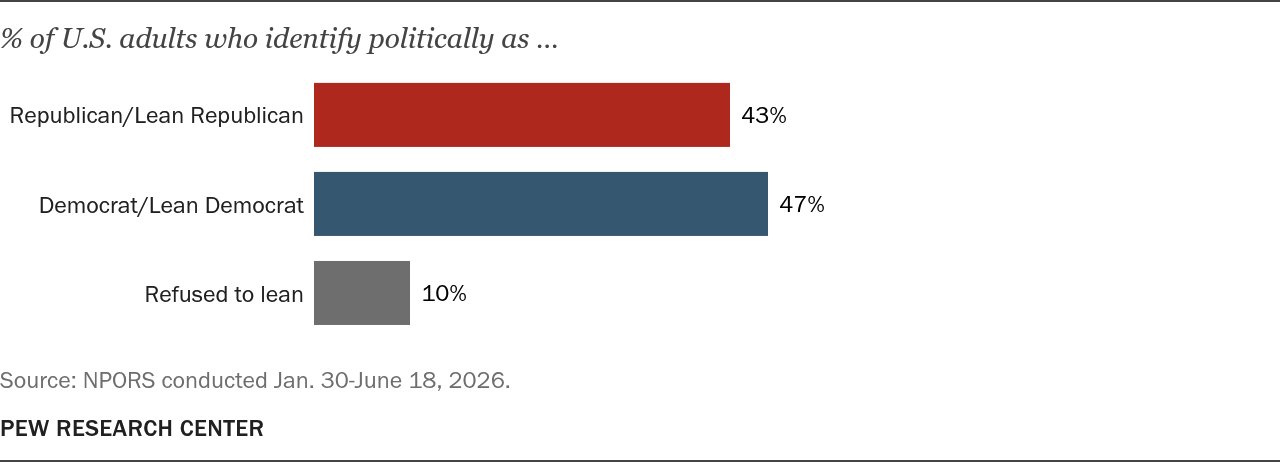
The 2026 NPORS data reveals a persistent divide in American political life. When asked about their political leanings, 47% of U.S. adults identified as Democrat or leaning Democratic, while 43% identified as Republican or leaning Republican. A notable 10% of the population declined to lean toward either major party, representing a silent but significant segment of the electorate that remains uncaptured by the traditional binary.
These figures underscore the entrenched nature of current political polarization. While the raw percentages provide a static look at party identification, the broader context—which the Center explores in its companion fact sheets on trends—suggests that party affiliation is becoming increasingly tied to lifestyle, media consumption, and geographic location. The 10% who refuse to lean, often referred to as "pure independents," remain a primary focus for political scientists attempting to predict the outcome of national elections, as this cohort often acts as the decisive swing factor in a polarized environment.

The Religious Landscape: An Ongoing Transformation
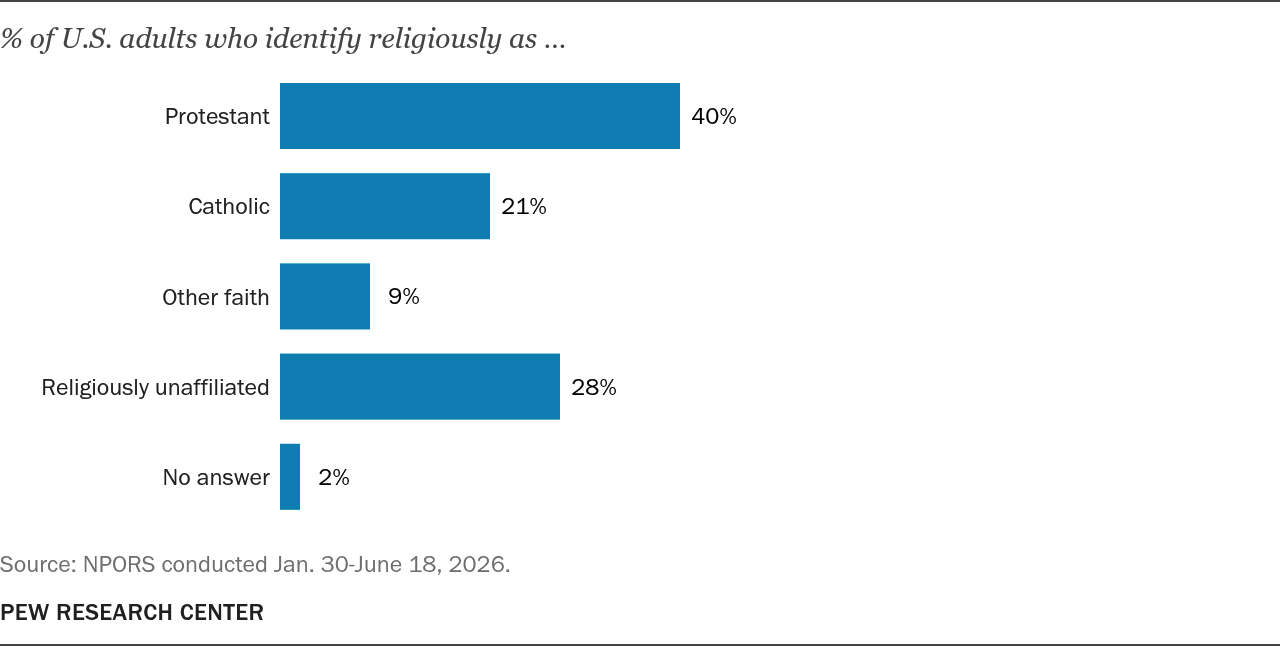
Religious affiliation in the U.S. continues to move away from traditional institutional structures. According to the 2026 survey, 40% of U.S. adults identify as Protestant, while 21% identify as Catholic. Perhaps most striking is the 28% of the population that now identifies as "religiously unaffiliated"—a category that has seen significant growth over the last two decades.
An additional 9% identify with other faiths, while 2% offered no answer. These trends align with previous research indicating a slow but steady decline in Christian identification in the U.S. The Center’s ongoing analysis of these trends suggests that this shift is not merely a decrease in belief, but a fundamental change in how Americans express their spirituality. The "religiously unaffiliated" demographic, sometimes termed the "nones," is not a monolith; it encompasses agnostics, atheists, and those who consider themselves "spiritual but not religious." Understanding the size and attitudes of this group is crucial for sociologists studying the intersection of public policy, morality, and civic engagement.
Digital Integration: The Era of Constant Connectivity
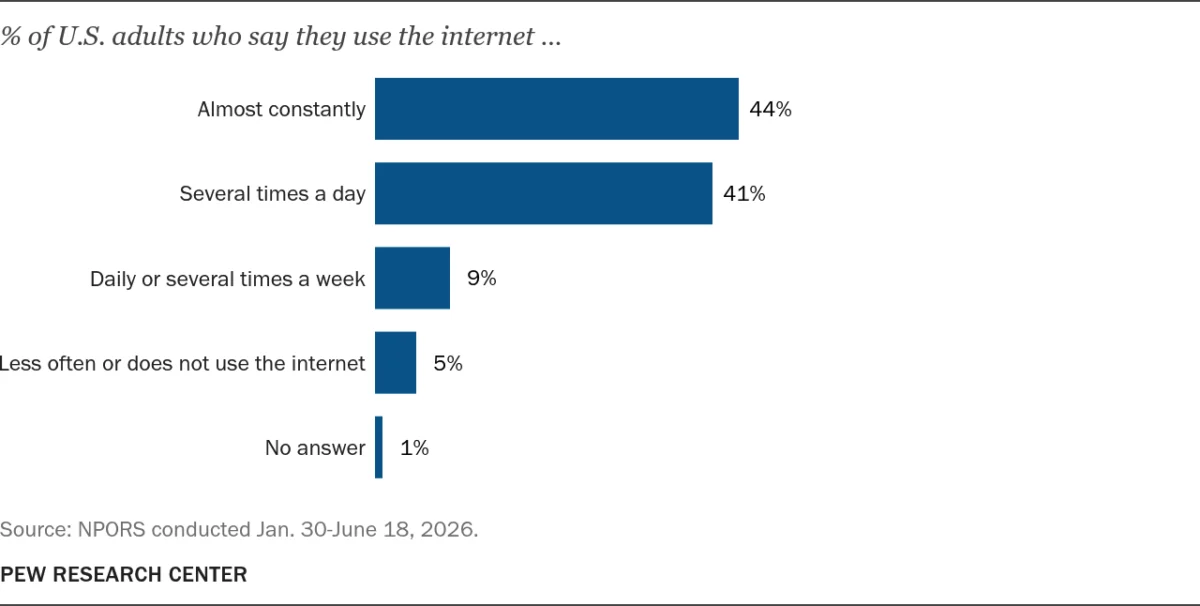
Perhaps the most dramatic shift captured by the 2026 NPORS is the degree to which the internet has permeated daily life. When asked about the frequency of their internet use, a staggering 44% of U.S. adults reported using the internet "almost constantly." Another 41% reported using it "several times a day."
Only 9% of the population uses the internet daily or several times a week, while a mere 5% report using it less often or not at all. This near-universal integration has profound implications for how information is disseminated and consumed. The "almost constant" group represents a fundamental shift in human behavior, where the digital and physical worlds are effectively merged. This high level of connectivity is a double-edged sword: it offers unprecedented access to information, yet it also accelerates the spread of misinformation and reinforces algorithmic echo chambers. The Center’s research into social media, mobile phone use, and broadband access continues to be a cornerstone for understanding the digital divide and the psychological impacts of constant connectivity.
Chronology of Methodology: A Commitment to Transparency
The reliability of the NPORS is bolstered by the Center’s commitment to archival transparency. By providing public access to the questionnaires (both paper and digital versions) and the comprehensive methodology reports for every year since 2020, Pew allows for a deep dive into the evolution of the survey.
The 2026 cycle, like its predecessors, includes a detailed methodological statement that explains how the data was weighted to match the U.S. Census Bureau’s population parameters. Weighting is a critical step in ensuring that the final data is representative of the entire nation, adjusting for factors such as age, race, gender, and educational attainment. The availability of these datasets allows academics, policymakers, and journalists to verify findings and perform secondary analyses, fostering a more informed public discourse.

Implications for Future Research
The findings from the 2026 NPORS point to a society that is highly digitized, religiously diverse, and politically bifurcated. As we look toward future iterations of the survey, several questions arise. Will the "religiously unaffiliated" segment continue to grow at the same rate? Will the "almost constant" internet user base eventually reach 50% or higher? And how will the 10% of political independents respond to the next cycle of national political shifts?
The strength of the NPORS lies in its consistency. By maintaining the same sampling frame and methodological rigor year over year, the Pew Research Center provides a baseline that is indispensable. In an era where trust in institutions is often questioned, the transparency of the NPORS methodology serves as a gold standard for social science research. It reminds us that public opinion is not merely a set of numbers; it is a reflection of the collective psyche of the nation.
Official Response and Academic Utility
The Pew Research Center views the NPORS not just as a data collection project, but as a public utility. By releasing the data to the public, the Center encourages a culture of accountability. Academic institutions frequently utilize these datasets to test theories on social behavior, political psychology, and the impact of technology on community health.
When discrepancies appear—such as the aforementioned differences between phone-based and multi-modal results—the Center does not hide them. Instead, it publishes dedicated analyses to explain why these shifts occur. This practice of "open science" is what keeps the NPORS relevant in a fast-changing media landscape. It provides a roadmap for other researchers who are struggling with the transition to digital-first polling methods.
Conclusion
The 2026 National Public Opinion Reference Survey is more than just a fact sheet; it is a vital document for any citizen, researcher, or policymaker interested in the direction of the United States. Whether it is tracking the rise of the unaffiliated, mapping the political divide, or measuring our obsession with the internet, the NPORS provides the clarity needed to navigate a complex society. As the Center continues its work, the annual release of this data remains a beacon of accuracy in a sea of often unreliable information, grounding our understanding of America in empirical truth.
For those wishing to delve deeper, the complete datasets, methodology reports, and questionnaires for the 2026 survey—as well as the historical archives stretching back to 2020—are available through the Pew Research Center’s official website. This access ensures that the conversation about who we are as a nation remains rooted in data that is as rigorous as it is revealing.