September 10, 2026
As the United States reaches the quarter-century mark since the terrorist attacks of September 11, 2001, the nation finds itself caught between two distinct realities: the indelible, collective trauma of the past and a rapidly evolving, often treacherous landscape of modern information. On the eve of this somber anniversary, new data from the Pew Research Center underscores that while the memories of 9/11 remain as vivid as a photograph, the mechanisms by which Americans process contemporary reality are increasingly fractured by a crisis of trust and a perceived gap in knowledge.
The Indelible Mark: A Quarter Century of 9/11
For the generation that lived through the events of September 11, 2001, the day remains a temporal anchor. According to recent survey data, a staggering 93% of Americans who were at least 10 years old at the time can recall exactly where they were or what they were doing when they first learned of the attacks.
This level of collective recall is rare in human history. The attacks, which claimed the lives of nearly 3,000 people and fundamentally altered the trajectory of American foreign and domestic policy, remain the most significant historic event in the collective memory of U.S. adults. Data from 2016 consistently placed 9/11 at the top of the list of life-defining historic events, outstripping the end of the Cold War, the rise of the internet, and the technological revolution of the early 21st century.
Twenty-five years later, the psychological footprint of that day persists. It is not merely a historical footnote but a defining variable in the American consciousness, shaping how the nation views its borders, its security, and its place in an increasingly unstable world.
Chronology of a Changing Information Landscape
The evolution of the media landscape since 2001 has been nothing short of tectonic. To understand how we arrived at our current state of "information fatigue," one must look at the trajectory of the last 25 years:
- 2001: The world relies on traditional broadcast television and print media for real-time updates. The "CNN effect" defines the 9/11 narrative.
- 2006–2010: The rise of social media platforms begins to democratize information. The gatekeepers of traditional journalism begin to lose their monopoly on truth.
- 2016–2020: The era of "fake news" and algorithmic echo chambers. Social media becomes a primary, yet highly volatile, source of news for the majority of Americans.
- 2024–2025: Trust in mainstream news organizations reaches a historic ebb. Simultaneously, distrust in social media information reaches an all-time high, with surveys showing that "lack of accuracy" is the primary reason users express frustration with digital platforms.
- 2026: The emergence of AI-driven tools, such as "Arbiter," marks a new frontier in the battle for narrative integrity, attempting to combat the systemic misinformation that has characterized the post-truth era.
The Information Gap: Data and Disillusionment
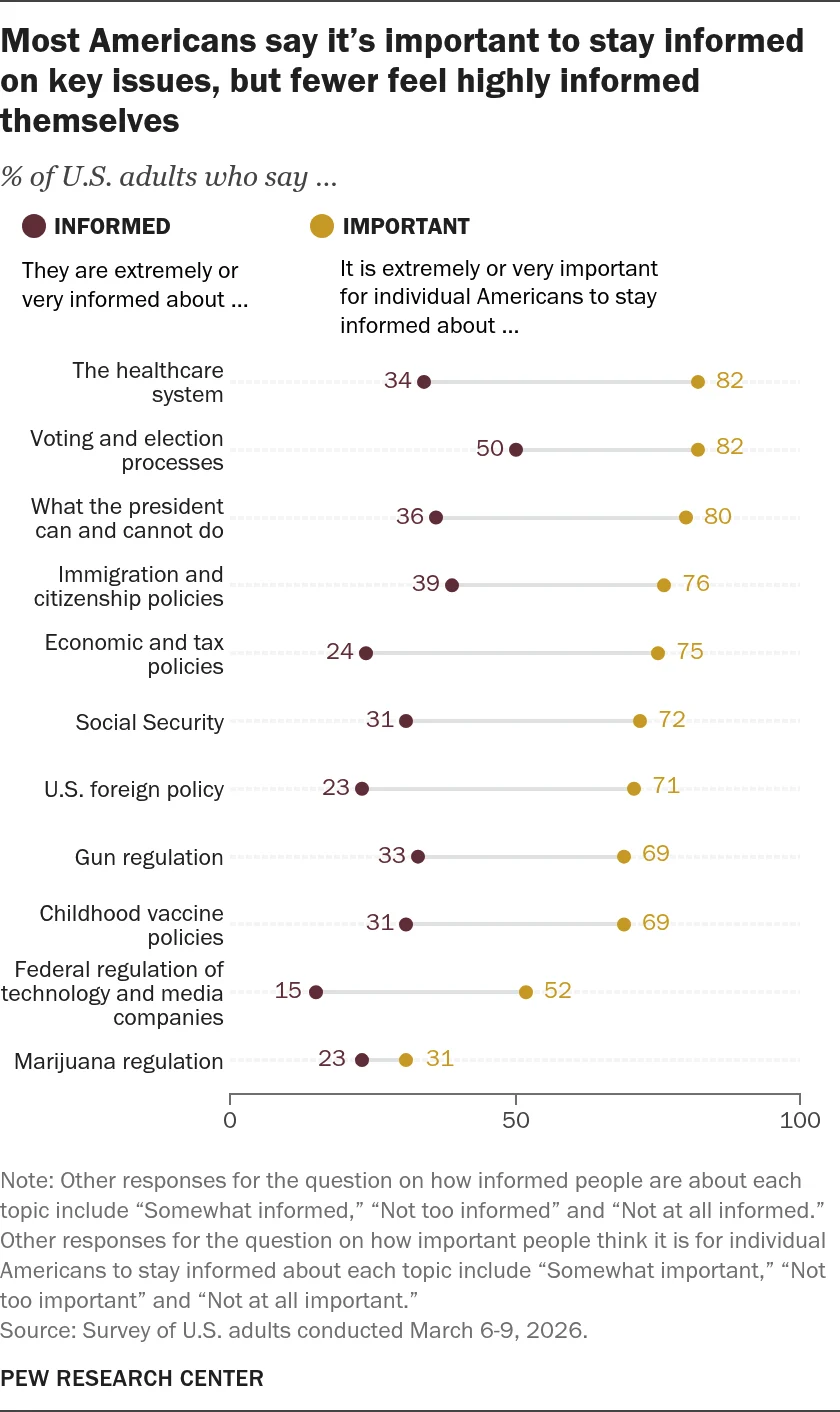
While the nation remains united in its memory of the past, it is deeply divided—and increasingly uninformed—regarding the present. A March 2026 survey conducted by the Pew Research Center reveals a sobering dichotomy: Americans overwhelmingly believe it is "crucial" to stay informed on complex policy issues, yet they admit they are woefully ill-equipped to do so.
The Perception of Necessity vs. Reality
The gap between the importance of a topic and the public’s self-assessed knowledge is profound:
| Topic | Importance (Extremely/Very) | Self-Assessed Knowledge |
|---|---|---|
| Healthcare System | 82% | 34% |
| Voting/Election Processes | 82% | 50% |
| Presidential Powers | 80% | 36% |
| Economic/Tax Policy | 75% | 24% |
| U.S. Foreign Policy | 71% | 23% |
| Tech Regulation | 52% | 15% |
This data suggests a society that is aware of its democratic responsibilities but feels overwhelmed by the complexity of modern governance. When only 24% of the population feels "highly informed" about economic and tax policies—despite 75% acknowledging its critical importance—the foundation for effective democratic discourse begins to crumble.
The Rise of "Arbiter" and the Search for Truth
As trust in traditional news outlets has wavered, the vacuum has been filled by a cacophony of social media narratives. With only 37% of U.S. adults expressing at least "some trust" in information found on social media as of 2025, the public is clearly signaling a need for a new way to filter the signal from the noise.
Enter "Arbiter," an emerging artificial intelligence tool designed to analyze social media trends and identify the proliferation of false or misleading narratives. Unlike corporate-owned algorithms, Arbiter operates as a nonprofit, independent entity. It marks a significant shift in how journalists and researchers approach the digital information ecosystem. By partnering with global news organizations, the developers hope to provide a neutral, data-driven layer of verification that human editors, working at the speed of the internet, can no longer provide on their own.
However, the efficacy of such tools remains to be seen. The core problem is not just technological; it is sociological. As surveys have consistently shown, the primary complaint of social media users is not the lack of information, but the lack of accuracy. When the public can no longer distinguish between credible reporting and algorithmic propaganda, the democratic process suffers.
Implications for the Future
The 25th anniversary of 9/11 serves as a stark reminder of how fragile national unity can be when confronted with external threats. Today, the threats are often internal, manifesting as a breakdown in our shared understanding of reality.
1. The Erosion of Institutional Authority
The steady decline in trust toward news organizations is not merely a reflection of perceived bias; it is a symptom of a society that has lost its common baseline for facts. When the majority of the public feels "not well informed" on critical issues like foreign policy or the healthcare system, they become more susceptible to emotional appeals and simplified narratives that often characterize social media discourse.
2. The Responsibility of the Citizenry
The data indicates that Americans are not apathetic; they recognize the importance of being informed. The 82% who cite voting and election processes as "crucial" to understand demonstrate a high level of civic engagement. The problem, therefore, is not a lack of intent, but a failure of the infrastructure provided to the citizenry.
3. A Call for Digital Literacy
As we move further away from the singular, shared reality of 2001, we must foster a more robust digital literacy. The reliance on AI tools like Arbiter is a reactive measure, but the proactive solution requires a fundamental shift in how citizens consume information. Schools, civic institutions, and technology platforms must collaborate to prioritize veracity over virality.
Conclusion: Bridging the Divide
As we reflect on the quarter-century since the world changed on that clear September morning, we must ask ourselves what kind of nation we have become. We are a nation that remembers the past with startling clarity, yet we struggle to comprehend the present with the same precision.
The path forward requires a renewed commitment to the uncomfortable, nuanced, and complex process of becoming truly informed. If we are to honor the memories of those we lost in 2001, we must ensure that the democracy they were a part of—a democracy built on the foundation of an informed electorate—is preserved for the next 25 years.
The challenge of the coming decade will not be the absence of information, but the cultivation of wisdom. In an era of AI, echo chambers, and persistent distrust, the most radical act a citizen can perform is to seek out, verify, and understand the truth. As the data shows, the desire for such understanding is still there; it is now up to the institutions of our society to provide the tools to meet it.
The Briefing is compiled by Pew Research Center staff, including Naomi Forman-Katz, Christopher St. Aubin, Emily Tomasik, Joanne Haner, and Sawyer Reed. It is edited by Michael Lipka and copy edited by David Kent.