
As the United States approaches Constitution Day on September 17, the document that serves as the bedrock of American governance—the U.S. Constitution—is once again under the spotlight. While public opinion polls frequently reveal a robust desire among the American electorate for systemic changes, ranging from the implementation of term limits for federal officials to sweeping reforms in campaign finance, the path to enacting these shifts is narrow, steep, and intentionally obstructed.
A recent analysis by the Pew Research Center, drawing on data from 106 global democracies, highlights a stark reality: the United States possesses one of the most rigid and difficult-to-amend constitutions in the world. Despite being in effect for 237 years, the document has been formally amended only 27 times, a testament to the Founding Fathers’ desire for stability—or, as some modern critics argue, a blueprint for political paralysis.
The Architecture of Stasis: Main Facts
The U.S. Constitution was designed not to be easily altered. Its authors sought to protect the nation from the "tyranny of the majority" and the shifting whims of volatile political cycles. However, in an era defined by extreme partisan polarization, this deliberate design feature has evolved into a significant hurdle for legislative progress.
The standard amendment process requires a two-thirds supermajority in both the U.S. House of Representatives and the U.S. Senate. If a proposal clears this daunting hurdle, it is then sent to the states, where it must be ratified by three-quarters of state legislatures—currently 38 out of 50 states. This multi-layered threshold ensures that any fundamental change to the American democratic framework requires a degree of national consensus that is increasingly rare in the modern political climate.
A Chronology of Constitutional Endurance
To understand why the Constitution is so static, one must look at its history. Since its ratification in 1788, the document has functioned as a living framework, yet its growth has been glacial.
- 1789–1791: The first ten amendments, known collectively as the Bill of Rights, were ratified to address immediate concerns regarding individual liberties and the scope of federal power.
- 1804: The 12th Amendment was passed, altering the process for the Electoral College to reflect the rise of political parties.
- 1865–1870: Following the Civil War, the "Reconstruction Amendments" (13th, 14th, and 15th) were added, fundamentally redefining citizenship, ending slavery, and extending voting rights.
- 1913: The 16th and 17th Amendments marked a significant shift, authorizing the federal income tax and allowing for the direct election of senators.
- 1920: The 19th Amendment guaranteed women the right to vote.
- 1971: The 26th Amendment lowered the voting age to 18.
- 1992: The 27th Amendment, which regulates congressional salaries, was ratified—a process that took over 200 years to complete after it was first proposed.
The lack of an amendment since 1992 illustrates how the threshold for national agreement has become increasingly difficult to meet, effectively freezing the Constitution in its current state regardless of the evolving needs of the citizenry.
Supporting Data: A Global Perspective
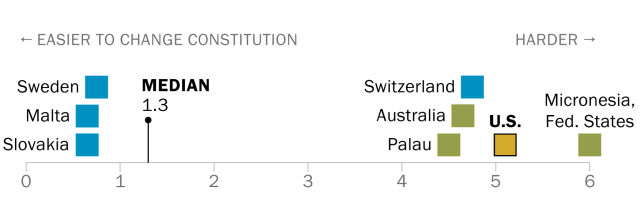
Using a scoring system developed by political scientist Donald S. Lutz, the Pew Research Center evaluated the difficulty of amending 101 democratic constitutions (excluding five "uncodified" constitutions where rules are spread across statutes and norms).

The results are revealing. The United States ranks as the second-most difficult democracy in which to amend a constitution, with a difficulty score of 5.10. It is surpassed only by the Federated States of Micronesia, which has a score of 6.00.
For perspective, countries like Switzerland, Australia, and Palau round out the top tier of the most difficult to amend. These nations, much like the U.S., rely on complex federal structures that require both national and state-level approval. At the other end of the spectrum, many nations—particularly those with unicameral legislatures—can amend their constitutions through processes that resemble standard lawmaking, provided they reach a required majority. This global comparison suggests that the U.S. is a significant outlier in its commitment to constitutional immutability.
Official and Scholarly Perspectives
Constitutional scholars often debate whether this rigidity is a feature or a bug. Conservative proponents of the current system argue that the difficulty of amendment is a safeguard against reactionary impulses. By forcing a high threshold for change, the system ensures that only truly settled, long-term national consensus can alter the fundamental law of the land.
Conversely, many political scientists note that the current "difficulty score" is exacerbated by modern political polarization. In the 18th century, reaching a two-thirds majority in Congress was a challenge of deliberation; today, it is often an impossibility due to the ideological divide between parties.
"The system was designed for a different era of governance," says one policy analyst. "When the cost of change is this high, the legislature often abandons the constitutional route entirely, preferring to pass regular legislation or rely on executive orders, which are inherently more fragile and prone to being overturned by subsequent administrations."
The Implications of a Static Document
The implications of an inflexible constitution are profound for American democracy.
1. The Rise of "Judicial Legislation"
Because the Constitution is so difficult to amend, the burden of updating its meaning has shifted from the legislative process to the judicial branch. When Congress cannot pass an amendment to clarify a right or a power, the public looks to the Supreme Court to reinterpret existing language. This has led to the "politicization" of the judiciary, as appointments to the Court become high-stakes battles over how the Constitution should be read.
2. Growing Disenchantment
Public opinion research consistently shows that Americans are interested in reforms that are essentially blocked by the current amendment threshold. When the electorate sees a clear path to reform—such as term limits—blocked by a seemingly impenetrable constitutional barrier, it can lead to political cynicism and a sense that the government is unresponsive to the popular will.
3. Institutional Fragility
When a system cannot adapt to changing social and technological realities, it risks becoming brittle. The founders intended for the Constitution to be a flexible framework, not a static monument. By making the amendment process so onerous, the U.S. has created a scenario where the only way to "update" the government is through external pressure, rather than internal, systematic refinement.
4. Comparison to Global Peers
The global data suggests that democratic health does not necessarily depend on constitutional rigidity. Nations with lower "difficulty scores" have successfully maintained stable democracies while allowing their constitutions to evolve alongside their societies. The U.S. remains a unique case study in how a country can balance the need for deep-seated stability with the necessity of growth.
Conclusion: The Path Forward
As we celebrate Constitution Day, the conversation surrounding the document should perhaps shift from mere veneration to a serious inquiry into its maintenance. Is the current 5.10 difficulty score sustainable in the 21st century?
The data provided by the Pew Research Center makes one thing clear: the American Constitution is a historical anomaly. While it has served as a beacon of stability for over two centuries, the very mechanism that keeps it secure from short-term disruption also prevents it from reflecting the will of a modern, diverse, and rapidly changing nation. Whether the U.S. will ever find a way to navigate this constitutional gridlock remains one of the most critical questions facing the American experiment. As polarization continues to define the political landscape, the debate over how—and if—to amend our founding charter is likely to grow only more intense in the years to come.