In the landscape of modern public opinion research, the gold standard of yesterday—weighting by simple demographics like age, gender, and education—is increasingly failing to capture the true pulse of the American electorate. As response rates plummet and partisan polarization deepens, the polling industry faces a fundamental crisis of representation.
A comprehensive new report from the Pew Research Center highlights a critical paradigm shift: the necessity of "political weighting." By adjusting survey data to reflect the known political composition of the United States—specifically through party affiliation and past voting behavior—pollsters are finding that they can mitigate some of the most persistent biases in modern data collection. However, as this report clarifies, political weighting is not a "magic bullet" that guarantees perfect results, but rather a necessary evolution in a changing survey environment.
Main Facts: The End of Demographic Reliance
For decades, the standard operating procedure for pollsters was straightforward: ensure the sample matched the U.S. Census Bureau’s distribution for core demographics. If a survey had too many college-educated women or too few young adults compared to national benchmarks, researchers would use statistical "weights" to bring the sample into alignment.
This approach was predicated on a fundamental assumption: that demographic categories were strong proxies for political views and that propensity to answer a survey was largely unrelated to one’s political identity.
That assumption has collapsed. In recent years, a phenomenon known as "differential partisan nonresponse" has become a defining challenge for survey methodology. Data now indicates that individuals’ political leanings—specifically whether they lean Democratic or Republican—are significantly correlated with their likelihood of participating in a survey. In the 2020 election cycle, for example, research consistently showed that Democrats were more likely to respond to surveys than Republicans, even when controlling for traditional demographic markers. Consequently, a sample that looks perfectly balanced by age and race may still be hopelessly skewed in its political representation.
Chronology: From Stability to Polarization
The history of survey research reflects a gradual move from trust in demographic representativeness to a cautious, data-driven skepticism.
- The Era of Demographic Consensus (1970s–2000s): For nearly forty years, demographic weighting was considered sufficient. The correlation between political party and survey participation was negligible. If a poll was accurate, it was because the researchers reached a representative slice of the American population.
- The Decline of Cooperation (2010s): As the digital age matured, telephone response rates began a steep, irreversible decline. Pollsters increasingly turned to online panels and mixed-methodology approaches to reach respondents.
- The 2020 Realization: The 2020 U.S. presidential election served as a wake-up call for the industry. Despite sophisticated demographic weighting, many polls continued to struggle with systemic errors. Post-election analysis by the American Association for Public Opinion Research (AAPOR) revealed that weighting by partisanship and past voting behavior—while helpful—was not a panacea, as the "Republicans" who did choose to respond were often systematically different from those who did not.
- The Present Day (2024–2025): The current methodology now treats political weighting as a best practice for political polls, while acknowledging that the "why" behind partisan nonresponse remains a complex, evolving puzzle.
Supporting Data: Why Adjustments Matter
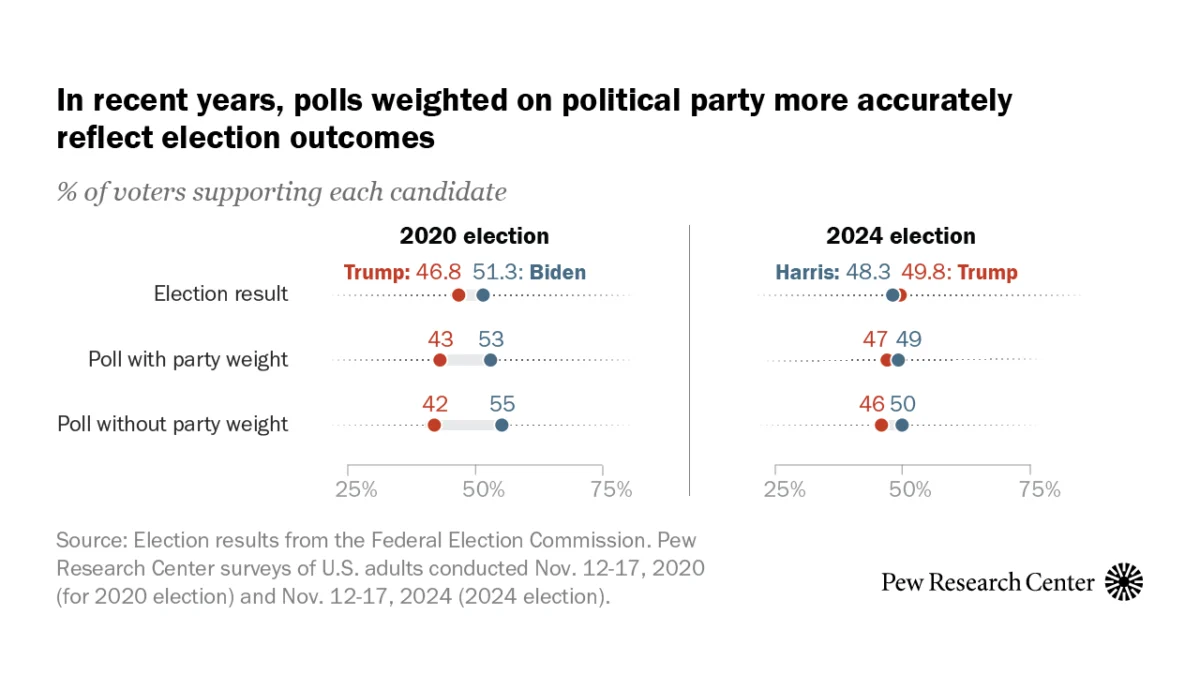
The evidence for the necessity of political weighting is found in the recurring discrepancies between unweighted survey outcomes and actual electoral results.
The Failure of Traditional Weighting
Traditional weighting methods fail when the "non-responders" have distinct political profiles that aren’t captured by age or geography. For instance, if White men over 50—a group often categorized by traditional metrics—are split into "participating" and "non-participating" segments, researchers find that those who opt in are often more politically active or hold different ideological stances than those who refuse. Without an adjustment for party affiliation, the final tally will inevitably reflect the bias of the "participating" group.
The "Attitudinal" Challenge
Critics argue that party affiliation is an "attitude," not a fixed trait like age, and is therefore unstable. While this is true, the data suggests that the risk of not adjusting is far higher than the risk of using an imperfect, shifting benchmark. Studies conducted by the Pew Research Center indicate that while weighting on party affiliation doesn’t improve every single metric in a survey—and can occasionally decrease accuracy on unrelated topics like personal finance—it consistently elevates the average accuracy across political survey questions.
Official Perspectives: The Limits of the Tool
Pew Research Center emphasizes that political weighting is not a universal requirement. The necessity of the adjustment depends entirely on the nature of the survey.
When to Weight
For surveys measuring political attitudes, voting intentions, or social issues where partisan divides are prominent (e.g., climate change, public health, or government trust), weighting by party affiliation is now widely considered essential. The case of COVID-19 vaccination rates in 2021 is a stark example: polls that failed to account for the strong correlation between partisanship and vaccination status significantly overestimated national vaccination rates.
When to Abstain
Conversely, for surveys on topics with no clear connection to political identity, such as highly specific scientific research or technical consumer behavior, political weighting may be unnecessary or even introduce "noise." Furthermore, for high-response-rate, government-conducted surveys like the Census Bureau’s American Community Survey (ACS), the sheer volume and compulsory nature of the data render political weighting irrelevant.
Implications: The Future of Representative Polling
The transition toward political weighting carries profound implications for how we interpret public opinion in the future.
1. The Death of the "Pure" Sample
Pollsters must accept that a "perfectly representative" raw sample is effectively impossible to obtain. Because the public is increasingly selective about which surveys they engage with, weighting is no longer a "correction"—it is a core component of survey design. The goal remains to reflect the full diversity of the public, but the path to that goal now requires sophisticated statistical adjustment.
2. The Need for Dynamic Benchmarks
Because party affiliation and voting behavior are subject to change, pollsters must ensure their benchmarks are as current as possible. This is why "panel" surveys—which allow researchers to track individuals over time—are becoming the preferred method. They offer a more stable and accurate view of the population than one-time, cross-sectional snapshots.
3. A Call for Transparency
The industry’s move toward political weighting requires a higher standard of transparency. When a pollster adjusts their data, they must be clear about which benchmarks they are using and why. As the Pew report suggests, there is a risk that using outdated benchmarks could introduce new, unforeseen errors.
4. Continued Recruitment Efforts
Perhaps the most important implication is that weighting cannot replace the hard work of recruitment. Even with the best weighting models, a survey that fails to reach diverse segments of the population remains fundamentally flawed. Pollsters must continue to lower the barrier to entry, making participation attractive and accessible to all citizens, regardless of their political affiliation or level of engagement.
Conclusion
Political weighting represents a necessary response to a fractured media and political environment. While it does not absolve pollsters of the duty to recruit widely and representatively, it provides a vital tool for correcting the systemic biases that have plagued modern polling. As the divide between those who participate in surveys and those who do not continues to align with partisan lines, the industry’s willingness to adapt its methodology will determine the future credibility of public opinion research. We are moving toward a more sophisticated, albeit more complex, era of data collection—one where understanding the politics of the respondent is as important as understanding their demographics.