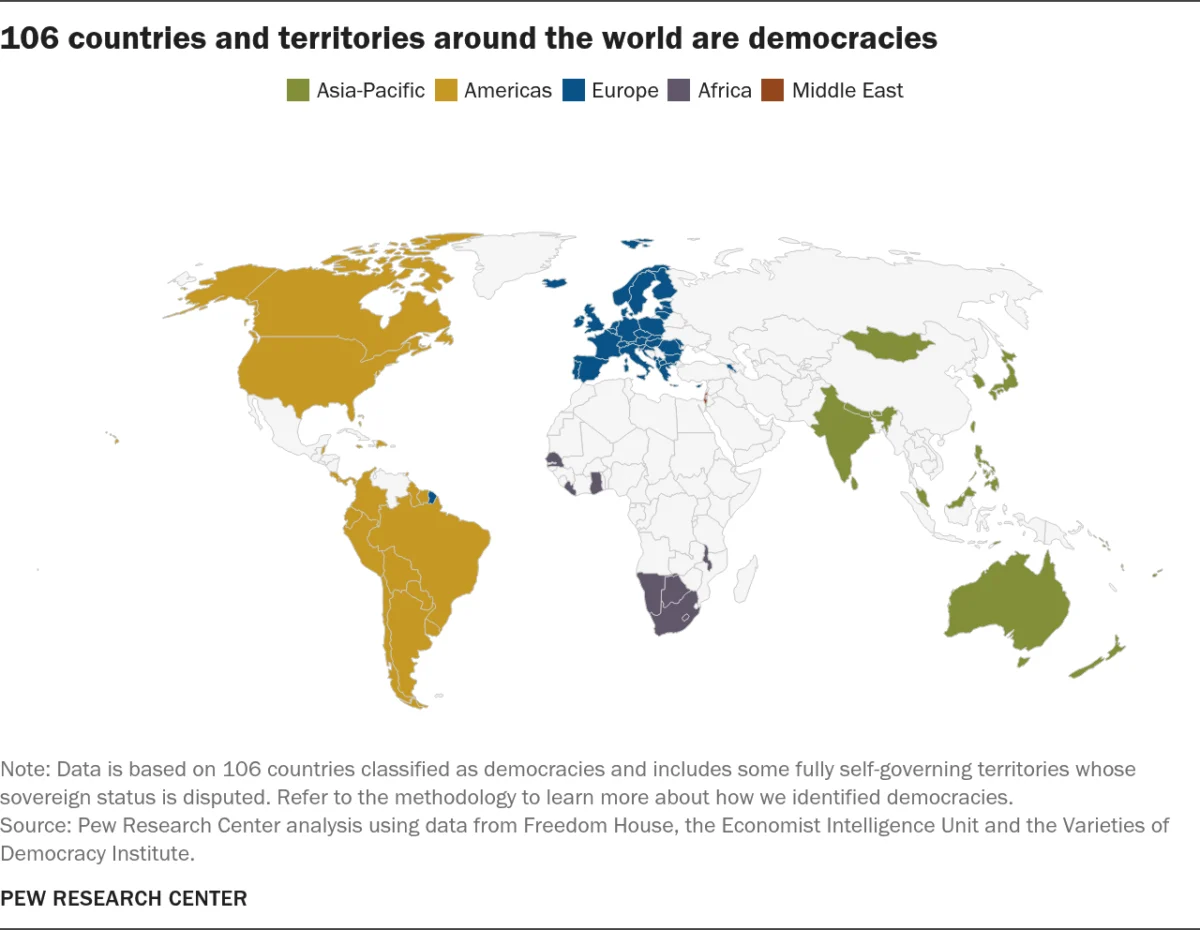
As the United States approaches the 250th anniversary of the signing of the Declaration of Independence, the American political experiment remains a subject of intense global study. While over 100 countries currently operate as functioning democracies, the U.S. system is not a universal template. Instead, it is a collection of unique constitutional structures, historical compromises, and distinctive political traditions that distinguish it from its peers.
Pew Research Center, in a comprehensive analysis of 106 democratic nations and territories, has identified eight specific dimensions where the U.S. political system stands in stark contrast to the global norm.
1. The Rigidity of the U.S. Constitution
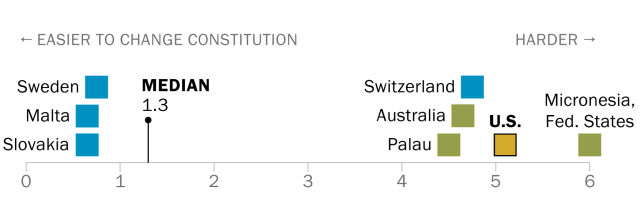
Perhaps the most fundamental way the U.S. stands apart is the extreme difficulty of its constitutional amendment process. While modern democracies often view constitutions as living documents subject to periodic adjustment, the U.S. Constitution has remained largely static for 237 years.

Using a classification scheme developed by political scientist Donald S. Lutz, researchers scored 101 democratic constitutions based on their amendment paths. The U.S. ranks as having the second-most onerous process in the world, surpassed only by the Federated States of Micronesia. To amend the U.S. Constitution, one requires a two-thirds supermajority in both chambers of Congress, followed by ratification by three-quarters of the states. In an era of profound political polarization, this high barrier ensures that the founding document remains unchanged even when large majorities of the public express support for reforms, such as term limits or campaign finance regulation.
2. The Global Rarity of Birthright Citizenship
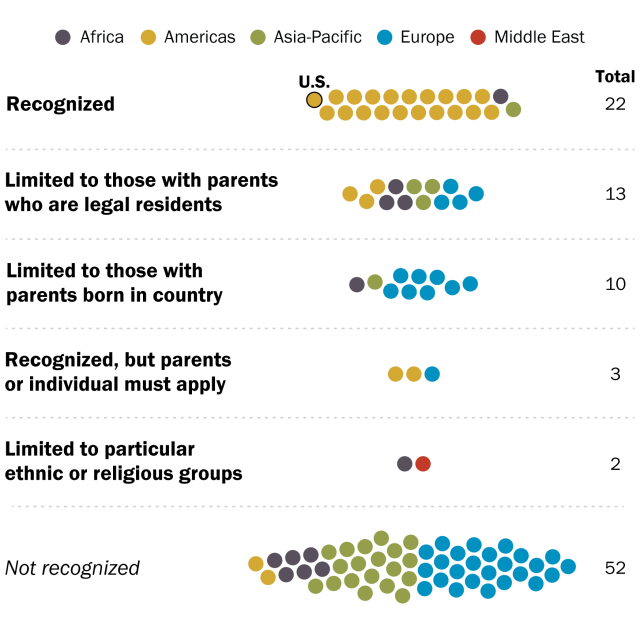
The 14th Amendment’s guarantee of birthright citizenship, recently reaffirmed by the Supreme Court, places the U.S. in a select minority. Out of the 106 democracies studied, only 22 recognize birthright citizenship in a form substantially similar to the U.S.—where children born on national soil are automatically citizens regardless of their parents’ status.
Nearly half of the world’s democracies (52) offer no form of birthright citizenship, requiring at least one parent to hold citizenship for the child to acquire it. Another 25 countries offer conditional birthright, such as requiring parents to be legal residents or born within the country themselves.

3. The Unique Electoral College
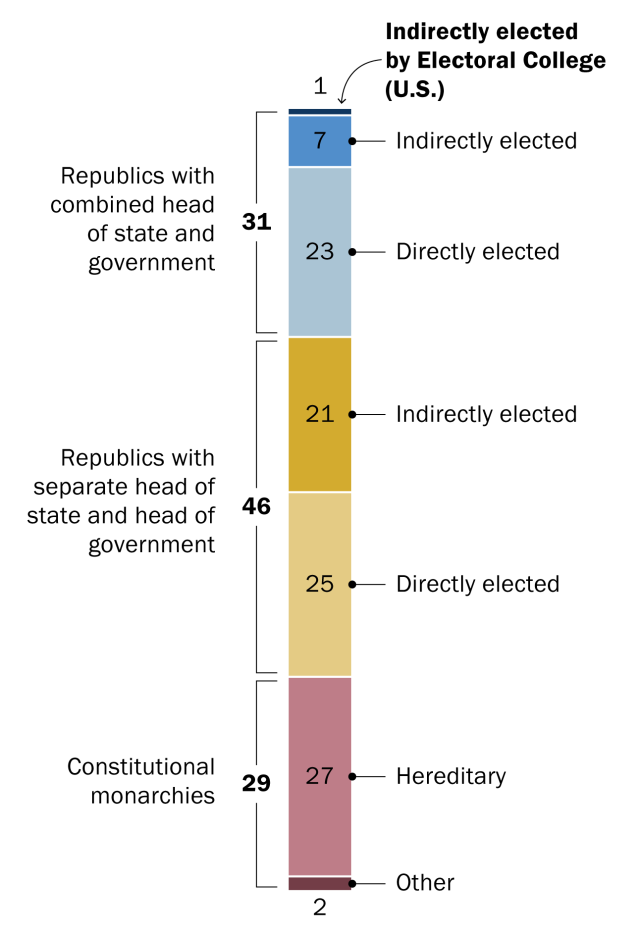
The U.S. president occupies a singular role as both head of state and head of government. While 30 other democracies share this combined leadership structure, the method of selection in the U.S. is truly an outlier.
In every other democracy with a combined head of state and government, the leader is either elected directly by the people or chosen by the national legislature. The United States is the only country where the electorate votes for a special body—the Electoral College—whose sole constitutional function is the selection of the president. This mechanism has allowed for instances where a candidate wins the presidency despite losing the popular vote, a phenomenon that has occurred four times since the modern system solidified in 1828.
4. Legislative Districting and Political Boundary Management
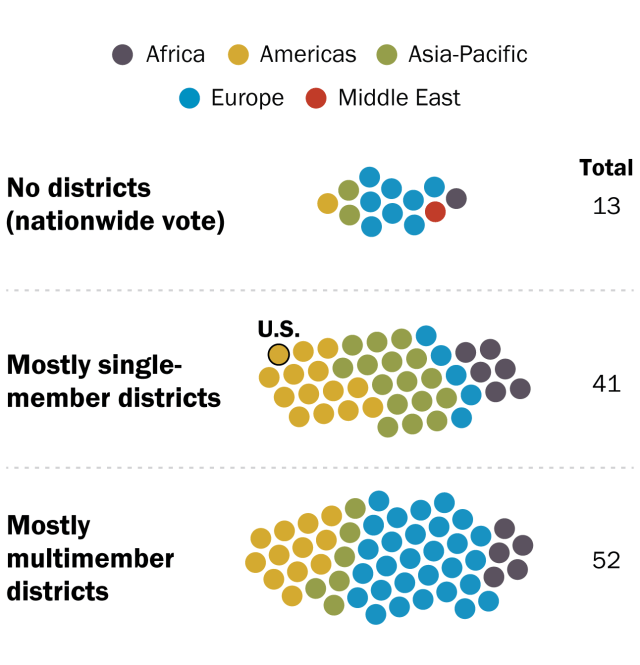
The way the U.S. House of Representatives is elected is also anomalous. Only 41 democracies rely exclusively or primarily on single-member districts. Most of the world uses proportional representation, where multiple representatives are elected from larger, multi-member districts, or they utilize a nationwide vote to fill the legislature.
Furthermore, the U.S. is unique in allowing state legislatures to draw their own district lines. In most other democracies that utilize districts, the process is handled by independent, non-partisan boundary commissions or national election agencies, effectively insulating the process from the immediate political interests of the ruling party.
5. Representation Ratios: The Scale of U.S. Democracy
The U.S. House of Representatives has not expanded its total membership since the early 20th century, despite the American population more than tripling. Consequently, the "representation ratio"—the number of constituents per lawmaker—is the second-highest of any democracy in the world.
Each U.S. representative serves an average of 802,000 people. Only India, with a ratio of 2.72 million constituents per member of the Lok Sabha, has a higher density. The median representation ratio across the 106 democracies studied is approximately 31,000. If the U.S. were to match this median, the House of Representatives would require over 11,000 members.
6. The Tuesday Election Tradition
While the world has largely shifted toward weekend voting, the United States remains firmly rooted in a mid-19th-century schedule. Election Day is held on a Tuesday, a vestige of an agrarian era when Sunday was reserved for church and Wednesday was often a market day.
Today, the U.S. is one of only 28 democracies that hold national elections on non-holiday weekdays. In contrast, 60 countries utilize Saturdays or Sundays for polling, and 16 others designate Election Day as a national public holiday to encourage participation.
7. The D.C. Representation Gap
Washington, D.C., holds the ignominious distinction of being the only national capital in a democracy where residents have no voting representation in the national legislature. While many countries grant their capitals special status, they invariably allow residents to elect lawmakers to represent their interests. The 694,000 residents of the District of Columbia currently send a delegate to the House of Representatives who may serve on committees but holds no vote on the floor—a structural exclusion that persists despite ongoing calls for statehood or constitutional reform.
8. Rigid Debt Limits
The U.S. defines its national debt limit in absolute, fixed dollar amounts rather than as a flexible percentage of Gross Domestic Product (GDP). This creates a unique political pressure point. While two-thirds of democracies have some form of debt control, most treat these as fiscal guidelines. In the U.S., the debt ceiling has become a primary tool for legislative leverage. Because the limit is not indexed to economic growth, Congress must periodically raise it, often resulting in high-stakes standoffs that threaten government shutdowns and global financial stability.
Chronology of Institutional Development
- 1787: The U.S. Constitution is written, establishing the Electoral College and the rigid amendment process.
- 1868: The 14th Amendment is ratified, cementing the concept of birthright citizenship.
- 1910s: The size of the U.S. House of Representatives is capped at 435 members, leading to the modern, high representation ratio.
- 1980s: A proposed constitutional amendment to give D.C. voting representation in Congress fails to achieve the necessary state ratifications.
- 2016 & 2024: Recent elections underscore the divergence between the popular vote and the Electoral College, reigniting national debates on democratic reform.
Official Responses and Political Discourse
The persistent debate over these "American exceptions" often pits constitutional traditionalists against institutional reformers. Proponents of the status quo argue that the U.S. system was intentionally designed with "friction" to prevent the tyranny of the majority and ensure that change is slow, deliberate, and consensus-driven.
Conversely, critics—including a growing majority of the American public, according to recent Pew data—point to the rigidity of the amendment process and the Electoral College as impediments to modern governance. Political leaders in both parties have periodically proposed legislative fixes, such as weekend voting or changing the debt ceiling mechanism, but they have frequently abandoned these efforts when faced with the procedural hurdles of the very system they seek to reform.
Implications for the Future
The uniqueness of the American system presents a dual-edged sword. On one hand, the stability and longevity of the constitutional order are sources of national pride and continuity. On the other, the difficulty of adapting to 21st-century realities—such as an massive increase in the representation ratio or the volatility of the debt ceiling—creates systemic risks.
As the nation marks its 250th anniversary, the challenge for American democracy will be to determine whether these "exceptional" features are foundational strengths that preserve the Republic, or outdated mechanisms that hinder its ability to respond to a rapidly changing, interconnected world. The data suggests that while the U.S. is indeed a robust democracy, its path remains distinctly its own, navigating a course that few other nations are willing to follow.