As the 2026 midterm election cycle reaches its crescendo, the American political landscape stands on the precipice of a significant, if long-overdue, demographic shift. In several key states, voters are poised to break historical barriers that have persisted for over two centuries. With the ballots cast this fall, the nation is all but guaranteed to see the inauguration of its first women governors in states that have previously only known male leadership in their executive mansions.
The significance of these potential milestones cannot be overstated. According to data provided by the Center for American Women and Politics at Rutgers University, 17 states in the Union have never had a woman serve as governor. This October, that number is finally set to diminish.
The High-Stakes Races: A Tale of Two States
The spotlight shines brightest on Minnesota and Tennessee, where the gubernatorial races are defined by the absence of historical precedent. In Minnesota, the contest features a high-profile showdown between Democratic U.S. Senator Amy Klobuchar and Republican state House Speaker Lisa Demuth. Regardless of the outcome, Minnesota will definitively elect its first woman governor, ending a 168-year streak of male occupancy in the office.
Similarly, in Tennessee, the race between Republican Senator Marsha Blackburn and Democratic Memphis City Council member Jerri Green represents a similar watershed moment for the Volunteer State. These contests are not merely local political battles; they serve as a bellwether for the shifting expectations of the American electorate, which increasingly views gender representation as a vital component of a healthy democracy.
Beyond these two headline races, the 2026 midterms feature three other gubernatorial contests across the country where a major-party nominee, if victorious, would claim the title of their state’s first woman governor. These races serve as a poignant reminder that while progress is being made, the "glass ceiling" remains firmly in place across a substantial portion of the American heartland.

The Chronology of Representation: From 1922 to 2026
The trajectory of women in American executive and legislative power has been anything but linear. To understand the current climate, one must look back at the tentative, often symbolic, beginnings of women in high office.
The Senate, the "world’s greatest deliberative body," did not see a woman walk its halls until 1922. Rebecca Latimer Felton of Georgia, a tireless suffragist, was appointed to a vacant seat at the age of 87. Her term was a singular, symbolic gesture, lasting only one day. It would be years before women became fixtures of the chamber rather than historical anomalies.
The executive branch saw similar early, if sparse, representation. In 1925, two women took the oath of office as governors. Wyoming’s Nellie Tayloe Ross ascended to power following the death of her husband, while Texas’s Miriam "Ma" Ferguson became the first woman to win a gubernatorial general election. Despite these early breakthroughs, the momentum stalled for decades, with the modern era of female leadership only truly taking root in the late 20th century.
Analyzing the Data: The Gender Gap in Governance
As of October 2026, the data from the Center for American Women and Politics paints a vivid picture of the current state of play. A total of 65 women have served as U.S. Senators in the history of the Republic. Crucially, more than 75% of these women—51 in total—first took office after 1980. This concentration of service in the last four decades suggests an acceleration of representation, yet it also highlights how stagnant the preceding 160 years were.
In the governor’s office, the numbers are even more modest. Since 1925, 53 women have held the top spot in 33 states. Today, women occupy 14 of the 50 governorships—a record high, yet still representing a minority of the states.

Senate Representation
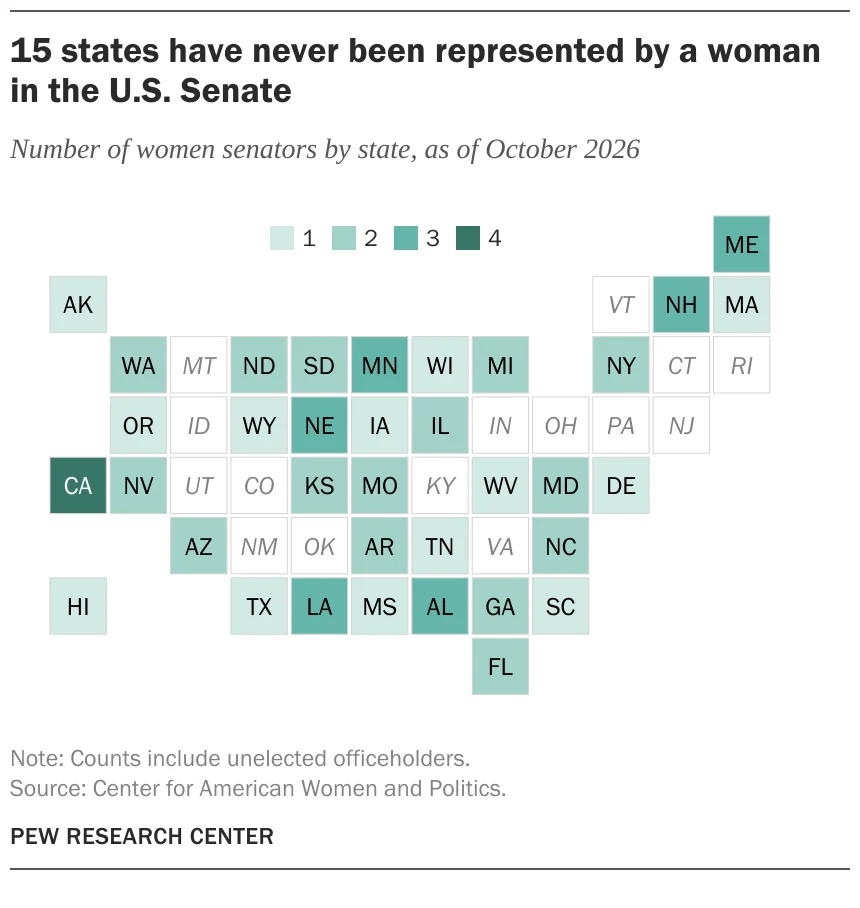
While the Senate currently boasts a record 27 women out of 100 seats, the distribution remains uneven. California leads the nation in sending women to the Senate, having elected four, including the long-serving giants Dianne Feinstein and Barbara Boxer. Conversely, 15 states have never been represented by a woman in the U.S. Senate. Two of these states—Montana and Oklahoma—have women, Alani Bankhead and N’Kiyla Jasmine Thomas, on the ballot this year, offering a chance to correct this historical imbalance.
The "Double-Zero" States
Perhaps the most striking finding in current political science research is the list of states that have failed to elect women to either the governorship or the U.S. Senate. Colorado, Idaho, Indiana, and Pennsylvania remain in a category of their own, having never seen a woman hold either of these two influential offices.
Official Perspectives and the Path Forward
Political analysts argue that the rise of women in 2026 is the result of a concerted effort by party infrastructures to cultivate female talent at the local and state levels. The Center for American Women and Politics (CAWP) notes that the pipeline for high office is increasingly populated by women who have cut their teeth in city councils, state legislatures, and non-profit advocacy.
"The 2026 midterms are a reflection of a long-term investment in female candidates," says a spokesperson for the non-partisan research group. "We are seeing a move away from ‘special circumstances’ appointments—like those of the early 20th century—toward grassroots-backed campaigns where candidates are winning on policy platforms rather than merely as placeholders for male predecessors."
The parties themselves have acknowledged this shift. In both the Minnesota and Tennessee races, the platforms of the candidates, regardless of party affiliation, have focused on economic stability, education, and infrastructure. The rhetoric suggests that the electorate is moving toward a post-gender-essentialist view of leadership, where voters prioritize the candidate’s agenda over their gender, even while acknowledging the historic nature of the election.

Broader Implications: What Does This Mean for 2027 and Beyond?
The election of a woman governor in a state that has never had one sends a profound message to younger generations. Representation impacts policy, not just in terms of the legislation that is prioritized—such as healthcare, child-care initiatives, and maternal health—but also in terms of the "visibility effect." When a young girl in a state like Minnesota or Tennessee sees a woman in the governor’s office, the perceived barriers to entry for political participation are lowered.
Furthermore, the diversification of the Senate caucus—which currently sits at 16 Democrats and 11 Republicans—suggests that female representation is becoming a non-partisan objective. As more women enter the Senate, the caucus dynamics change, potentially leading to more collaborative legislative approaches, as some studies have indicated that women in Congress are more likely to participate in cross-aisle legislative efforts.
However, challenges remain. The fact that 17 states have yet to elect a woman governor suggests that regional political cultures still hold significant sway over the viability of candidates. The "traditional" image of a governor or senator—often rooted in patriarchal norms of the 19th and early 20th centuries—persists in some conservative strongholds, making the path for women in those states more arduous.
Conclusion: A Turning Point in American History
As the polls close this November, the United States will undoubtedly record new data points in its history books. The 2026 midterms will not solve the issue of gender parity in American government, but they will mark a definitive shift in the status quo.
When the first woman governor of Minnesota or Tennessee takes the oath of office in January 2027, it will be the culmination of a century-long struggle for recognition and equality. It serves as a reminder that the democratic experiment is constantly evolving, and that the "face" of American leadership is slowly, inevitably, becoming more reflective of the population it serves.

Whether these candidates win or lose, their presence on the ballot is a victory for the democratic process. They have proven that the barriers to entry are not impassable, and their campaigns have set the stage for a future where the election of a woman to the highest office in a state is no longer a historic event, but a standard occurrence. As we look toward the 119th Congress and the future of the governors’ mansions across the nation, one thing is certain: the era of the all-male executive chamber is rapidly becoming a relic of the past.