The landscape of American public opinion regarding the Middle East has undergone a profound transformation in recent years. New data from a comprehensive Pew Research Center survey, conducted between May 4 and May 17, 2026, reveals a stark cooling in American sentiment toward the Israeli people and their government. While perceptions of Palestinians have remained relatively stable, the traditional gap in favorability between the two populations has all but evaporated, marking a significant pivot in the U.S. geopolitical consciousness.
This shift comes at a volatile moment, occurring roughly two months into a large-scale conflict involving Israel, the United States, and Iran. As the regional dynamics remain in flux, the American public is increasingly distinguishing between its views of civilian populations and their respective political leaderships, frequently holding negative opinions of the latter across the board.
The Chronology of Disenchantment
To understand the current climate, one must look at the recent trajectory of public sentiment. As recently as 2022, the American public held the Israeli people in significantly higher regard than the Palestinian people. However, the catalytic events of October 2023—the Hamas attack on Israel—and the ensuing war initiated a period of rapid erosion in how Americans perceive Israel.
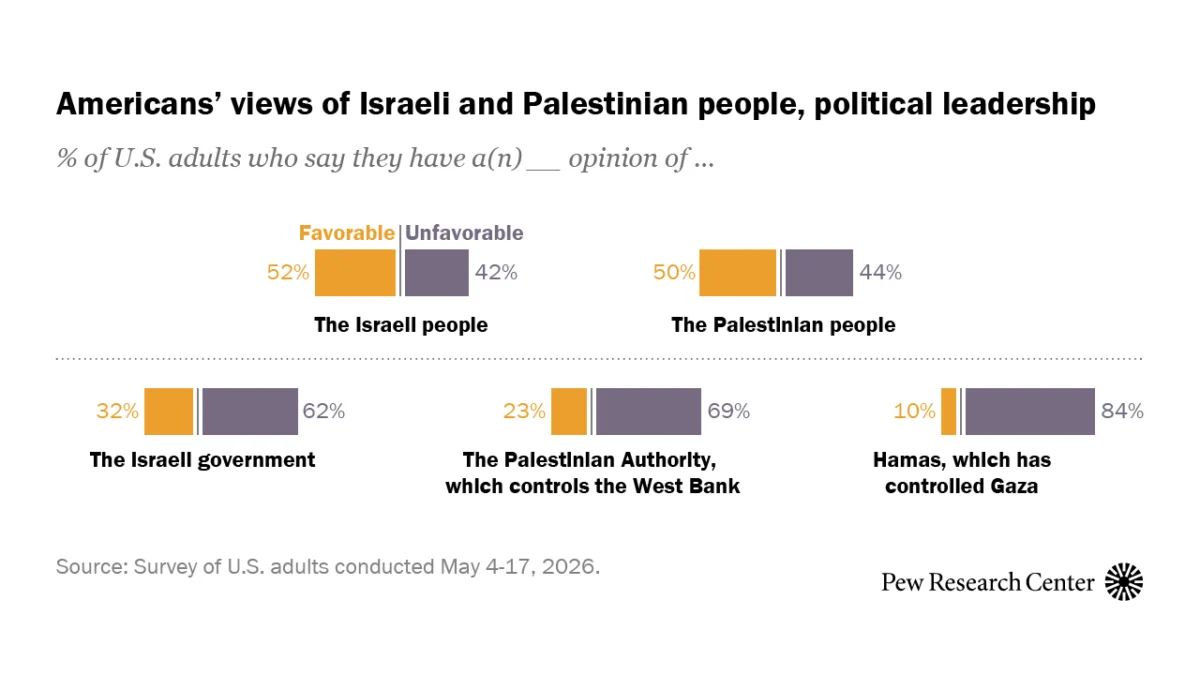
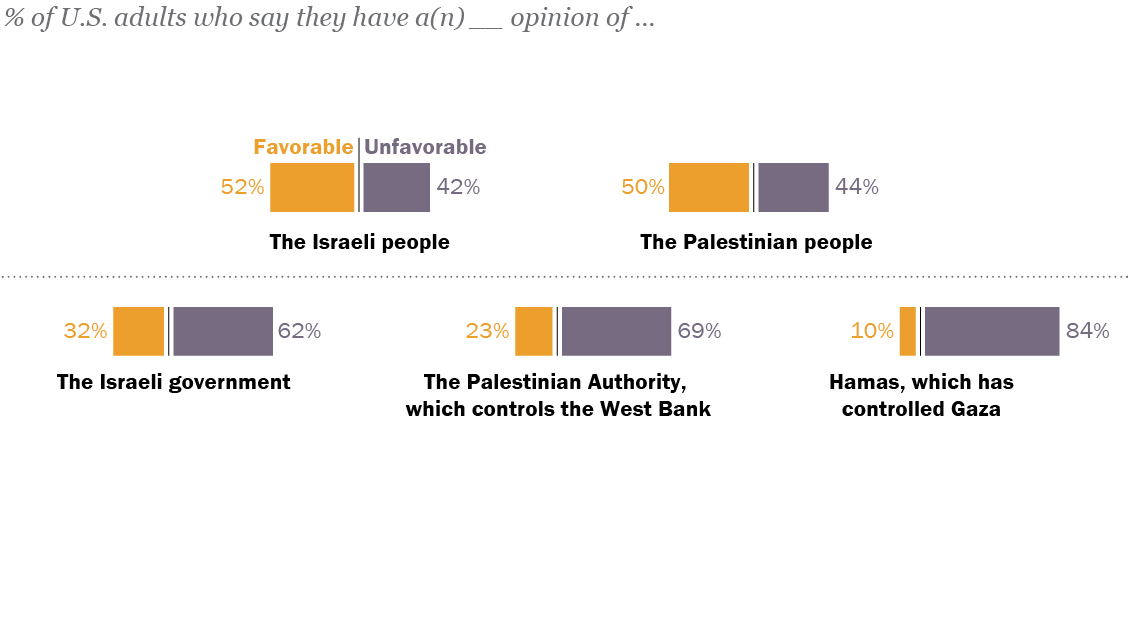
By 2024, the favorable view of the Israeli people began to dip, falling from 67% in 2022 to 64%. By 2025, that figure dropped further to 56%, and the most recent data from May 2026 shows it settling at 52%. Conversely, the unfavorable view of the Israeli people has climbed steadily, from 25% in 2022 to 42% in the current survey.
In contrast, views of the Palestinian people have remained remarkably resilient despite the intense regional instability. In 2022, 53% of Americans held a favorable view of the Palestinian people; in 2026, that number stands at 50%. While their unfavorable ratings have seen a marginal increase, the stability of these figures has effectively neutralized the once-pronounced favoritism toward the Israeli populace.
Political Leadership: A Universal Decline
Perhaps the most consistent finding in the 2026 survey is the deep-seated skepticism toward political leadership on both sides. The American public distinguishes sharply between the individuals living in the region and the entities that govern them.
Majorities of Americans now express an unfavorable view of the Israeli government, the Palestinian Authority (which holds sway in the West Bank), and Hamas (which, at the time of the survey, controlled Gaza). Negative sentiment toward the Israeli government has risen sharply in recent years, reaching 62% in the latest poll, up from 51% in 2024.
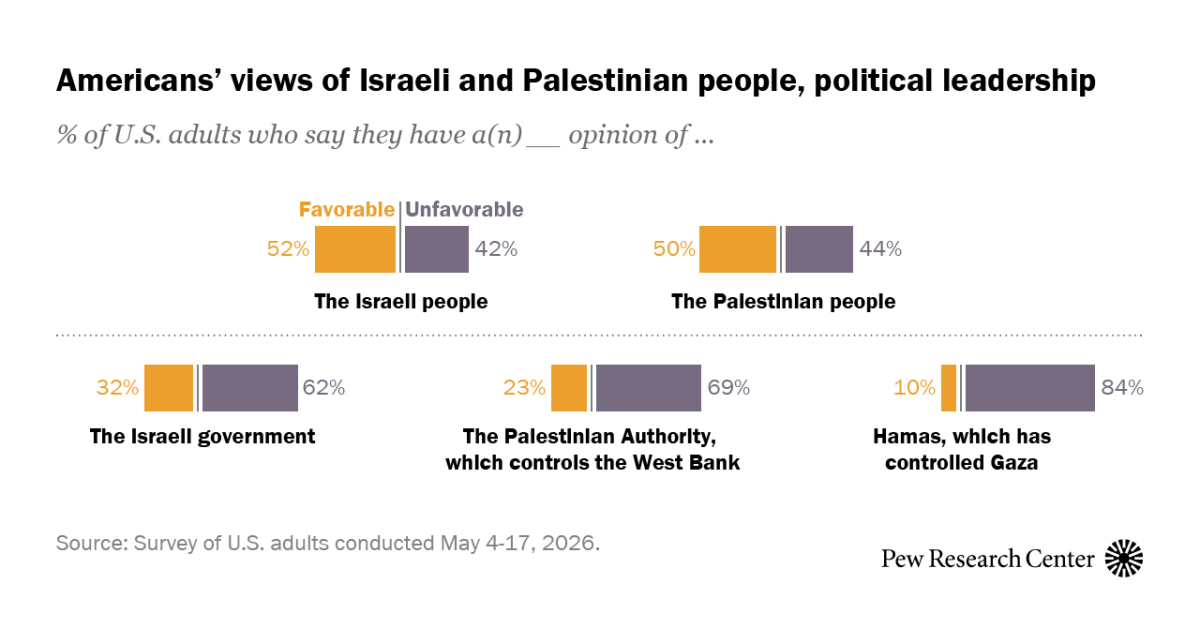
The Palestinian Authority and Hamas fare even worse in the eyes of the American public. The Palestinian Authority suffers from a 69% unfavorable rating, while Hamas continues to face overwhelming rejection, with 84% of Americans expressing an unfavorable view. These figures suggest that, regardless of the political aisle, the American public has grown increasingly disillusioned with the leadership structures currently guiding the conflict.
Supporting Data: The Partisan and Generational Divide
The survey, which captured responses from 12,574 U.S. adults, reveals that these shifts are not occurring in a vacuum. They are deeply stratified by political ideology, age, and religious identity.
The Partisan Gap
The ideological divide between Republicans and Democrats regarding the Middle East has widened into a chasm. Republicans and Republican-leaning independents remain more favorable toward the Israeli people and government, though even this group has seen a decline in enthusiasm. Democrats, meanwhile, have grown increasingly sympathetic to the Palestinian cause.
Among Democrats and Democratic-leaning independents, the favorable view of the Palestinian people (67%) now dwarfs their favorable view of the Israeli people (43%). This represents a significant reversal from historical trends where support for Israel was often more bipartisan. On the issue of government leadership, the partisan divide is even more pronounced: only 16% of Democrats view the Israeli government favorably, compared to 51% of Republicans.
The Generational Shift
Age serves as one of the most reliable predictors of these sentiments. The survey highlights a "youth gap," where American adults under 30 express significantly more favorable views of the Palestinian people (58%) than the Israeli people (32%).
This demographic trend is driven primarily by young Democrats. In contrast, Americans over the age of 65 remain the most supportive of Israel, with 68% holding a favorable view of the Israeli people. This generational divide underscores a broader shift in how younger Americans engage with global human rights issues and the historical narratives of the Middle East.
Religious Perspectives and Their Influence
Religious affiliation continues to color how Americans interpret the conflict. The data reveals that Jews and White evangelical Protestants maintain the highest favorability toward Israel. Among Jews, 83% hold a favorable view of the Israeli people, though even this support has seen a slight decline among younger Jewish cohorts.
White evangelical Protestants stand as the only religious group where a majority (57%) continues to view the Israeli government favorably. Conversely, Muslim Americans and the "religiously unaffiliated"—those who identify as atheist, agnostic, or "nothing in particular"—are far more likely to sympathize with the Palestinian people. Muslims reported a 78% favorable view of the Palestinian people, while 59% of the religiously unaffiliated expressed the same sentiment.
Broader Implications for U.S. Foreign Policy
The cooling of American sentiment toward Israel, combined with the persistent skepticism of Palestinian leadership, poses a complex challenge for policymakers in Washington. The data suggests that the American public is no longer operating under the assumption that support for the Israeli state is a prerequisite for a balanced foreign policy.
The Domestic Political Cost
As public opinion shifts, elected officials—particularly within the Democratic Party—may find it increasingly difficult to maintain traditional stances that favor unqualified support for the Israeli government. The growing favorability of the Palestinian people among younger voters and progressives suggests that the political cost of ignoring these sentiments will likely increase in future election cycles.
The Challenge of Diplomatic Neutrality
The widespread unfavorable views toward the Palestinian Authority and Hamas, coupled with the rising disapproval of the Israeli government, indicate that the U.S. public feels a sense of detachment from the political entities involved. This "a pox on both houses" attitude complicates efforts to advocate for specific diplomatic solutions. If the public perceives all parties involved as failing or unworthy of support, the appetite for sustained U.S. military or financial intervention may continue to wane.
The Role of Information and Media
The survey was conducted in the shadow of a wider conflict, highlighting how real-time exposure to the consequences of war—via social media and 24-hour news cycles—is shaping public opinion. As information becomes more decentralized, the traditional narratives that historically bolstered support for specific allies are being challenged by diverse, grassroots perspectives that prioritize humanitarian concerns over geopolitical alliances.
Conclusion: A New Reality
The findings from the May 2026 Pew Research Center survey are a clear indicator that the American perception of the Middle East is entering a new, more critical, and perhaps more cynical era. The erosion of the "Israel-support" consensus, the hardening of partisan divides, and the profound generational shift toward empathy for the Palestinian population suggest that the United States is moving away from its historical patterns of engagement.
As the conflict continues to evolve, the disconnect between public opinion and established foreign policy will likely become a defining feature of the American political landscape. For leaders in Israel, the Palestinian territories, and the United States, the task of aligning diplomatic strategy with an increasingly skeptical and polarized American electorate has never been more daunting. The data is clear: the American public is watching, and their support is no longer a given—it is being re-evaluated in real-time, amidst the rubble of a changing world.