WASHINGTON — Artificial intelligence tools have rapidly woven themselves into the fabric of daily life, with roughly half of all U.S. adults now relying on generative AI platforms like ChatGPT, Microsoft Copilot, and Google Gemini for everything from drafting emails to brainstorming project ideas. Yet, as the nation hurtles toward the high-stakes 2026 midterm elections, a new nationwide survey reveals a striking paradox: an overwhelming majority of Americans are drawing a firm line when it comes to seeking political guidance from algorithms.
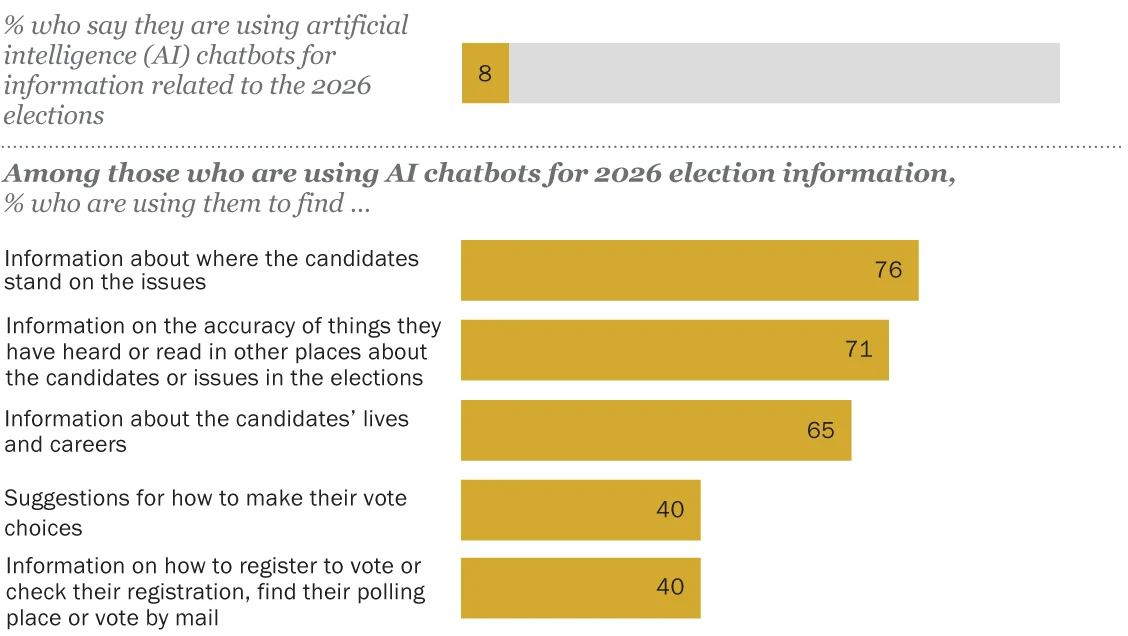
According to a comprehensive new study conducted by the Pew Research Center, just 8% of U.S. adults say they are utilizing AI chatbots to find information related to the upcoming midterm elections.
While tech giants and political consultants debate the future of automated campaigns, the electorate at large remains deeply hesitant to invite artificial intelligence into the democratic decision-making process. For the vast majority of voters, traditional media, candidate websites, and personal networks remain the primary conduits for political news. However, for the small slice of the population that is turning to chatbots, the data paints a fascinating picture of what these users are hoping to find—and who, precisely, is willing to trust a machine with their vote.
Main Facts: The State of AI in the 2026 Midterms
The survey, which polled 5,273 U.S. adults between October 12 and October 18, 2026, via the Center’s American Trends Panel, offers a nuanced snapshot of technology adoption intersecting with civic duty.
While overall generative AI adoption has soared to historical highs over the past few years, its application in politics remains a niche endeavor. The headline findings underscore a wide chasm between general AI utility and political inquiry:
- Low Overall Adoption: Only 8% of American adults report using AI chatbots to look up 2026 election information. Conversely, 92% say they are not using these tools for this purpose.
- Issue and Policy Focus: Among the small minority of chatbot users who do seek election information, the vast majority are looking for substance. A striking 76% use chatbots to find out where candidates stand on key issues.
- Fact-Checking Claims: 71% of chatbot-using respondents turn to the tools to verify the accuracy of statements, claims, or news they have heard or read elsewhere regarding candidates and issues.
- Biographical Research: 65% use the platforms to learn more about candidates’ personal backgrounds and professional careers.
- Voting Logistics and Advice: Forty percent (40%) look to chatbots for suggestions on how to cast their ballots, while an equal share (40%) use them for practical logistics, such as checking voter registration status, finding polling places, or navigating vote-by-mail procedures.
- The Generative Divide: Younger adults are significantly more likely to dabble in political AI than older demographics. Eleven percent of Americans under 50 report using chatbots for election info, compared to just 4% of those aged 50 and older.
Chronology: How AI Transitioned from Novelty to Political Tool
To understand why Americans are approaching AI cautiously ahead of the 2026 midterms, it is necessary to trace how generative artificial intelligence evolved from a Silicon Valley experiment into a mainstream phenomenon.
2022–2023: The Generative AI Explosion
The modern era of consumer AI began in late 2022 with the public launch of OpenAI’s ChatGPT. Within months, millions of users began experimenting with large language models (LLMs). As the 2024 presidential election cycle approached, watchdogs, journalists, and election officials sounded the alarm over the potential for AI-generated deepfakes, synthetic robocalls, and automated disinformation campaigns designed to mislead voters.
2024–2025: Regulatory Guardrails and Platform Restrictions
During the 2024 election cycle, major tech companies—including OpenAI, Google, and Microsoft—implemented strict internal policies prohibiting their chatbots from generating definitive voting instructions, impersonating candidates, or providing real-time election results. Instead, users asking about polling locations or candidate ballots were frequently directed to authoritative, non-partisan resources like Vote.org or state election websites. Despite heightened anxieties surrounding deepfakes and misinformation, actual voter reliance on chatbots for direct information remained low, as consumers learned to treat AI outputs with a healthy degree of skepticism.
Mid-2026: Broad Adoption, Narrow Political Use
By mid-2026, Pew Research data showed that overall American adoption of chatbots had stabilized at around 50% for general tasks. People were comfortable using AI for cooking recipes, drafting professional text, or troubleshooting software. Yet, as the 2026 midterm campaigns heated up in the fall, this widespread familiarity failed to translate into a mass migration toward AI-driven political research. The October 2026 survey captured a public that recognizes the power of AI, but prefers to keep it out of the ballot box.
Supporting Data: Breaking Down the Numbers
A deeper dive into the Pew Research Center metrics reveals distinct demographic trends and specific behavioral patterns among those who venture into political AI queries.
The Demographic Breakdown
The 8% adoption rate for election-related chatbot queries is not evenly distributed across American society. Paralleling broader trends in technology use, age emerges as the most significant divider:
- Under 50: 11% report using chatbots for election info. This group grew up alongside digital transformation and is generally more comfortable integrating emerging tech into daily routines.
- 50 and Older: Only 4% report doing the same. Older Americans have traditionally relied on established media outlets, television broadcasts, and direct mail for political education.
What Users Want From Chatbots (Detailed Percentages)
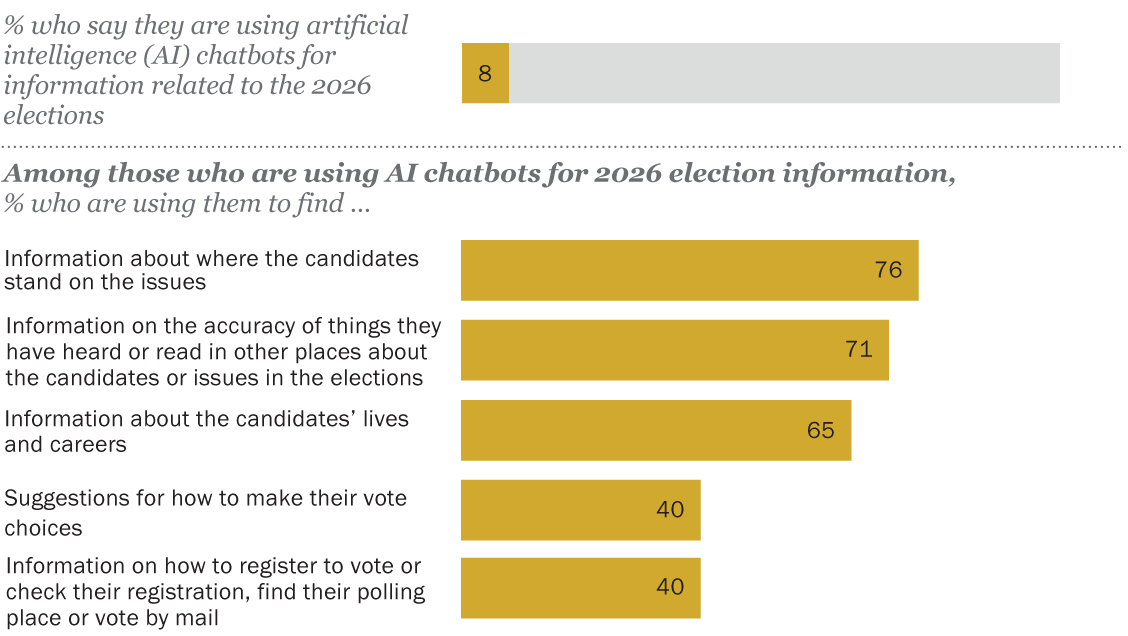
For the 8% who actively prompt AI models about the midterms, their queries are heavily skewed toward policy evaluation and verification rather than direct vote solicitation:
- Candidate Stances on Issues (76%): Voters want quick summaries of complex legislative records, economic platforms, and ideological positions.
- Fact-Checking Claims (71%): In an era saturated with campaign ads, social media spin, and hyper-partisan messaging, users look to LLMs to separate fact from fiction.
- Candidate Backgrounds (65%): Biographical details, career histories, and past public service records are frequent points of inquiry.
- Voting Advice and Suggestions (40%): A minority look to AI to help synthesize their values and suggest potential voting choices—a practice that raises significant concerns among political scientists regarding algorithmic bias.
- Logistics and Registration (40%): Navigating the bureaucratic maze of voter registration, deadlines, and polling locations remains a task traditionally handled by government websites, but a notable segment is testing AI for these steps.
Official Responses and Expert Reactions
The reluctance of Americans to embrace AI for political decisions has elicited varied reactions from policy analysts, academic researchers, and tech industry leaders.
Academic and Research Perspectives
Ted Van Green, the Pew Research Center research analyst who authored the report, notes that the numbers reflect a rational hesitation among the electorate.
"Americans are increasingly comfortable using AI for routine or creative tasks, but politics is deeply personal and high-stakes," researchers noted in related analyses. "Voters are naturally wary of entrusting sensitive civic duties—like deciding who to vote for or where to cast a ballot—to technology that has well-documented issues with hallucinations and bias."
Political scientists have also expressed relief that mass adoption of political chatbots has not materialized. "If 40% or 50% of the country were relying on black-box algorithms to tell them how to vote, we would be facing an unprecedented crisis of democratic accountability," said Dr. Elena Vance, a professor of political communication at a major midwestern university. "The fact that only 8% are looking to these tools—and primarily for basic research rather than direct instruction—gives regulatory bodies and civil society more time to establish healthy norms."
Industry Adjustments
Major AI developers have largely welcomed the cautious approach of the public. Following intense scrutiny during previous election cycles, companies have continuously refined their safety filters. Modern LLMs are programmed to recognize election-related queries and respond with disclaimers or links to verified government databases, drastically reducing the risk of accidental disinformation originating directly from commercial chatbot interfaces.
Implications: What This Means for the Future of Democracy
As the 2026 midterms conclude and observers look ahead to future election cycles, the findings carry profound implications for campaigns, technology developers, and voters alike.
1. Campaigns Must Still Focus on Traditional Channels
For political campaigns, the data serves as a clear reminder that voters are not primarily discovering candidates through ChatGPT or Gemini. While digital outreach, targeted social media advertising, and AI-driven voter data modeling happen behind the scenes, the front-facing voter experience remains anchored in traditional media, local debates, and grassroots engagement. Campaigns that abandon standard outreach in favor of over-investing in chatbot optimization risk missing the vast majority of the electorate.
2. The Persistence of the Algorithmic Trust Gap
The stark divide between general AI adoption (50%) and political AI adoption (8%) highlights a persistent "trust gap." Americans understand that AI is a powerful tool, but they harbor profound skepticism regarding its neutrality. Political discourse is inherently subjective and value-laden—qualities that do not mesh well with mathematical optimization models. Until the public develops greater confidence in the neutrality and factual accuracy of LLMs regarding controversial public policies, political chatbot usage is likely to remain a fringe activity.
3. The Threat of Misinformation Remains Real
Despite low rates of intentional chatbot consultation by voters, the broader ecosystem of AI-generated content remains a formidable challenge. While few citizens are asking chatbots for election advice, many are encountering AI-generated deepfakes, synthetic images, and automated social media propaganda on platforms like X, Facebook, and TikTok. The distinction between users seeking AI election info and voters being exposed to AI-driven propaganda is critical for election security officials moving forward.
Conclusion
The 2026 midterm elections are proving to be a transitional period for artificial intelligence in public life. While the technology is ubiquitous in the workplace and consumer sectors, the American voter remains fiercely protective of the democratic process. By keeping chatbots at arm’s length, the electorate is signaling that when it comes to choosing leaders and shaping the future of the nation, human judgment—for now—remains irreplaceable.