WASHINGTON — In a legal victory for major media organizations, a federal judge ordered the Trump administration on Thursday to temporarily restore White House briefing room and grounds access to reporters from CNN, MS NOW, and Politico. The outlets had filed a joint lawsuit challenging their abrupt ban last week, setting off a fresh constitutional battle over the boundaries of executive authority, the rights of the press, and the deep partisan fractures defining the American media landscape.
The judicial intervention comes at a volatile time for national journalism. It coincides with corporate media consolidation—highlighted by Paramount’s recent settlement allowing its acquisition of Warner Bros. Discovery—and new polling data from the Pew Research Center illustrating stark political polarization regarding the state of American democracy and fundamental civil liberties.
Main Facts
The core of the legal dispute centers on the Trump administration’s decision to revoke the hard passes of journalists representing CNN, MS NOW, and Politico. Following the ban, the three news organizations swiftly filed a federal lawsuit, arguing that the exclusion was an unconstitutional retaliation for critical news coverage and a violation of the First Amendment rights of access.
A federal judge granted a temporary injunction forcing the White House to reinstate press credentials while the litigation proceeds. President Donald Trump defended the administration’s initial actions by pointing to what he characterized as sustained, hostile coverage. Speaking to reporters on Friday prior to the injunction, Trump justified the ban as a response to "two years of unfair and negative coverage" from the targeted outlets.
Simultaneously, the media industry is undergoing massive structural shifts. Paramount has successfully resolved an antitrust lawsuit brought by a coalition of state attorneys general, clearing the path for its acquisition of Warner Bros. Discovery. As a condition of the settlement, Paramount committed to establishing an independent editorial oversight board to supervise two of the nation’s most influential broadcasting giants: CNN and CBS News. According to recent audience data, nearly half of all U.S. adults (46%) regularly consume news from at least one of these two networks.
Chronology of Events
The unfolding sequence of events highlights how quickly tensions between the executive branch and the media have escalated:
- March 2025: Pew Research Center polling reveals deep-seated partisan divides regarding trust in mainstream media. A majority of Republicans (58%) report distrusting CNN, with similar widespread skepticism directed at MS NOW and Politico.
- June 2025: Media consumption tracking indicates that CNN and CBS News remain primary information sources for approximately one-third and three-in-ten U.S. adults, respectively.
- June 22–28, 2026: The Pew-Knight Initiative conducts a major national survey exploring public attitudes toward press freedom, civil liberties, and government oversight.
- Mid-September 2026: Reporters from CNN, MS NOW, and Politico are stripped of their White House press credentials and barred from the grounds.
- September 21, 2026: Paramount reaches a decisive antitrust settlement with state authorities, clearing the merger with Warner Bros. Discovery with the caveat of an independent editorial board.
- September 24, 2026: A federal judge rules in favor of the media organizations, issuing an order requiring the Trump administration to temporarily restore White House press access pending further legal review.
Supporting Data and Polling Insights
Public opinion regarding the health of press freedom in the United States is sharply divided along partisan lines, according to data collected by the Pew-Knight Initiative in June 2026.
Overall, 44% of U.S. adults believe that the press has become less free during the second Trump administration. Conversely, 12% say the press has grown more free, 26% perceive no change, and 17% remain unsure.

The underlying partisan chasm is profound:
- Democrats and Democratic-leaners: 72% assert that the press has become less free since Trump’s return to office.
- Republicans and Republican-leaners: Only 15% share that concern, reflecting divergent views on the role and accountability of major journalistic institutions.
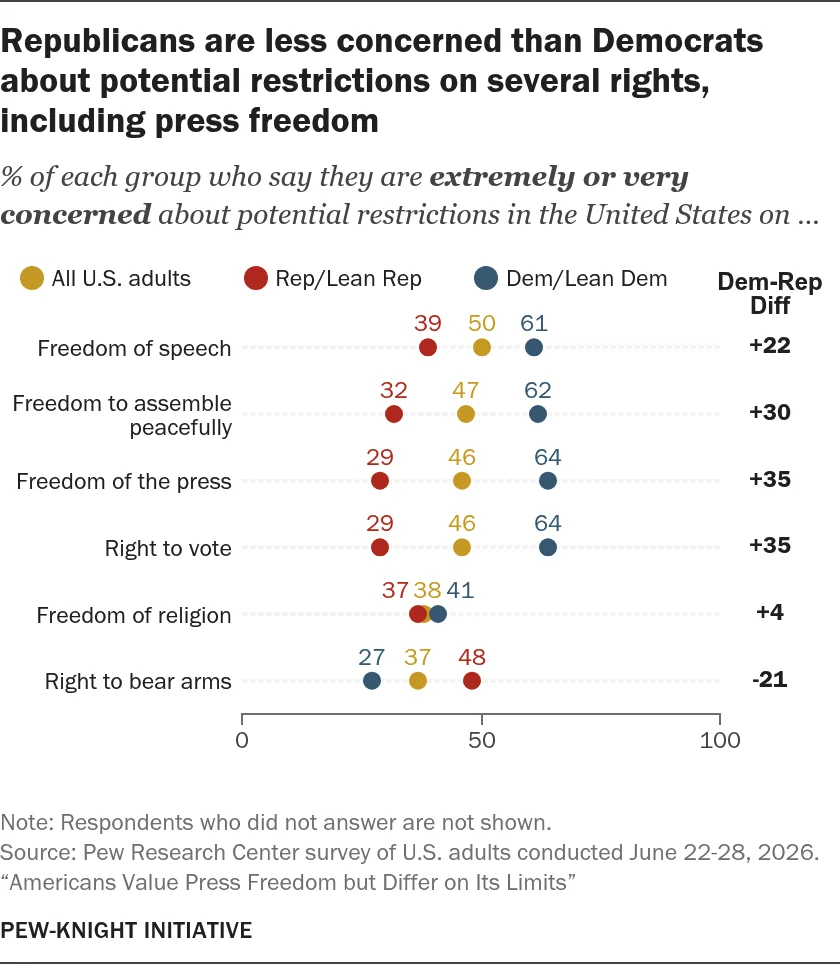
Furthermore, broader anxieties over constitutional freedoms reveal distinct ideological priorities among the American public. When asked about potential government restrictions on core rights, U.S. adults express varying degrees of concern:
- Freedom of speech: 50% extremely or very concerned (61% of Democrats vs. 39% of Republicans).
- Freedom to assemble peacefully: 47% extremely or very concerned (62% of Democrats vs. 32% of Republicans).
- Freedom of the press: 46% extremely or very concerned (64% of Democrats vs. 29% of Republicans).
- Right to vote: 46% extremely or very concerned (64% of Democrats vs. 29% of Republicans).
- Freedom of religion: 38% extremely or very concerned (41% of Democrats vs. 37% of Republicans).
- Right to bear arms: 37% extremely or very concerned (27% of Democrats vs. 48% of Republicans).
These figures demonstrate a recurring trend: Democrats express significantly higher anxiety regarding potential limitations on democratic norms, speech, assembly, and voting rights, whereas Republicans are notably more focused on safeguarding Second Amendment protections.
Official Responses and Stakeholder Positions
The legal battle has mobilized advocacy groups, legal scholars, and political figures, each framing the dispute through contrasting principles of governance and accountability.
- The White House: Administration officials maintain that the executive branch holds discretionary authority over who is granted physical access to the White House complex. President Trump has framed the decision not as an attack on press freedom, but as a necessary pushback against what his administration views as biased, activist journalism designed to destabilize the executive branch.
- The Media Coalitions: Attorneys representing CNN, MS NOW, and Politico argue that the White House briefing room functions as a designated public forum where the government cannot selectively penalize news organizations based on the content or tone of their reporting. They contend that revoking access sets a dangerous precedent for government censorship and viewpoint discrimination.
- Media Industry Watchdogs: Press freedom organizations have expressed alarm over the administration’s actions, warning that excluding specific outlets from the seat of executive power undermines the public’s right to independent oversight and transparent governance.
Implications for Press Freedom and the Media Landscape
The convergence of the White House press ban, the judicial injunction, and major corporate mergers like Paramount’s acquisition of Warner Bros. Discovery carries far-reaching implications for the future of American journalism.
First, the ongoing litigation will test the limits of executive privilege versus First Amendment protections within modern administration protocols. A definitive ruling from higher courts could establish a lasting legal standard regarding whether executive grounds access can be withheld based on administrative grievances with editorial tone.
Second, the structural changes at CNN and CBS News—governed by Paramount’s new independent editorial board—will be heavily scrutinized. As two of the nation’s premier news gathering institutions transition under new corporate mandates, the media industry faces mounting pressure to maintain editorial integrity amidst a climate of intense public skepticism and political polarization.
Ultimately, as public trust in news organizations remains deeply fragmented along partisan lines, the events of September 2026 underscore a fragile ecosystem where the fundamental tenets of press freedom, corporate consolidation, and executive power are continuously contested.