Main Facts
Twenty-five years after the tragic events of September 11, 2001, the landscape of Muslim life in the United States remains a complex study in resilience, demographic expansion, political visibility, and persistent public scrutiny. While Muslim Americans shared fully in the nation’s collective grief and initial shock a quarter-century ago, they have spent the decades since carrying the distinct societal burden of being systematically singled out for suspicion.
Today, Muslims represent a rapidly growing, culturally vibrant, and increasingly influential thread in the American religious fabric. Demographic tracking by the Pew Research Center estimates that the U.S. Muslim population has more than doubled over the last two decades, surging from roughly 2.4 million individuals in 2007 to approximately 5.5 million today. Concurrently, the physical infrastructure of the community has expanded significantly: the number of operating U.S. mosques has risen from an estimated 1,200 in the year 2000 to nearly 2,800 by 2020.
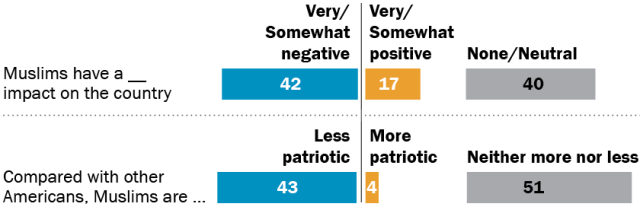
Yet, this institutional and demographic growth exists alongside enduring social challenges. Public opinion data gathered in early 2026 reveals that 43% of U.S. adults view Muslims as less patriotic than other Americans, while 42% believe that Muslim Americans exert a negative impact on the country. Furthermore, about half of the American public (51%) continues to maintain that Islam is more likely than other religions to encourage violence among its adherents—a sentiment that has grown increasingly polarized along partisan lines over the past twenty-five years.
Chronology: Two and a Half Decades of Evolution
To understand the contemporary reality of Muslim Americans, it is essential to trace the historical arc of public attitudes, institutional milestones, and legislative or social shifts since the turn of the millennium:
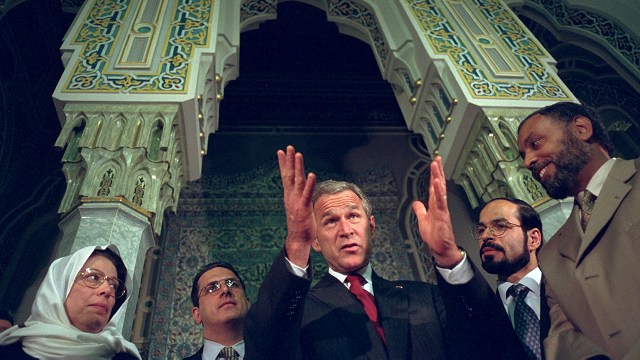
- September 2001: Al-Qaida terrorists execute attacks on the World Trade Center and the Pentagon, prompting an immediate surge in anti-Muslim hate crimes tracked by the FBI, which skyrocketed from 28 incidents in 2000 to a staggering 481 in 2001. Days later, President George W. Bush visits the Islamic Center of Washington, D.C., forcefully declaring, "Islam is peace."
- March 2002: Six months post-9/11, baseline polling establishes that 25% of U.S. adults believe Islam is more likely than other religions to encourage violence.
- 2000–2007: The institutional footprint of Islam expands rapidly. Mosque counts climb across suburban and urban landscapes, while Pew Research Center conducts its first comprehensive baseline study of the U.S. Muslim population in 2007, pegging the total population at 2.4 million.
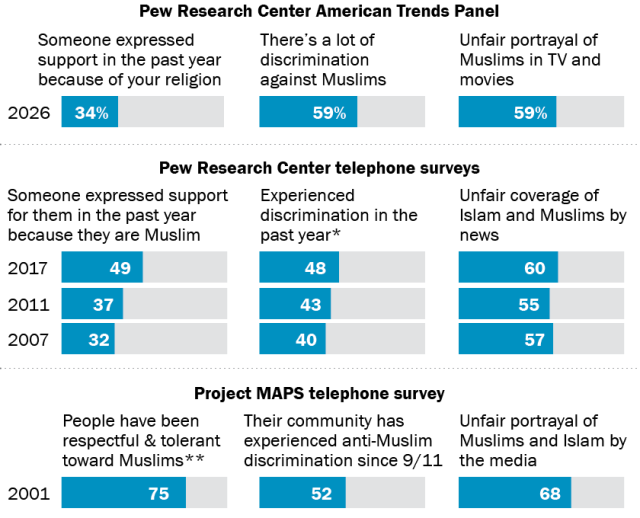
- 2011–2017: Controversies erupt nationwide concerning the construction of new mosques and Islamic cultural centers. During this window, Pew conducts deep-dive follow-up surveys in 2011 and 2017, uncovering persistent feelings of unfair media portrayal and experiences of localized discrimination, particularly among younger and U.S.-born Muslims.
- 2022: Dr. Mehmet Oz secures the Republican nomination for a U.S. Senate seat in Pennsylvania, marking the first time a major U.S. political party nominates a Muslim candidate for the upper chamber of Congress.
- 2025–2026: Political representation reaches new milestones. Four Muslim members serve in the U.S. Congress, with a fifth poised to join. In Michigan, voters select Abdul El-Sayed as a Democratic nominee for the U.S. Senate in 2026. In New York City, Zohran Mamdani is inaugurated as the city’s first Muslim mayor. Simultaneously, a spring 2026 Pew Research survey captures a snapshot of public perceptions a quarter-century after the tragedy that reshaped modern American security and sociology.
Supporting Data: Public Opinion and Demographics
Data accumulated through decades of sociological polling, federal crime tracking, and demographic analysis provides a granular window into the American Muslim experience.
Public Perception and Partisan Polarization
In the wake of 9/11, partisan differences regarding Islam were relatively narrow; Pew’s March 2002 polling showed that 32% of Republicans and Republican leaners, alongside 23% of Democrats and Democratic leaners, believed Islam encouraged violence. Over the next twenty-four years, however, this metric underwent profound polarization. By early 2026, 76% of Republicans and GOP leaners held the view that Islam encourages violence, compared with 29% of Democrats and Democratic leaners.
When asked in 2026 surveys to evaluate Muslims broadly, 42% of U.S. adults stated that Muslims have a negative impact on the nation, while only 17% reported a positive impact (with 40% expressing neutral or unsure viewpoints). Furthermore, 43% characterized Muslims as less patriotic than other Americans, while a slim majority of 51% felt they were neither more nor less patriotic.
The Trajectory of Hate Crimes
Federal Bureau of Investigation (FBI) Uniform Crime Reporting data highlights the persistent threat of bias-motivated incidents. Following the historic spike to 481 anti-Islamic incidents in 2001, reported hate crimes never returned to pre-9/11 baselines. Figures fluctuated through the years—recording a low of 95 incidents in 2021 and alternating highs such as 307 incidents in 2016 and 236 incidents in 2023, settling at 205 reported incidents by 2025. Criminologists note these figures capture only reported crimes from participating agencies, meaning the actual societal incidence of bias may be higher.
Within the Muslim American Community
Surveys of Muslim Americans themselves reveal a dual narrative of external hostility and internal perseverance:
- Discrimination vs. Support: In late 2001, 52% of surveyed Muslims reported community-level discrimination, yet 75% simultaneously felt that everyday Americans were respectful and tolerant. By 2026, 59% of U.S. Muslims stated there is "a lot" of discrimination against Muslims in the U.S., and an identical 59% pointed to unfair portrayals in television, movies, and news media. However, community resilience remains evident: 34% noted that someone had explicitly expressed support for them in the past year simply because they are Muslim.
- Generational and Nativity Divides: Studies show notable divergences within the Muslim community. U.S.-born Muslims and younger demographics (ages 18–40) report higher rates of experiencing discrimination in the past year compared to foreign-born and older counterparts. Scholars attribute this to younger, native-born generations possessing higher expectations for social equity and a more vocal, assertive stance on civil rights.
Official Responses and Political Rhetoric
Public discourse surrounding the Muslim American community remains sharply divided between institutional inclusion and marginalizing rhetoric.
On one hand, high-profile political figures have increasingly integrated into the highest echelons of American governance. Congressional representation has grown, culminating in multiple Muslim lawmakers serving in Washington. State and local milestones, such as Zohran Mamdani’s election and inauguration as New York City’s first Muslim mayor, signal a notable shift in civic integration and electoral potency in historically significant urban centers.
On the other hand, explicit political appeals to anti-Muslim sentiment persist within certain segments of the national political sphere. Rhetorical shifts have occasionally evolved from localized security concerns into broader civilizational or national security warnings. For example, prominent federal lawmakers have utilized public platforms to question the presence and loyalty of Muslims in public office, characterizing elected officials of the Islamic faith in adversarial terms. Civil rights organizations and interfaith coalitions continuously monitor and push back against such rhetoric, emphasizing that constitutional protections guarantee equal citizenship and freedom of worship for all Americans regardless of creed.
Implications for the Future
As the United States moves past the 25-year milestone of September 11, the socio-political trajectory of Muslim Americans holds profound implications for the nation’s democratic health and pluralistic identity.
- The Challenge of Civic Cohesion: The deep partisan divide over the perception of Islam suggests that religious tolerance remains a contested cultural battleground. Bridging the gap between the 76% of Republicans and 29% of Democrats who view Islam through a lens of suspicion will require sustained interfaith dialogue, education, and civic engagement.
- Generational Activism: The rising generation of young, native-born Muslim Americans is distinctly less willing to accept systemic marginalization quietly. Their growing presence in grassroots organizing, legal advocacy, and electoral politics indicates that the community will continue to demand equitable representation, fair media portrayals, and rigorous protection against hate-based violence.
- Institutional Normalization: With the mosque count approaching 2,800 nationwide and the total population reaching 5.5 million, Islam is permanently woven into the demographic and architectural landscape of the United States. As municipal and federal leaders with diverse backgrounds assume office, the baseline of American leadership is slowly expanding to reflect a multi-faith reality that transcends the historical trauma of 2001.
Ultimately, the portrait of Muslim Americans twenty-five years post-9/11 is one defined not solely by the shadows of tragedy, but by the tenacity of a community that has continually built institutions, claimed its civic rights, and contributed robustly to the pluralistic promise of the United States.