In a move that sends shockwaves through the media and technology sectors, Fox Corporation has officially confirmed its acquisition of Roku, the pioneering streaming platform, in a deal valued at approximately $22 billion. This transaction, which merges one of the world’s most recognizable legacy media conglomerates with the leading streaming aggregator in the United States, marks a pivotal shift in the ongoing "streaming wars." By integrating Roku’s expansive distribution ecosystem with Fox’s powerhouse news and sports programming, the deal signals a new era of consolidation where platform ownership becomes just as vital as content creation.
The Deal Mechanics and Financial Structure
The agreement, which has been the subject of intense industry speculation for months, is structured as a cash-and-stock transaction. Under the terms, Roku shareholders will receive $160 per share, comprised of 60% cash and 40% in Fox common stock. To facilitate the massive cash component of the acquisition, Fox has secured $12 billion in fully committed bridge financing from Morgan Stanley, signaling strong institutional confidence in the strategic viability of the merger.
Upon the anticipated closure of the deal in the first half of 2027, the ownership structure of the combined entity will see current Fox shareholders holding approximately 73% of the company, while former Roku shareholders will retain a 27% stake. The deal is projected to be accretive to free cash flow per share by the second full year of operations. Furthermore, Fox management anticipates realizing approximately $400 million in run-rate cost synergies, with significant potential for revenue growth through cross-platform advertising and data-driven targeting.
A Strategic Chronology: From Early Investor to Owner
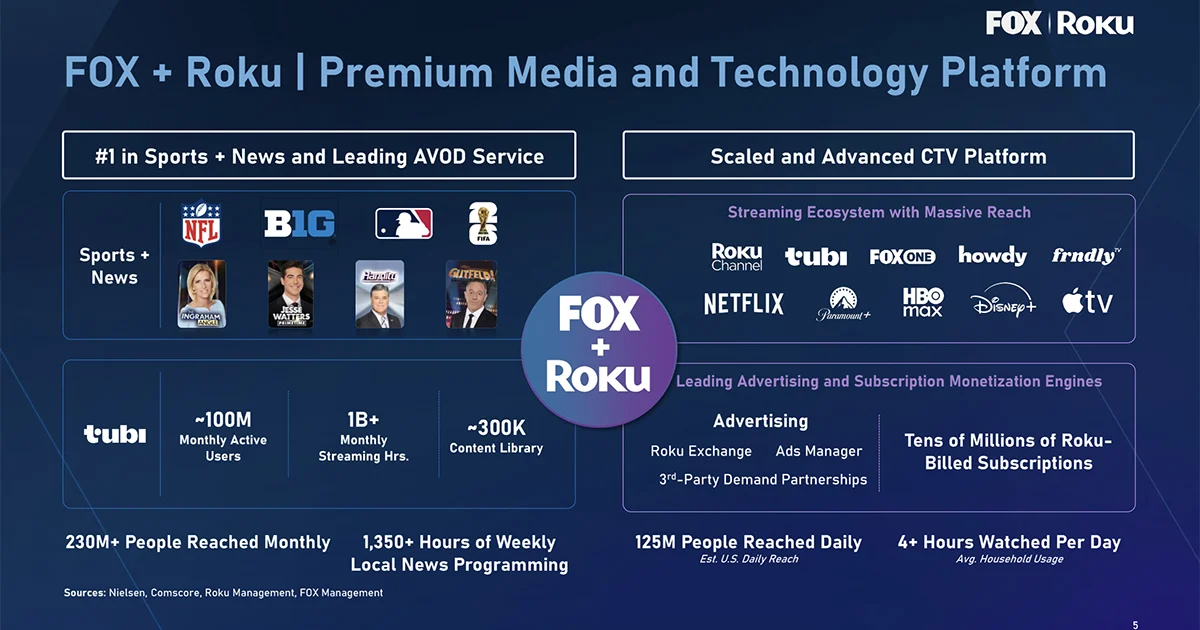
The relationship between Fox and Roku is not a new one. Fox was an early believer in the streaming platform’s potential, participating as a pre-IPO investor as far back as 2013. Over the last decade, the two companies have grown alongside one another, with Fox leveraging the Roku platform to distribute its diverse content portfolio, including Fox News, Fox Sports, and the ad-supported streaming service, Tubi.
The trajectory of Roku’s market valuation serves as a backdrop to this acquisition. During the pandemic-fueled streaming boom of 2021, Roku’s stock soared to an all-time high of $479.50. However, as the market recalibrated and subscriber growth slowed across the industry, Roku’s share price faced a precipitous decline, dropping to under $100 by 2022. Between April 2022 and late 2025, the stock struggled to regain its momentum, rarely sustaining peaks above the $100 threshold. For Fox, the current $22 billion valuation—representing 24x FY27E EBITDA—is seen as a strategic entry point to acquire a massive, engaged user base at a significant discount from its pandemic-era highs.
Decoding the Financials: Why Roku?
The financial rationale behind this acquisition lies deep within Roku’s pivot from a hardware manufacturer to an advertising and subscription powerhouse. During its Q1 earnings report, Roku provided a rare, granular look at its business health:
- Advertising Dominance: Roku reported advertising revenue of $613 million, a staggering 27% year-over-year increase.
- Subscription Growth: Subscription revenue reached $519 million, up 30% year-over-year.
- Platform Engagement: Total streaming hours on the platform grew by 8%, reaching 38.7 billion hours.
- Hardware Shift: Revenue from device sales dropped 16% to $118 million, now accounting for less than 10% of total revenue.
These figures illustrate that while the physical "Roku stick" remains a ubiquitous household item, the company’s true value is now its role as a digital storefront and advertising engine. With $2.38 billion in cash on hand and zero long-term debt at the time of the Q1 report, Roku is a clean, cash-flow-positive asset that offers Fox immediate scale in the lucrative Connected TV (CTV) advertising market.
Operational Implications: What Happens Next?
One of the most pressing questions for investors and consumers alike is whether the Roku interface will change. Fox has moved to assuage fears, stating that Roku will remain an "open platform." The company plans to continue supporting and promoting third-party content, maintaining the aggregation strategy that made Roku the preferred choice for cord-cutters.
Crucially, Fox intends to keep Tubi and The Roku Channel as separate entities for the time being. While there is a roughly 33% overlap in their respective audiences, both platforms possess unique brand identities and content libraries that Fox believes are better served by distinct management and programming strategies. By keeping these services separate, Fox aims to capture two different segments of the market: the broad-reach, fast-paced nature of Tubi’s library-driven model, and the specialized, feature-rich ecosystem of The Roku Channel.
Leadership and Future Governance
As part of the integration process, Anthony Wood, the founder, chairman, and CEO of Roku, will join the board of directors at Fox Corporation. Wood’s transition to the board is intended to ensure continuity and provide strategic guidance as the two corporate cultures merge. His presence on the board is a testament to the fact that Fox views Roku not merely as a portfolio acquisition, but as a technological foundation upon which they intend to build the next decade of media distribution.
The Broader Industry Implications
The Fox-Roku merger represents a seismic shift in how media companies approach the "middle-man" problem. For years, legacy media companies have been at the mercy of platforms like Roku, Amazon Fire TV, and Apple TV to reach their audiences. By acquiring Roku, Fox effectively removes the middle-man for its own content while simultaneously gaining the ability to collect first-party data on what millions of households are watching across every competing service.
This "vertical integration" is expected to trigger a defensive response from other major media conglomerates. Competitors who rely on Roku for distribution—including Disney, NBCUniversal, and Warner Bros. Discovery—must now navigate a landscape where their primary gateway to the consumer is owned by a direct competitor. This could lead to a fragmentation of the streaming interface market or, conversely, a new wave of acquisitions as other media giants seek their own proprietary hardware or platform solutions.
Furthermore, the advertising synergy is undeniable. Fox’s ability to pair its high-value sports and live news inventory with Roku’s precision-targeted ad platform creates a formidable competitor to the tech giants like Google and Amazon. By leveraging Roku’s data on viewer habits, Fox can offer advertisers a level of precision that traditional linear television has never been able to provide.
Conclusion
The acquisition of Roku by Fox Corporation is a high-stakes bet on the future of television. It acknowledges that in an era of fragmented media consumption, the platform that controls the "home screen" holds the keys to the kingdom. While the integration will undoubtedly face regulatory scrutiny and the complexities of blending two distinct corporate cultures, the deal provides Fox with the infrastructure to thrive in a digital-first world.
For the consumer, the immediate impact may be negligible as the "open platform" commitment remains in place. However, the long-term implications for the streaming industry are profound. As Fox integrates its vast content library with Roku’s sophisticated data and distribution capabilities, the line between content creator and platform provider will continue to blur. Whether this move secures Fox’s dominance or serves as a cautionary tale of media overreach, the $22 billion price tag cements this as one of the most significant transactions in the history of digital media. As the industry moves toward 2027, all eyes will be on how effectively these two giants can coalesce into a singular force capable of redefining the modern living room experience.