For sports media executives and streaming engineers, the Super Bowl represents the ultimate "stress test" of digital infrastructure. As Super Bowl LX took center stage, DAZN—the global sports streaming powerhouse—offered a masterclass in how to orchestrate a high-stakes, multi-territory broadcast. While domestic viewers in the United States were tethered to traditional broadcast or specific domestic streaming agreements, international NFL Game Pass subscribers enjoyed a sophisticated, low-latency, and high-fidelity feed for the modest price of £0.99.
This report examines the technical architecture, operational logistics, and the strategic distribution model that allowed DAZN to deliver the NFL’s crown jewel to over 200 territories simultaneously.
Main Facts: The Architecture of a Global Stream
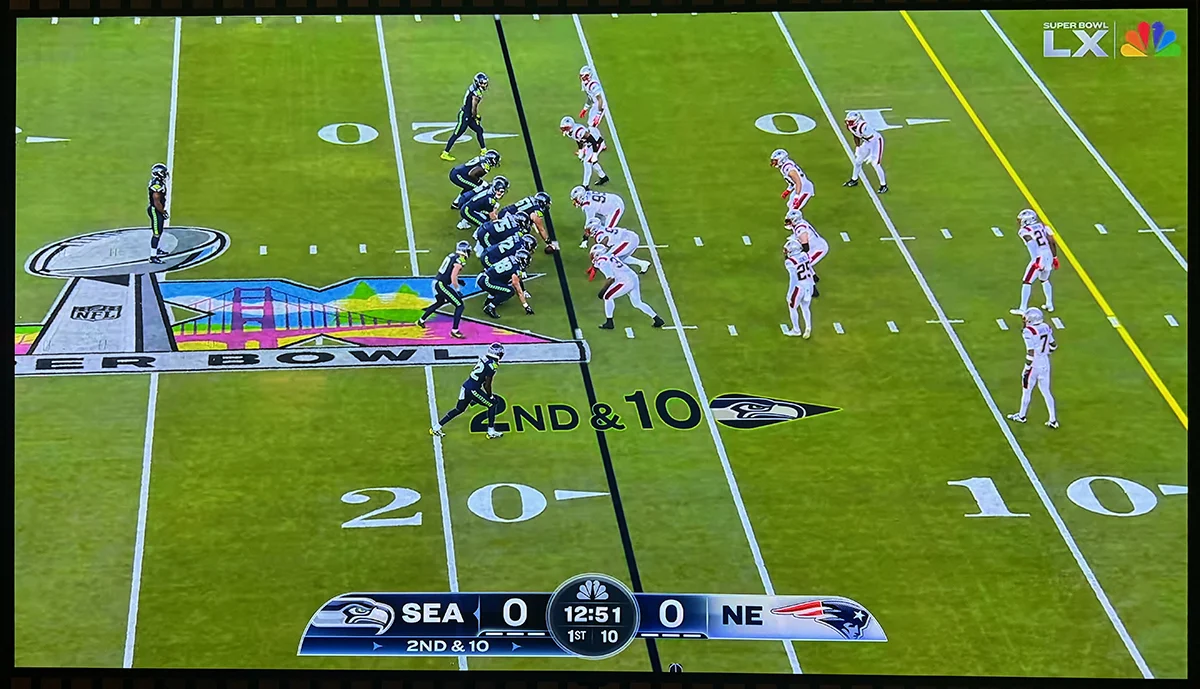
The technical quality of the Super Bowl LX stream was a focal point of industry observation. DAZN opted for a 1080p HDR output rather than an upscaled 4K signal, a strategic choice that prioritizes frame rate and bit-depth consistency over raw pixel count.
By ingesting NBC’s international feed—provided in 1080p at 59.94 fps HLG (Hybrid Log-Gamma) with 5.1 surround sound—DAZN ensured a broadcast-standard experience that avoids the common artifacts associated with excessive upscaling. The resulting stream provides a crisp, high-dynamic-range image that retains the fluid motion essential for fast-paced professional football.
The Technical Stack at a Glance
- Ingest Source: NBC International Feed (1080p/59.94 fps HLG/5.1).
- Production Playout: Amagi-powered graphics, dynamic ad insertion, and regionalized promos.
- OTT Encoding: Mediakind and M2A Media.
- HDR Standard: HDR10 (1080p/59.94 fps).
- Audio Configuration: Dolby 5.1 (HDR) and Stereo (SDR).
- CDN Strategy: Multi-CDN approach utilizing Akamai, CloudFront, and Fastly.
Chronology: From Atlanta to the Global Stage
The journey of the Super Bowl signal is a testament to modern media logistics. The process begins at the source, where NBC generates its international feed.
Phase 1: Ingest and Processing
The raw signal is routed through Encompass in Atlanta. This facility acts as the central hub, receiving the HDR 5.1 and SDR 5.1 versions of the pre-game, game, halftime, and post-game coverage. From here, the feed is transmitted to DAZN’s regional production facilities.
Phase 2: Regionalization and Localization
Localization is where DAZN’s global footprint becomes apparent. The feed is distributed to various regional facilities where commentary is overlaid in German, Spanish, Portuguese, Italian, French, and Japanese. This is not merely a voice-over; it is a full production effort that ensures local audiences receive culturally relevant context and expert commentary.
Phase 3: Playout and Ad Insertion
Using Amagi’s cloud-based playout platform, DAZN manages real-time graphics and promos. This is critical for Super Bowl broadcasts, where ad revenue is tied to specific, high-value slots. The ability to insert ads dynamically ensures that the stream remains personalized to the user’s location, maximizing the value of every commercial break.
Phase 4: Delivery
The final OTT stream is generated by M2A Media and Mediakind. The workflow splits into two primary tiers: a high-fidelity 1080p HDR10 feed with Dolby 5.1 audio, and a robust 1080p SDR feed with stereo audio, ensuring compatibility across a wide range of devices, from high-end smart TVs to mobile devices with limited bandwidth.
Supporting Data: Infrastructure and Monitoring
Delivering a stream to over 200 territories requires more than just bandwidth; it requires geographical redundancy. DAZN’s decision to utilize a multi-CDN strategy—Akamai, CloudFront, and Fastly—mitigates the risk of localized outages. By spreading the load across three of the world’s most robust content delivery networks, DAZN ensured that if one provider faced a regional bottleneck, traffic could be rerouted dynamically.
The "human element" of the monitoring was equally extensive. DAZN operated dedicated monitoring facilities in Leeds, Bangor, and Hyderabad. These teams conducted 24/7, end-to-end monitoring of the feed. By maintaining presence in different time zones, DAZN ensured that engineers were awake and active regardless of when the peak traffic hit their specific region.
Device Testing and Compatibility
To verify the performance, tests were conducted using the Swedish app version of DAZN within the United States. The experience was seamless, demonstrating that the backend logic effectively manages geo-fencing while maintaining high throughput. Whether viewed on a high-end console or a mobile tablet, the frame rate consistency remained the priority, resulting in a broadcast that felt "live" rather than "delayed."
Official Responses and Strategic Implications
While DAZN has remained tight-lipped regarding specific user-concurrency numbers for Super Bowl LX, the technical success of the stream signals a shift in the NFL’s international strategy.
The Shift to Direct-to-Consumer (DTC)
The NFL’s partnership with DAZN for the international Game Pass has effectively removed the middleman of traditional terrestrial broadcast rights in many countries. By controlling the feed from the ingest point all the way to the subscriber’s screen, the NFL and DAZN can gather granular data on viewer behavior, device usage, and ad engagement.
The "Price Point" Strategy
The £0.99 price point for the game—a promotional masterstroke—was clearly designed to maximize adoption of the DAZN app. By lowering the barrier to entry, DAZN has successfully converted casual NFL fans into registered users, populating their database with millions of new, active profiles.
Technical Implications for the Future
The decision to stick with 1080p HDR10 rather than pursuing an upscaled 4K stream is a significant indicator of industry maturity. Engineering teams have learned that a rock-solid 1080p stream at 60fps is vastly superior to an unstable 4K stream that suffers from buffering or macro-blocking. As the streaming industry looks toward the next decade, the focus is clearly moving away from "resolution wars" and toward frame rate stability, color accuracy (HDR), and low-latency delivery.
The Verdict: Quality Over Hype
The Super Bowl LX stream serves as a definitive case study in how to handle massive scale without sacrificing technical integrity. By focusing on the "plumbing"—the ingest, the localized playout, and the multi-CDN delivery—DAZN managed to make the viewing experience feel effortless for the end user.
For those of us testing the stream across various devices, the consistency was the most impressive takeaway. There were no noticeable sync issues between the audio and the video, and the HDR implementation felt intentional and refined, avoiding the "over-processed" look that often plagues live sports broadcasts.
As we look toward the future of sports streaming, DAZN’s performance with Super Bowl LX suggests that the era of "buffer-free" global sports is finally here. By integrating world-class partners like Amagi, Mediakind, and M2A Media, and by maintaining a rigorous monitoring presence, DAZN has set a new benchmark for how international rights holders should approach the world’s biggest game.
Final Thoughts on Viewer Experience
It is important to note that the quality of any stream is ultimately filtered through the viewer’s own hardware. While the source signal was pristine, the experience on a modern, high-bitrate-capable device remains significantly better than on legacy hardware. However, DAZN’s encoding profile was clearly tuned to provide a "good enough" experience for the majority of the market, ensuring that even users on less-than-optimal connections could enjoy the spectacle without constant interruption.
In conclusion, Super Bowl LX was a victory not just for the winning team on the field, but for the engineering teams in Leeds, Bangor, Hyderabad, and Atlanta. They proved that with the right architecture, a global audience of millions can experience the same quality of broadcast simultaneously, setting the stage for even more ambitious digital sports delivery in the years to come.
Disclaimer: The testing conducted for this report utilized a standard account provided by DAZN to ensure the accuracy of the stream analysis. Observations regarding image quality are based on professional evaluation and may vary based on end-user hardware and ISP performance.