By Investigative Staff
October 26, 2026
In an era defined by aggressive immigration enforcement and a highly polarized political landscape, the U.S. Immigration and Customs Enforcement (ICE) agency has found itself at the center of a deepening national divide. A new comprehensive survey from the Pew Research Center, conducted between September 28 and October 4, 2026, reveals that public sentiment toward the agency has reached a new low. With the Trump administration’s second term firmly committed to a sweeping deportation agenda, the agency’s standing among the American public is increasingly tenuous, reflecting broader societal fractures over the rule of law, national security, and human rights.
The Current Climate: A Deepening Chasm
According to the survey of 5,062 U.S. adults, a clear majority of Americans (56%) now view ICE with disfavor. This figure represents a notable uptick in negative sentiment compared to the previous year, during which 49% of respondents expressed unfavorable views. In contrast, only 35% of the public currently holds a favorable view of the agency, while 9% remain undecided.
When compared against 12 other major federal departments and agencies, ICE consistently ranks as the least favorably viewed, illustrating the intense scrutiny the agency has faced since it became the primary instrument of the White House’s promise to execute what the administration characterizes as a necessary response to an "invasion" of criminals.

Chronology of Escalation: From Policy to Polarization
The trajectory of public opinion regarding ICE has been inextricably linked to the policy shifts within the executive branch.
- 2025: The Baseline of Concern: At the end of 2025, the agency was already struggling with public perception, with 49% of the public expressing unfavorable views. Even then, the partisan divide was evident, though not as severe as it would become.
- Early 2026: The Rhetorical Shift: As the Trump administration ramped up its rhetoric regarding the "invasion" of undocumented immigrants, the administration signaled a massive, systematic expansion of detention and deportation operations.
- March 2026: Visible Enforcement: High-profile operations in major urban centers, including the New York Federal Plaza Immigration Court, brought federal agents into public view, sparking debates on civil liberties and the reach of federal power.
- Late 2026: The Current Snapshot: The latest data reflects the cumulative impact of these intensified enforcement operations. Both major parties have seen a shift toward more negative views, suggesting that even among those who support stricter border controls, the optics and methods of the current administration’s enforcement strategies are generating significant discomfort.
Supporting Data: A Breakdown by Demographic and Party
The data suggests that the "ICE question" is no longer just a matter of immigration policy, but a core component of American identity politics.
Partisan Divergence
The partisan gap remains wide, yet the trend lines are moving in a negative direction for the agency across the board.
- Republicans and Republican-leaners: Support for ICE remains the highest in this group, yet it has dipped from 72% a year ago to 67% today. This 5-point decline indicates that even within the agency’s core base of support, there is a cooling of enthusiasm.
- Democrats and Democratic-leaners: The opposition is near-total and growing. Currently, 84% of Democrats hold an unfavorable opinion of ICE, an increase from 78% in 2025. This underscores the extent to which the agency has become a symbol of the administration’s policies that the Democratic base strongly rejects.
Racial and Ethnic Perspectives
The survey highlights a profound divide across racial and ethnic lines, with minority communities expressing the highest levels of skepticism and distrust toward the agency.

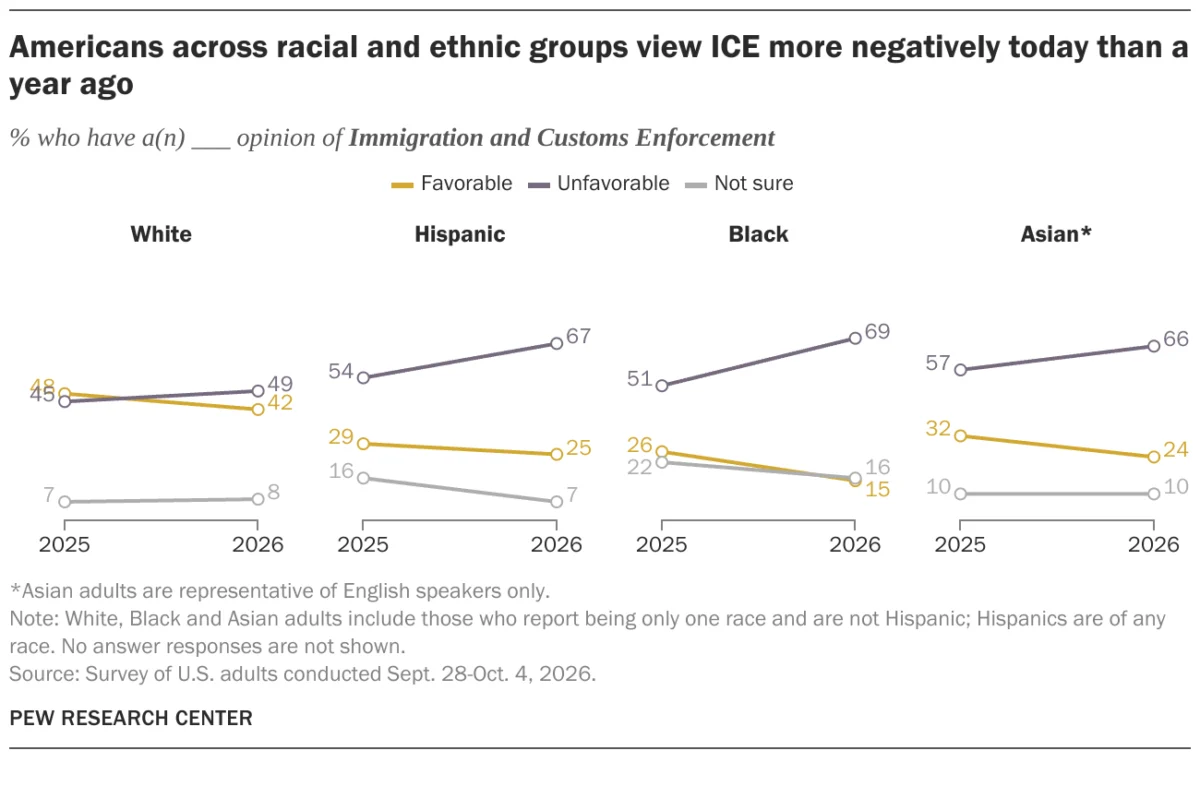
- Black, Hispanic, and Asian Adults: Majorities of these groups view the agency negatively, with 69% of Black adults, 67% of Hispanic adults, and 66% of Asian adults expressing an unfavorable opinion. In each of these demographics, the shift toward negativity has been substantial over the past 12 months.
- White Adults: While White adults remain the demographic most likely to hold a favorable view of the agency, the trend is shifting here as well. Currently, 49% of White adults express an unfavorable view, up from 45% in 2025.
Perhaps most striking is the intra-party data. Among Republicans, while White voters largely support the agency (71% favorability), Hispanic Republicans show a much more moderate, and sometimes skeptical, view, with only 53% expressing favorability and 39% holding an unfavorable view. Among Democrats, the consensus is nearly universal, with 89% of White Democrats and 79% of Hispanic Democrats viewing the agency negatively.
Official Responses and Administrative Strategy
The Trump administration has consistently framed these enforcement efforts as a matter of national survival. Administration spokespersons have argued that the data regarding "unfavorable" views is merely a byproduct of a media campaign designed to undermine law enforcement.
"ICE is the tip of the spear in our mission to restore sovereignty to the American border," a White House official stated during a press briefing earlier this month. "While the administration recognizes that enforcement is often difficult to watch, the primary responsibility of this agency is to remove those who have entered our country illegally and threaten our communities. We are not in the business of popularity contests; we are in the business of public safety."
Conversely, civil rights groups have pointed to these poll numbers as evidence of a "growing moral crisis." Representatives from the American Civil Liberties Union and other advocacy organizations argue that the negative shift in public opinion is a direct reflection of the public’s rejection of mass detention, family separation, and the militarization of immigration enforcement.

The Broader Implications: A Nation Divided
The implications of these findings are profound. If the primary federal agency responsible for immigration enforcement is viewed with hostility by the majority of the population, the efficacy of its operations may be compromised.
1. Challenges to Operational Legitimacy
When a law enforcement agency loses the trust of the communities it operates within, cooperation declines. Local jurisdictions that are already hesitant to assist federal immigration efforts may further distance themselves, potentially leading to a constitutional stalemate between state and federal authorities.
2. The Midterm Election Landscape
With the 2026 midterms looming, the status of ICE and the administration’s deportation agenda are set to be central campaign issues. The survey data suggests that the administration’s hardline stance may be mobilizing its base, but it is simultaneously alienating a growing segment of the independent and suburban electorate, particularly among white voters who were previously neutral or supportive of the agency.
3. Long-term Social Cohesion
The intensity of the "unfavorable" ratings—particularly the 84% disapproval among Democrats—signals that the debate over immigration is no longer just about policy preferences; it has become a fundamental test of how Americans view the role of the state in their daily lives. The agency, which was created in the post-9/11 era to consolidate national security, has now become a polarizing figurehead that arguably divides the country as much as it protects it.

Conclusion: A Turning Point
The 2026 survey results serve as a definitive marker of the current administration’s impact on the public consciousness. While the administration maintains that its enforcement-first strategy is necessary to address the "invasion" of criminals, the public is increasingly signaling that the costs—both social and moral—are becoming too high.
As the agency continues its work, the challenge for the administration will be to determine whether it can maintain its aggressive stance while addressing a public that is, by an increasing margin, turning its back on the institution tasked with implementing it. Whether this data leads to a recalibration of policy or a doubling-down of the current approach remains one of the most significant questions facing the nation as we head into the final months of the year.
For further analysis of the methodology and raw data regarding this study, including the full questionnaire and detailed topline results, readers are encouraged to visit the Pew Research Center’s official archives and the 2026 midterm methodology report.