A groundbreaking new report from the Pew-Knight Initiative has unveiled a complex map of how Americans participate in public life—and how that participation fundamentally dictates what they know about the machinery of their own government. By categorizing the U.S. adult population into four distinct "engagement groups," researchers have uncovered a stark correlation: the more active an individual is in their community, news consumption, and religious life, the more informed they are about basic political realities.
The study, which synthesizes data from comprehensive national surveys conducted in late 2025, moves beyond traditional demographic analysis to examine how behavioral patterns cluster together. The results suggest that "civic health" is not just about voting; it is a holistic lifestyle that influences one’s grasp of factual political information.

The Four Pillars of Civic Engagement
To understand the landscape of American public life, the Pew-Knight Initiative utilized a cluster analysis based on 19 specific measures of participation. These measures spanned political activity, community involvement, religious attendance, and frequency of news consumption. This data-driven approach led to the identification of four distinct segments of the American public:
- Mobilizers: The most active participants across every measured domain. They are highly engaged in politics, community life, news, and religion. While they represent the smallest segment of the population, they serve as the engine of public discourse.
- Connectors: Highly involved in social and civic life—joining groups and making charitable donations—but they maintain a lower profile in direct political activities compared to the Mobilizers.
- Spectators: This group is defined by its consumption habits. They follow the news at high rates but are significantly less likely to participate directly in the democratic process or community service.
- Outsiders: The least engaged group across all metrics. They report lower levels of voting, volunteering, and news consumption, and they exhibit the lowest levels of political knowledge.
Chronology and Context: The 2024–2025 Political Cycle
The research is particularly salient because it captures American behavior during a pivotal period. The survey questions regarding engagement focused on the 12 months preceding the study, a window that encompassed the 2024 presidential election.

While political participation often spikes during an election year, the researchers note that the "engagement groups" identified in this study provide a stable baseline for understanding public behavior. The data, collected through the Cross-Sectional Engagement Survey and the American Trends Panel, offers a rare, granular look at how the post-election landscape has settled. By comparing these behaviors, the report provides a snapshot of a nation that is deeply divided not just by ideology, but by the very extent to which its citizens participate in the public square.
Supporting Data: Knowledge Gaps and the "Not Sure" Factor
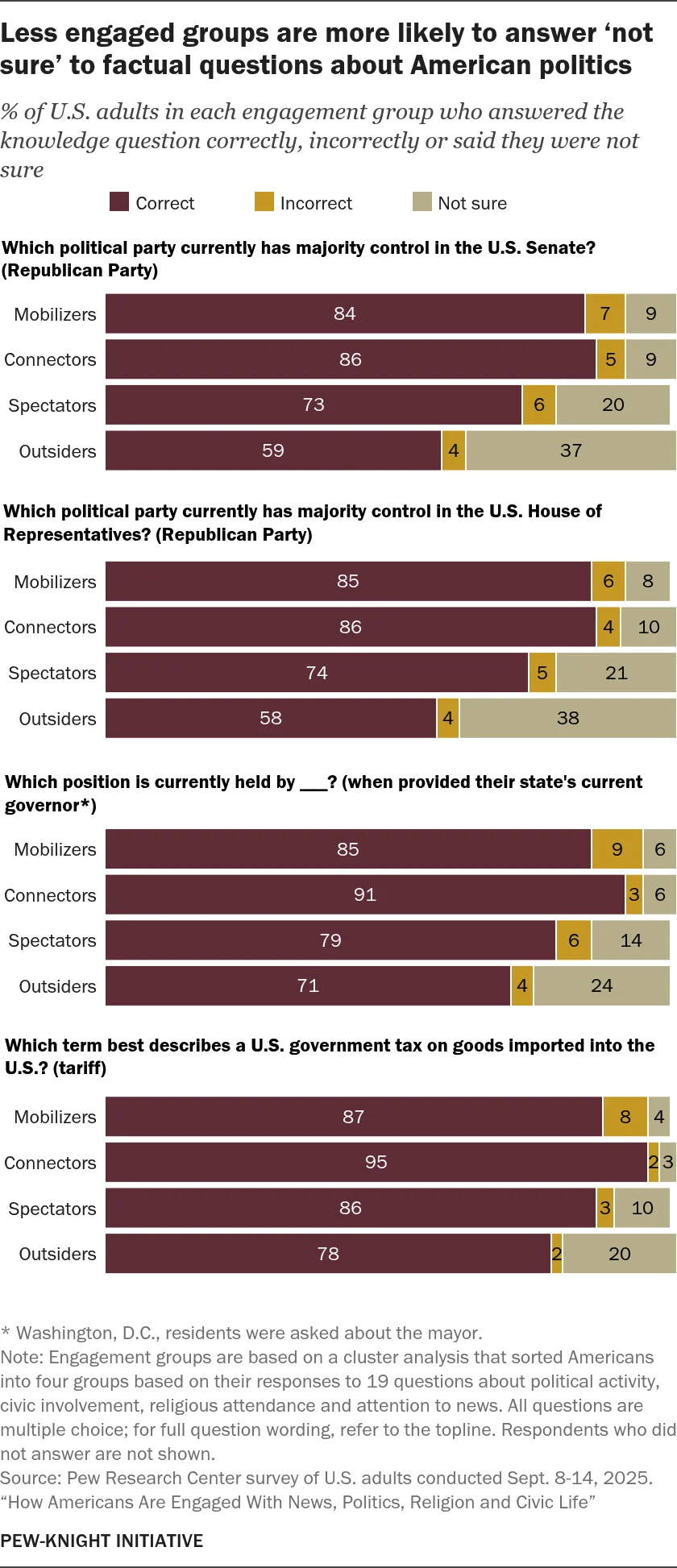
A central finding of the research is that while most Americans correctly identify basic political facts, the "Outsiders" group consistently lags behind. The survey tested respondents on four factual questions:

- Which party controls the U.S. Senate?
- Which party controls the U.S. House of Representatives?
- The identity of their state’s governor.
- The definition of a "tariff" as a tax on imports.
Across the board, approximately 73% of adults correctly identified the party in control of the House and Senate. However, when performance was broken down by engagement group, the divide became clear. For example, while 84% of Mobilizers correctly identified the Senate majority, only 59% of Outsiders could do the same.
Crucially, the research identifies that this knowledge gap is driven primarily by uncertainty, not misinformation. Across all groups, very few people (no more than 10%) selected an incorrect answer. Instead, the less engaged groups were significantly more likely to admit they were "not sure." Half of all Outsiders (50%) answered "not sure" to at least one of the four questions, whereas only 15% of Mobilizers opted for that response.

Demographic Intersections: Age and Education
The report emphasizes that engagement is not occurring in a vacuum. It is deeply intertwined with two demographic stalwarts: education and age.
The Education Gradient
Higher levels of formal education remain a powerful predictor of political knowledge. The study found that across every engagement group, those with a college degree were more likely to answer all four questions correctly. For instance, among the "Spectator" group, 67% of college graduates provided correct answers to all four questions, compared to just 46% of those with a high school diploma or less.
The Age Divide
Age serves as an equally significant separator. In every category, older Americans demonstrated higher levels of political knowledge than their younger counterparts. The gap is particularly striking among the most active group, the Mobilizers: 83% of those aged 50 and older answered all four questions correctly, compared to only 49% of Mobilizers under the age of 30. This suggests that political knowledge accumulates over time, likely reinforced by the sustained habits of news consumption and civic participation that come with age.
The Gender Gap in Political Confidence
One of the more nuanced findings of the study involves the gender gap. Research has long shown that men are more likely to guess when faced with political trivia, whereas women are more likely to express uncertainty. This study confirms that pattern holds true among less-engaged populations.

Among "Outsiders," 59% of women reported being "not sure" on at least one question, compared to 38% of men. However, this gap vanishes among the most active citizens. Among "Mobilizers," the gender difference in "not sure" responses is statistically negligible (15% for women versus 13% for men). This suggests that high levels of engagement effectively close the gender-based confidence gap, as both men and women who are fully integrated into public life gain the necessary information to feel certain in their knowledge.
Implications: A Call for Civic Literacy
The implications of this research are profound for the health of American democracy. If political knowledge is a prerequisite for effective citizenship, the fact that a significant portion of the population is effectively "outsourced" from the information stream is a cause for concern.

The Role of "Outsiders"
The existence of the "Outsiders" group—individuals who are not just politically inactive but also less informed—suggests that efforts to increase voter turnout may face hurdles if they do not also address the underlying lack of engagement with the news and community life. Simply encouraging people to vote without fostering a deeper habit of following current events may not produce a more informed electorate.
Integrating the "Connectors"
The study offers a sliver of optimism in the "Connectors" group. These individuals are already highly engaged in their communities and charitable activities. They possess the social infrastructure to become more politically informed if the right bridges are built. By connecting community-based activities to broader political discussions, there is a potential to move a large portion of the public into a more informed tier of engagement.

Policy and Institutional Responses
The Pew-Knight Initiative’s methodology serves as a reminder that surveys must be designed to reach those who are least likely to participate. The researchers went to great lengths to include online, paper, and telephone respondents to ensure that "Outsiders" were not missing from the final data set.
As the nation looks toward future election cycles, the findings underscore that there is no "one-size-fits-all" solution to civic apathy. Promoting political knowledge requires a dual approach: it must be taught through formal education, but it must also be cultivated through the encouragement of everyday civic behaviors—from attending local meetings to staying current with the news.
Ultimately, the data suggests that in the United States, knowledge is the byproduct of participation. Those who participate in the life of their community and the discourse of the nation are the ones who understand it best. The challenge for the coming years, therefore, is to find ways to bring more Americans into the fold, transforming the "Outsiders" and "Spectators" into "Connectors" and "Mobilizers." Only then can the country ensure that its electorate is as informed as it is active.