The promise of the streaming revolution was simple: decouple content from the bloated, contract-heavy shackles of traditional cable and deliver a leaner, more affordable alternative. For a few years, it worked. But as the industry has matured, the lines between "new media" and "old cable" have blurred to the point of invisibility. This week, the industry reached a psychological—and financial—tipping point as Disney announced another price hike for Hulu + Live TV, pushing the service into triple-digit monthly territory.
For many, the $100-a-month threshold isn’t just a number; it is a symbol of the death of the cord-cutting dream. As the costs of live linear streaming services climb, consumers are left asking a fundamental question: If the price is the same as cable, why deal with the buffering?
Main Facts: The New Financial Reality
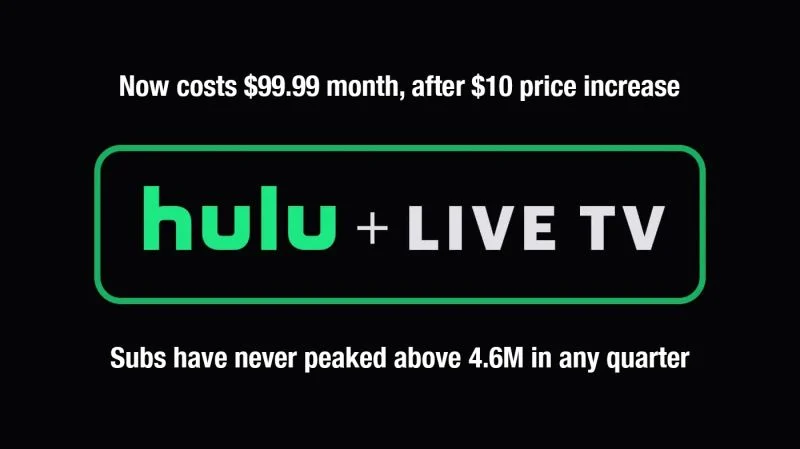
The latest round of price adjustments from Disney has sent shockwaves through the streaming subscriber base. Hulu + Live TV, which provides a bridge between on-demand streaming and traditional linear broadcast, has seen its monthly subscription fee rise by $10. The standard tier now costs $100 per month, while the premium tier—Hulu + Live TV (No Ads)—has climbed to $109.99 per month.
This move effectively places Hulu among the most expensive streaming options on the market. For the average household, this creates a significant budgetary challenge. When these services first hit the market, they were pitched as a "skinny bundle"—a curated selection of channels that cut out the filler of cable. Today, the "skinny" has vanished, replaced by the same bloated economics that streaming was originally designed to disrupt.
A Chronological Descent: From $40 to $100
To understand the frustration of the consumer, one must look at the trajectory of these costs over the last decade.
- May 2017: Hulu + Live TV makes its debut with a starting price of $40 per month. At the time, it was hailed as a revolutionary product that offered the flexibility of no long-term contracts and a user-friendly interface.
- 2017–2020: The service experiences steady growth as cord-cutting becomes a mainstream trend. Prices see modest, incremental increases, but remain well below the cost of traditional satellite or cable packages.
- 2021: Disney reports a subscriber count of 4 million for its live streaming service. However, this is the period where the growth rate begins to plateau significantly.
- 2021–2024: Despite a massive content library and the integration of Disney+ and ESPN+, the service struggles to attract new users. Growth is stagnant, with the subscriber base failing to ever crest the 4.6 million mark in any given quarter.
- 2025 (Fiscal Q4): Subscriber numbers sit at approximately 4.4 million—a negligible increase over four years, despite the massive expansion of the streaming ecosystem.
- Late 2025: Disney implements the latest $10 hike, pushing the base price to the $100 barrier, signaling a potential shift in corporate strategy regarding the viability of linear live streaming within the Hulu ecosystem.
Supporting Data: Stagnation in a Growth Market
The data regarding Hulu + Live TV’s performance is telling. In an era where streaming platforms like Netflix and Disney+ have seen tens of millions of new sign-ups, the live linear product has been effectively dead in the water.
When analyzing the performance metrics, the "stagnation gap" becomes clear. Between Q1 2021 and Q4 2025, Hulu + Live TV added only 400,000 subscribers. In a market that was supposed to be the primary destination for the millions of people abandoning cable, this growth rate is anemic.
Furthermore, the price-to-value proposition has shifted. When the service cost $40, it was an easy "yes" for a household looking to save money. At $100, the cost-benefit analysis changes entirely. Many traditional cable bundles, when bundled with internet services or promotional pricing, are now effectively cheaper or equal in cost to the $100 Hulu offering. This effectively erases the "cord-cutting discount" that served as the primary incentive for the industry’s birth.
Official Responses and Strategic Silencing
One of the most notable changes in recent reporting is the shift in how Disney discloses its subscriber data. For years, the company provided a clear breakdown of Hulu + Live TV subs. Recently, that transparency has vanished. Disney has stopped separating these figures, choosing instead to aggregate them with other metrics.
This lack of granular reporting is a classic corporate tactic used when a product line is underperforming or being positioned for a sunset phase. When asked about the future of the product, Disney executives have remained tight-lipped, pivoting instead to the "total ecosystem value" of the Disney Bundle, which includes Disney+, Hulu, and ESPN+.
The silence speaks volumes. By burying the live linear numbers, Disney is shielding the service from the scrutiny of Wall Street analysts who are increasingly skeptical of the long-term viability of linear streaming.
Implications: The Potential "Fubo-fication" of the Market
The most significant implication of the $100 price point is the suspicion that Disney is preparing to exit the live linear streaming space entirely.
Industry analysts have pointed to a curious development: the appointment of Alisa Bowen, the former President of Disney+, as the new CEO of Fubo. Fubo is a competitor that specializes in live sports and linear broadcasting. The industry is rife with speculation that Disney may be orchestrating a strategic wind-down of its own live TV product.
If Disney were to phase out Hulu + Live TV, it would likely steer its existing user base toward a partnership or a merger with Fubo. This would allow Disney to offload the high-maintenance, low-margin business of operating a live TV service while focusing its internal resources on its core strength: on-demand content and intellectual property.
For the consumer, the implications are profound. If the industry consolidates into a single platform for live linear streaming, competition will drop, and prices will likely stay at or above the $100 mark. The era of the "bargain" stream is over. We have entered the era of "re-bundling," where streaming services are beginning to look, feel, and cost exactly like the cable providers they were meant to replace.
Conclusion: The New Cable
As we look toward the future of home entertainment, it is clear that the "skinny bundle" was a fleeting experiment rather than a permanent replacement for traditional television. The $100 price tag on Hulu + Live TV serves as a stark reminder of the realities of content licensing and the high cost of broadcast sports.
For the millions of subscribers still clinging to their live TV apps, the decision to keep the service is no longer about saving money. It is about convenience. However, as costs continue to rise, that convenience will eventually be weighed against the reality that, for the price of a standard modern streaming setup, one could arguably secure a more robust traditional cable package.
The dream of cheap, flexible television hasn’t just been put on hold—it has been priced out of existence. Consumers now find themselves back where they started: paying a premium for a bundle of channels they may or may not watch, delivered through a platform that is increasingly indistinguishable from the giants of the past. The question remains: how much longer will the audience pay for the privilege?