In an era defined by rapid technological shifts, intense political polarization, and the lingering social ripples of a global pandemic, the question of how—and to what extent—Americans participate in their communities has become more critical than ever. A groundbreaking study released by the Pew Research Center, as part of the Pew-Knight Initiative, suggests that the traditional narrative of a binary "engaged vs. disengaged" citizenry is fundamentally outdated. Instead, the American public operates across a nuanced landscape of four distinct engagement groups, each defined by unique patterns of political, civic, religious, and news-related behavior.
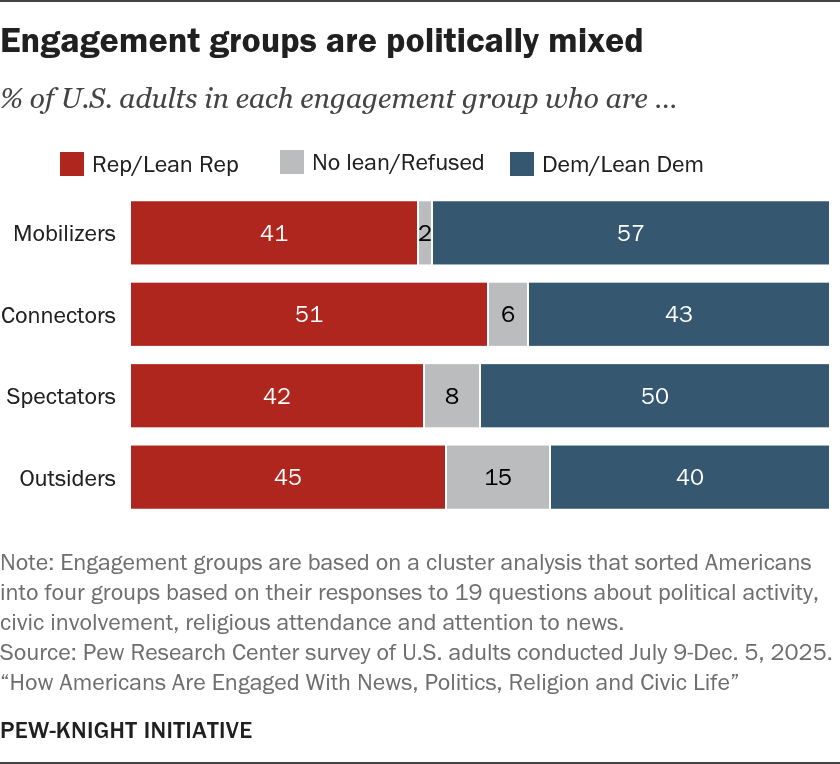
The study, which analyzed data from over 5,000 U.S. adults, reveals that these groups are not strictly aligned with political party lines. Rather, they represent diverse approaches to public life, reflecting different socioeconomic realities, generational perspectives, and priorities.

The Four Engagement Groups: A Taxonomy of Participation
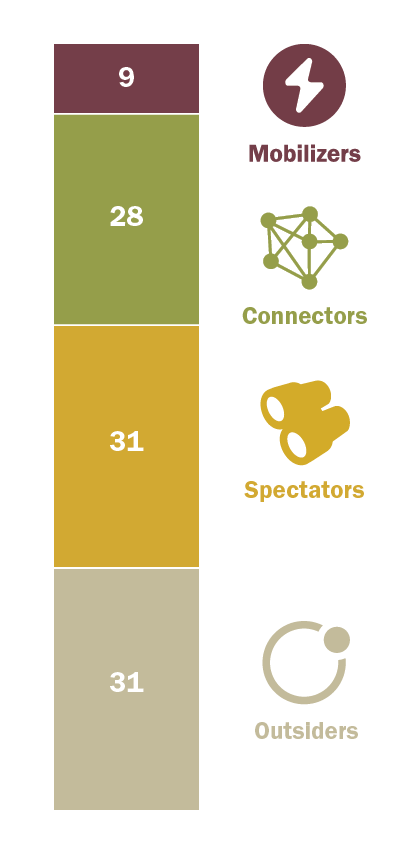
To move beyond simplified metrics, researchers conducted a cluster analysis based on 19 distinct measures of activity. The resulting typology sorts the U.S. adult population into four segments: Mobilizers, Connectors, Spectators, and Outsiders.
- Mobilizers (9%): These are the hyper-active participants of the American experience. They are highly engaged across all categories, including politics, civic organizations, and religious life.
- Connectors (28%): Centered on community, these individuals are deeply involved in social and religious organizations and demonstrate high levels of news consumption, yet they remain largely on the periphery of intense political activism.
- Spectators (31%): This group functions as the "audience" of public life. They follow the news with great interest and remain informed, but they largely opt out of the labor-intensive work of civic and political participation.
- Outsiders (31%): Comprising the least engaged segment of the population, this group reports low participation across nearly all measured activities, including voting, volunteering, and news consumption.
Chronology and Methodology: Capturing a Dynamic Landscape
The data, collected between July and December 2025, provides a snapshot of American life in the immediate aftermath of the 2024 presidential election. Recognizing that standard polling often misses those who are less integrated into public life, researchers employed a rigorous, multi-modal methodology. The primary data source, the Cross-Sectional Engagement Survey, utilized online, paper, and telephone formats, with intensive follow-up protocols to reach non-responders.
By supplementing this with the American Trends Panel (ATP), researchers were able to map these behavioral clusters against attitudes regarding civic knowledge and news trust. The timing of the study is significant; by capturing data in the year following a major national election, researchers were able to assess how political activity acts as a "gateway" or a "barrier" to other forms of participation.
Supporting Data: Understanding the Differences
The data reveals sharp contrasts in the socioeconomic makeup and behavioral patterns of these groups.
The Mobilizers: Intensity and Influence
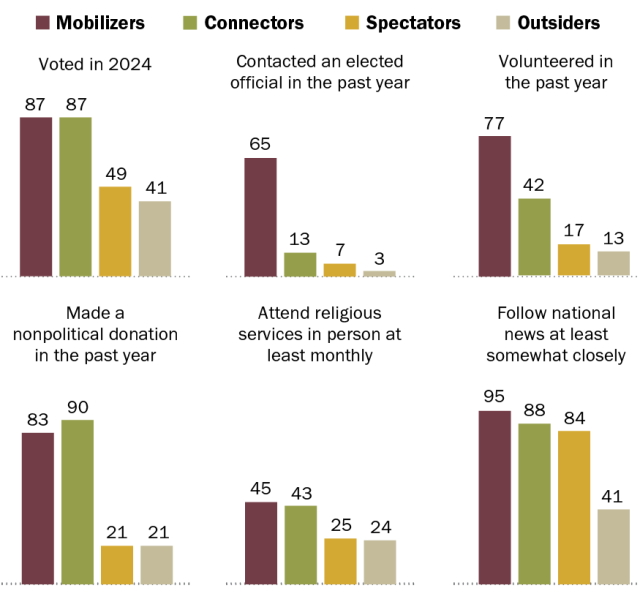
Mobilizers are the most distinct group, characterized by high levels of education and income. Nearly half (47%) report an annual income of over $100,000, and 53% are college-educated. Their political activity is high-octane: 74% have displayed a campaign sign or worn political gear, and 65% have contacted an elected official. While they lean Democratic (57% vs. 41% Republican), their defining trait is ideological intensity. Whether conservative or liberal, they are more likely to hold "very" ideological views than members of other groups.
The Connectors: The Bedrock of Community
Connectors, representing nearly three-in-ten Americans, are the backbone of local civil society. While they vote and follow the news at rates similar to Mobilizers, their focus is local and charitable. A staggering 90% have made a non-political donation in the past year, and 65% are active members of an organization. Demographically, they are older, predominantly White, and demonstrate high levels of religious participation, with 43% attending services at least monthly.
The Spectators: The Digital Observers
Spectators are the youngest group in the analysis, with 64% under the age of 50. Their engagement is almost entirely digital. They represent a paradox: they are highly informed—84% follow national news closely—but they participate in the "soft" side of engagement. They like, save, or chat about news daily, but they do not translate this knowledge into traditional civic action like volunteering or attending school board meetings.
The Outsiders: Barriers to Entry
The "Outsiders" group poses a significant challenge for researchers and policymakers. With 48% holding a high school diploma or less, and 31% earning under $30,000 annually, this group faces systemic barriers to engagement. While they are not necessarily disaffected—many express a belief in God and a sense of belonging—they are simply not plugged into the infrastructure of civic life. Only 13% have volunteered in the past year, and their news consumption is remarkably low compared to the other three groups.
Official Perspectives: The "Why" Behind the Study
The Pew-Knight Initiative was born from a recognition that broad, sweeping claims about "civic decline" often obscure more than they reveal. "Participation in public life is not one-dimensional," the report notes. The initiative aims to provide an integrated picture of how Americans balance their identities as news consumers, citizens, and community members.
The study also addresses the "Why now?" question. With the rise of AI, the decline of traditional local media, and the lingering effects of the pandemic on face-to-face social interaction, the ways in which individuals form beliefs and identities have fundamentally changed. By segmenting the public, the initiative hopes to offer a more accurate map for those trying to strengthen American democracy.

Implications for the Future of Civic Engagement
The findings suggest that strategies to "boost engagement" must be tailored to the specific profiles of these groups.
For Spectators, the challenge is not one of interest, but of activation. They are already informed; the question is how to bridge the gap between "following the news" and "contributing to the community." Their digital-first behavior suggests that online platforms could be more effectively utilized to facilitate low-friction civic participation.

For Outsiders, the implications are more sobering. The data suggests that low engagement is tied closely to socioeconomic status. If 31% of the population remains disconnected from the mechanisms of civic influence, the result is a democratic deficit where the needs and perspectives of lower-income, less-educated citizens remain underrepresented in the public discourse.
Furthermore, the finding that political polarization does not dominate all engagement groups is a rare hopeful note. While political parties draw clear lines, the existence of a large group of "Connectors" who focus on community life over political ideology suggests that there is still a reservoir of common ground in American life—provided that the mechanisms for participation move beyond national politics and toward the local, tangible issues that matter in daily life.
In conclusion, this research highlights that the American public is not a monolith. While the "Mobilizers" lead the charge, the "Connectors" sustain the social fabric, the "Spectators" maintain an informed awareness, and the "Outsiders" represent an untapped, albeit marginalized, segment of the population. Understanding these four groups is the first step toward a more representative and resilient democracy. As technology continues to evolve the ways we interact, the ability to tailor civic participation to these distinct archetypes will be essential for the health of the American republic.