As the world stands on the precipice of a new technological era, the competitive landscape of artificial intelligence has moved from the realm of abstract scientific pursuit to the center of global geopolitics. A new, comprehensive survey from the Pew Research Center, conducted in June 2026, reveals a stark reality: the American public views the United States as an underdog in the race for AI dominance, trailing behind its primary geopolitical rival, China.
The findings, based on responses from 3,488 U.S. adults, provide a detailed snapshot of a nation wrestling with the implications of an AI-driven future. While the technological race is being fought in laboratories and server farms, the battle for public perception is being played out in households across America, where uncertainty remains the prevailing sentiment.
The Perception Gap: China’s Perceived Lead
The most striking revelation of the study is the lopsided view regarding global AI leadership. By a three-to-one margin, Americans are more likely to name China as the more advanced nation in artificial intelligence development. Specifically, 36% of respondents believe China currently holds the lead, while only 12% grant that distinction to the United States.
Equally significant is the "uncertainty factor." A full 33% of Americans admit they are unsure which country is currently ahead. This high degree of public ambivalence suggests that despite the ubiquity of AI in the news cycle, the average citizen struggles to quantify the relative progress of these two superpowers. Only 18% of those surveyed believe the two nations are currently neck-and-neck in their development trajectories.

Demographic Disparities in Perception
The data reveals clear demographic fault lines. Women are notably more likely than men to perceive China as the leader (41% vs. 31%) and are also more likely to express uncertainty (37% vs. 29%). Furthermore, political affiliation appears to color these perceptions: 43% of Democrats or those leaning Democratic believe China is more advanced, compared to 30% of Republicans.
Usage patterns of modern AI tools also correlate with these views. Those who regularly interact with AI chatbots are more inclined to believe the U.S. is leading (16%) compared to those who do not use such tools (9%). However, the perception of Chinese advancement remains high across both groups, suggesting that personal exposure to the technology does little to mitigate the public’s impression of American lag.
A Chronology of the AI Arms Race
To understand the current public sentiment, one must look at the rapid escalation of the "AI arms race" over the past few years:
- 2023-2024: The widespread public release of generative AI models ignited a global frenzy. International conferences, such as the World Artificial Intelligence Conference in Shanghai, became platforms for nations to signal their technical prowess.
- Early 2025: The Biden administration solidified its stance by implementing rigorous export controls on advanced semiconductors and specialized AI hardware, aiming to restrict China’s ability to train state-of-the-art models.
- Mid-2025: Global bodies, including the United Nations, began issuing warnings regarding the "AI divide," noting that the concentration of computational power in the hands of a few wealthy nations threatens to destabilize global economic equity.
- 2026: The current year has seen the integration of AI into military and cybersecurity frameworks, turning the technology into a pillar of national security strategy. Both Washington and Beijing have framed their respective AI programs as essential for national survival and economic prosperity.
The Imperative of Leadership
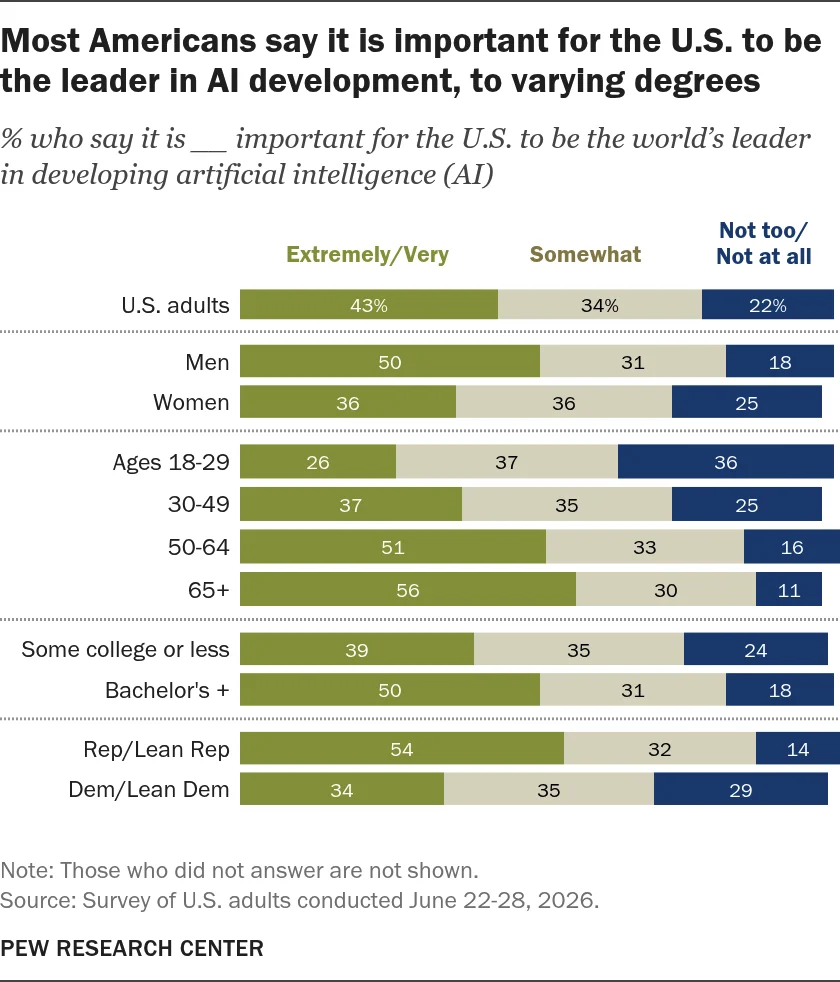
Despite the widespread belief that the U.S. is trailing, there is broad consensus that the race matters. Approximately 43% of Americans view it as "extremely" or "very" important for the U.S. to lead the world in AI development.

This sentiment is particularly pronounced among specific groups. Men (50%) are more likely than women (36%) to prioritize U.S. leadership. Education levels also play a role, with 50% of those holding a bachelor’s degree or higher viewing leadership as critical, compared to 39% of those with less education.
Age, however, represents the most dramatic divide. Older Americans are the strongest proponents of American AI dominance. Among those aged 65 and older, 56% consider U.S. leadership a top priority—a stark contrast to the 18-29 age bracket, where only 26% share the same level of urgency.
Official Responses and Strategic Doctrines
The political discourse surrounding AI has become a point of convergence for otherwise divided American administrations.
President Donald Trump has positioned AI as a cornerstone of his economic and security platform, repeatedly asserting that the U.S. "must have the most powerful AI systems" in the world. His administration has framed the situation as a zero-sum game, explicitly calling for the pursuit of "global dominance" to counter international threats.

This stance is echoed by the bipartisan consensus regarding national security. Former President Joe Biden’s administration focused heavily on defensive measures, prioritizing the restriction of technology flow to adversaries. The primary objective has been to prevent China from utilizing advanced U.S.-origin algorithms or hardware for military augmentation or sophisticated cyber-warfare operations. This "tech-containment" strategy has defined much of the diplomatic tension between Washington and Beijing for the past 24 months.
The Global Inequality Conundrum
Beyond the superpower rivalry, Americans harbor deep concerns about the impact of AI on the global economic order. A majority of respondents (51%) believe that the rise of AI will inevitably widen the gap between rich and poor countries.
This view is rooted in the reality that AI development requires massive capital, energy, and infrastructure—resources that are currently concentrated in a handful of high-income nations. Only 7% of Americans believe AI will help narrow the divide, while 16% suggest it will have little to no impact.
This concern is felt most acutely among certain cohorts:

- Political Divide: 60% of Democrats believe AI will increase global inequality, compared to 45% of Republicans.
- Education: 62% of college-educated Americans express concern about the widening gap, compared to 46% of those without a degree.
- Tech Literacy: Active users of AI chatbots are more pessimistic about the potential for global inequality (55%) than non-users (47%).
Implications for the Future
The Pew Research findings paint a picture of a nation that is both anxious and unsure. The public recognizes the immense stakes of the AI race—viewing it not just as a matter of technological progress, but as a fundamental component of national power and global stability.
The disconnect between the public’s belief that China is winning and the official rhetoric that the U.S. is "in a race to dominate" suggests a potential messaging gap. While policymakers emphasize the necessity of maintaining a lead, the public appears to be observing the rapid proliferation of Chinese technology and concluding that the advantage has already shifted.
As we move deeper into 2026, the challenge for the U.S. is twofold: effectively navigating the complex international landscape to maintain a technological edge, and communicating the realities of this progress to a public that feels increasingly uncertain about the nation’s standing on the global stage. Whether AI serves as a tool for American empowerment or a catalyst for global disparity remains the defining question of the decade. The data indicates that the American people are watching closely, and for many, the jury is still out.