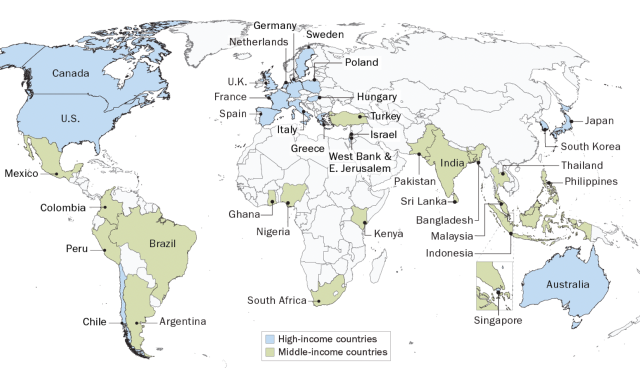
A new comprehensive study from the Pew Research Center has unveiled a striking geopolitical fault line in international public opinion. By surveying over 45,000 individuals across 37 countries in the spring of 2026, researchers have identified a clear, consistent pattern: a nation’s economic prosperity is a primary predictor of its citizens’ sentiment toward China and its leadership.
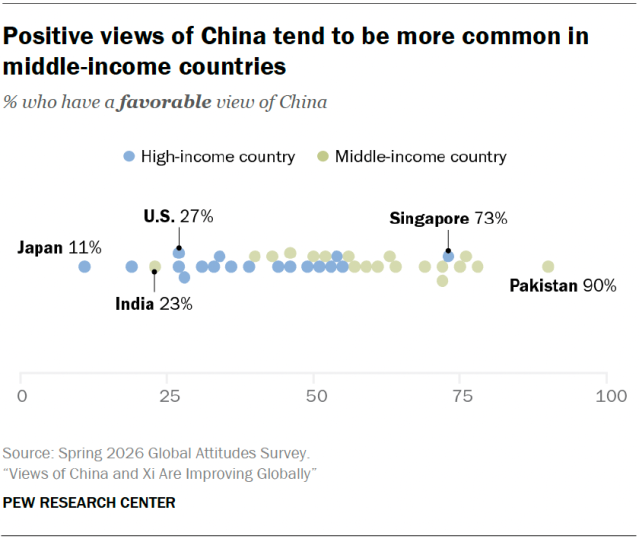
The findings suggest that the "Global North" and "Global South" are drifting apart in their perception of Beijing. While citizens in high-income, industrialized nations increasingly view China through a lens of skepticism and concern, populations in middle-income nations often maintain a significantly more favorable, and occasionally optimistic, view of the Asian superpower.
Main Facts: A Tale of Two Worlds
The 2026 survey, conducted between February 8 and May 13, reveals that the divide is not merely a matter of policy disagreement but a fundamental difference in how China’s global role is perceived.
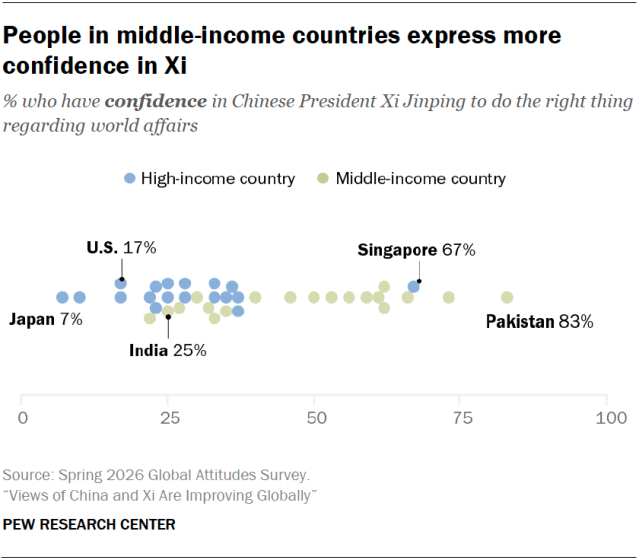
In high-income countries—ranging from the United States and Japan to Germany and Sweden—public opinion is dominated by negative sentiment. A majority of respondents in these nations express profound distrust of China’s foreign policy, skepticism regarding its human rights record, and a lack of confidence in President Xi Jinping. Conversely, in middle-income nations such as Kenya, Nigeria, Pakistan, and Indonesia, the narrative is markedly different. In these regions, China is frequently viewed as a valuable partner, a sentiment often correlated with extensive infrastructure investment and development aid associated with the Belt and Road Initiative and similar cooperative frameworks.

Chronology of Shifting Sentiments
To understand the current landscape, one must look at the evolution of these perceptions over the last decade.
- Pre-2020: International opinion of China was largely mixed, with economic opportunities often outweighing concerns regarding the political system.
- The Xi Era (2012–2022): As noted in previous Pew research, the shift began in earnest during President Xi’s first two terms. Increasing centralization of power and a more assertive foreign policy began to erode China’s "soft power" in the West.
- 2023–2025: Negative reviews of China’s foreign policy became the norm in Western democracies, driven by concerns over geopolitical tensions, trade imbalances, and post-pandemic diplomatic friction.
- 2026 (The Current Study): The divide has solidified. High-income nations now exhibit record-high levels of unfavorable views, while the "economic wealth gap" has become the defining variable in how China is received on the global stage.
Supporting Data: The Numbers Behind the Sentiment
The data underscores a dramatic contrast in perception across several key metrics:
Favorability and Leadership
In high-income nations, the disapproval rating is overwhelming. For instance, in Japan, Israel, the United States, South Korea, and Sweden, seven-in-ten or more adults hold an unfavorable view of China. The contrast with middle-income nations is sharp: in countries like Pakistan, Kenya, and Malaysia, roughly three-quarters of the population view China favorably.
Confidence in President Xi Jinping follows an identical trajectory. While he enjoys broad support in developing economies, his standing in the West is at an all-time low. In Japan, 92% of those surveyed expressed a lack of confidence in his leadership—a staggering figure that reflects deep-seated regional tensions.
The Question of Personal Freedoms
Perhaps the most significant gap in values involves the perception of human rights. When asked if the Chinese government respects the personal freedoms of its citizens, the consensus in high-income countries is near-unanimous in the negative. In nations like Germany, Sweden, and Australia, roughly nine-in-ten respondents believe Beijing fails to protect basic civil liberties.
In contrast, half of the middle-income countries surveyed saw majorities expressing belief that China does respect these freedoms. This highlights a disconnect between Western political discourse—which emphasizes democratic norms—and the priorities of nations where the focus is often on economic stability and poverty reduction.
The Asia-Pacific Exception: The Philippines
While the "wealth equals perception" rule holds firm in most regions, the Philippines stands out as a unique case study. Despite being a middle-income country, the Philippines mirrors the high-income nations in its apprehension. With 86% of its population concerned about territorial disputes in the South China Sea, the Philippines views China as a primary security threat, demonstrating that regional proximity and sovereignty issues can occasionally override economic alignment.
Official Responses and Diplomatic Context
While the Chinese government has historically dismissed such polls as "Western-centric" or "biased," the data presents a complex diplomatic challenge for Beijing. The "Wolf Warrior" style of diplomacy, characterized by aggressive rhetoric, has been effective at mobilizing domestic nationalist sentiment but has arguably accelerated the decline of China’s image in the West.
Conversely, Beijing has leaned into its role as a provider of "Global South" solidarity. By positioning itself as an alternative to Western-led financial institutions, China has successfully fostered a reservoir of goodwill in Africa and parts of South Asia. The data from the 2026 survey suggests that this strategy is working, as economic ties continue to serve as the bedrock of China’s positive image in developing markets.
Implications for Global Stability
The implications of this divide are far-reaching for the future of global governance:
1. Fragmentation of International Organizations:
As China gains more support from the developing world, we may see a hardening of blocs within the United Nations and other international forums. If the "Global South" continues to view China through a lens of economic cooperation while the "Global North" views it as a systemic rival, the potential for gridlock on issues such as climate change, trade regulations, and security treaties will increase.
2. Economic Decoupling:
The negative sentiment in high-income countries is already providing the political mandate for "de-risking" or decoupling strategies. When the public perceives a country negatively, leaders face less resistance when imposing trade barriers, investment restrictions, or export controls on critical technologies.
3. The Battle for "Soft Power":
The fact that perceptions of China vary so drastically based on economic status suggests that "soft power" is no longer a universal currency. China does not need to win the "hearts and minds" of Western citizens to achieve its geopolitical objectives, provided it maintains strong, dependency-based relationships with middle-income nations.
4. Security Dilemmas:
The heightened concern regarding territorial disputes, particularly in the Asia-Pacific region, suggests that public opinion is becoming a volatility factor. Governments in the region are under increasing pressure from their own citizens to take a harder line against perceived encroachment, raising the risk of accidental escalation in maritime flashpoints.
Conclusion: A World Realigned
The 2026 Pew Research Center findings confirm that we have entered an era where public opinion is deeply stratified by economic reality. China’s challenge is no longer to be "liked" globally, but to manage a world that is increasingly bifurcated. For the West, the data serves as a wake-up call regarding the depth of the alienation from China’s model. For the developing world, it highlights a strategic partnership that, while economically beneficial, may eventually force these nations to navigate the growing crossfire between two competing global ideologies.
As we look toward the remainder of the decade, the divide between the "affluent skeptics" and the "developing partners" will likely define the contours of international relations, shaping everything from trade policy to the stability of the global security order.