As artificial intelligence (AI) rapidly integrates into the fabric of American daily life—from the automation of mundane administrative tasks to the complex algorithms driving healthcare and finance—a profound shift has occurred in the national psyche. For the first time since the rise of mainstream generative AI, a distinct partisan divide has emerged. According to a new comprehensive survey conducted by the Pew Research Center, Democrats are now significantly more likely than Republicans to express deep-seated concern regarding the pervasive role of AI and its long-term impact on the labor market.
This data, derived from a June 2026 survey of 3,488 U.S. adults, signals a departure from previous years where concern was more evenly distributed or, in some cases, higher among conservative demographics. As the 2026 midterm elections approach, these diverging attitudes are transforming AI from a niche technological debate into a central campaign issue, forcing candidates to address voter anxieties regarding job security, corporate power, and federal oversight.
The Core Findings: A Reversal of Sentiment
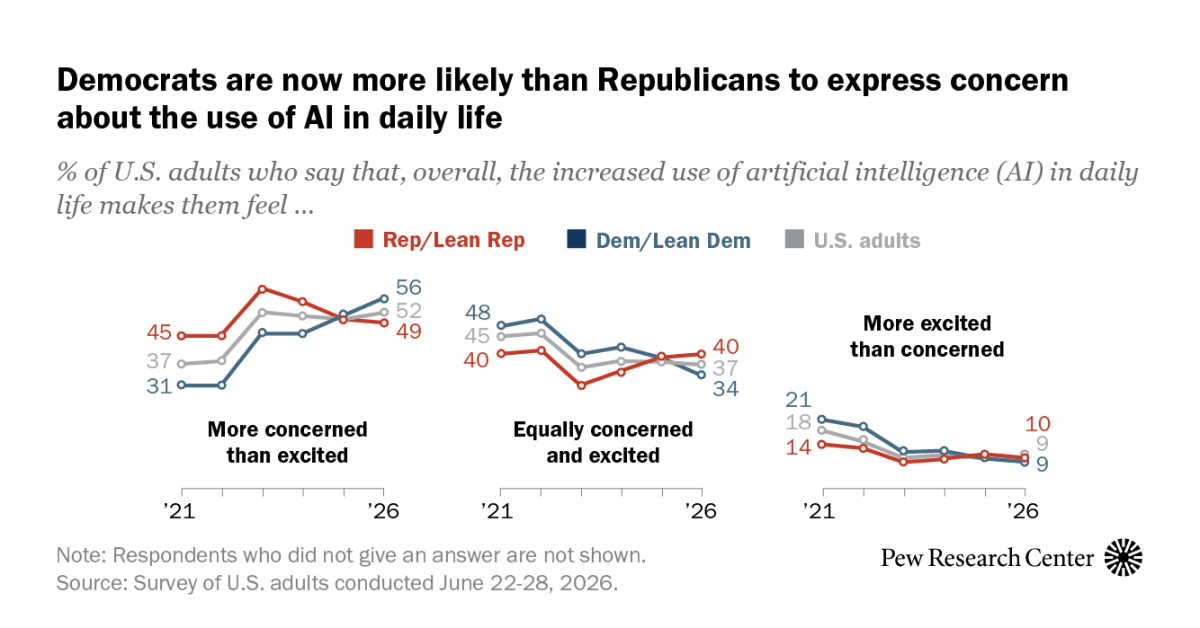
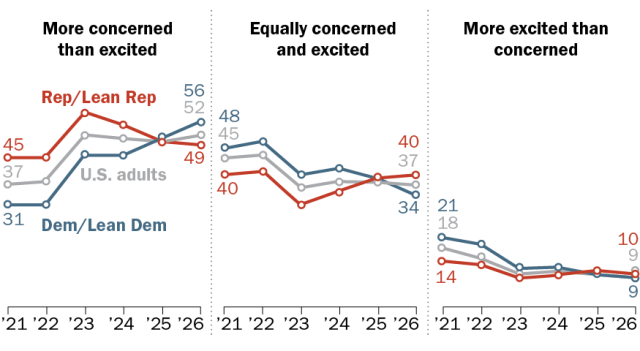
The June survey reveals that 56% of Democrats and independents who lean Democratic now report feeling "more concerned than excited" about the increased use of AI in daily life. In contrast, roughly half (49%) of Republicans and Republican-leaning independents share this level of apprehension.
This statistical flip is significant. In 2023, the inverse was largely true: 59% of Republicans expressed concern, compared to 46% of Democrats. The rapid escalation of anxiety among Democrats—particularly those at the ideological left—has been the primary driver of this trend. Among liberal Democrats, the level of concern has surged from 45% in 2023 to 63% today. Simultaneously, conservative Republicans have seen a 14-percentage-point decline in their expression of concern over the same period, suggesting that while the public at large remains wary, the reasons for that wariness are increasingly being filtered through partisan lenses.
A Chronology of Growing Unease
To understand how the American public arrived at this point of apprehension, one must look back at the trajectory of AI adoption since the early 2020s.
- 2021: The Era of Curiosity: In the early stages of widespread AI deployment, the American public was largely characterized by a sense of uncertainty. Only 37% of U.S. adults reported being more concerned than excited. At this stage, the technology was viewed as an experimental tool rather than a structural threat to the economy.
- 2022: The Onset of Realization: As tools like Large Language Models (LLMs) began to demonstrate human-like proficiency in writing and coding, the percentage of concerned citizens crept up to 38%. The partisan gap remained relatively narrow, with 45% of Republicans and 31% of Democrats expressing more concern than excitement.
- 2023: The Great Surge of Fear: The rapid public release of generative AI platforms caused a massive spike in public concern. The national average of "more concerned than excited" jumped to 52%. Republicans, particularly those in conservative circles, voiced the highest levels of alarm at 59%, potentially driven by narratives surrounding "woke AI" and the potential for algorithmic bias in tech platforms.
- 2024–2025: Normalization and Polarization: During this period, the baseline level of concern remained high, hovering around 50–51%. However, the internal composition of that fear began to shift. The political rhetoric surrounding AI started to coalesce around specific policy goals, such as data privacy and the regulation of tech giants.
- 2026: The Partisan Split: By the summer of 2026, the data confirmed a clear realignment. Democrats, increasingly focused on the socio-economic impacts of automation and the potential for workforce displacement, have become the primary cohort expressing worry.
Supporting Data: The Impact on the Workforce
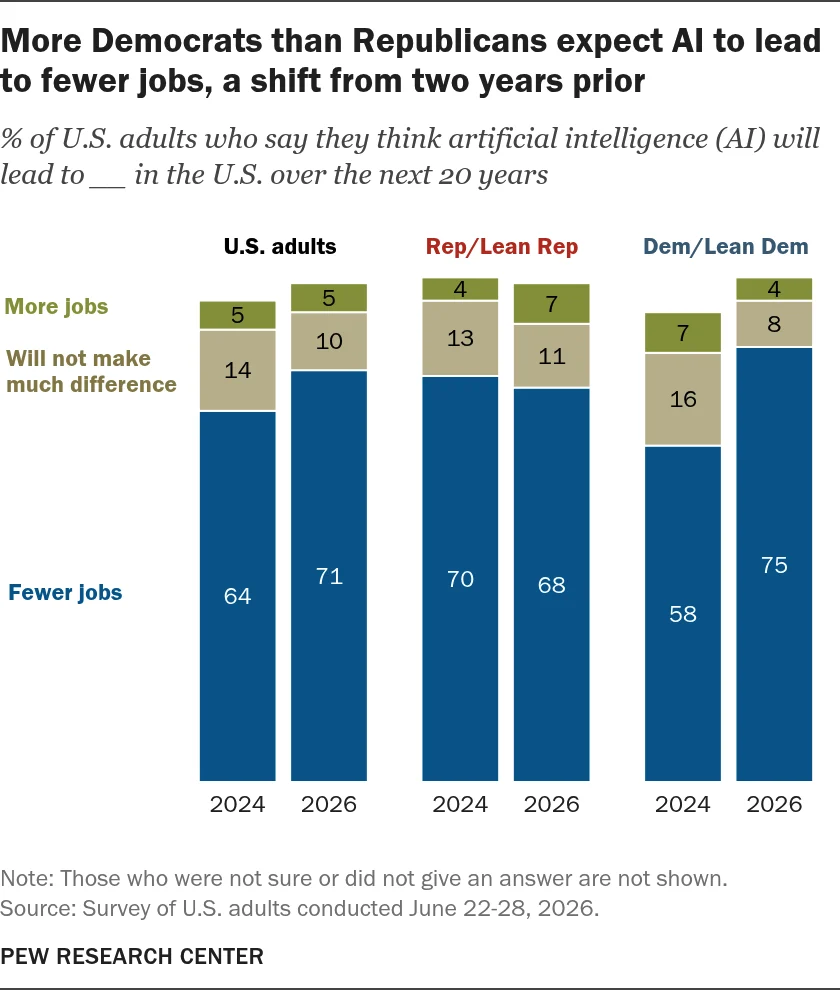
The anxiety surrounding AI is not merely existential; it is intensely practical, specifically concerning the future of employment. A staggering 71% of U.S. adults now believe that AI will lead to "fewer jobs" in the United States over the next 20 years.
When analyzed by party, the divergence is striking. Today, 75% of Democrats anticipate that AI will result in fewer jobs, a significant jump from 58% just two years ago. Conversely, Republican outlooks have remained relatively stable, with 68% anticipating fewer jobs—a slight decrease from the 70% recorded in 2024.
This suggests that the Democratic base is increasingly reacting to the potential for large-scale economic disruption within the service, creative, and white-collar sectors—areas where AI is perceived to have the most immediate impact on current professional roles. Meanwhile, the relative stability of Republican sentiment may reflect a variety of factors, including a more optimistic view of technological innovation as a driver of market efficiency or a differing set of priorities regarding how the federal government should interact with private tech firms.
Official Responses and Political Implications
As AI enters the bloodstream of the 2026 midterm election cycle, the legislative response has become a point of contention. Candidates are being pressed to define their stance on three key pillars:
1. Data Center Infrastructure
With the massive energy requirements of AI data centers becoming a point of local environmental and economic debate, candidates are being forced to choose between supporting rapid technological infrastructure growth or prioritizing local resource management.
2. Regulatory Frameworks
Democrats are increasingly calling for stringent federal oversight, advocating for "guardrails" that ensure AI is transparent, unbiased, and accountable to public interests. Republicans, while also concerned about tech power, often prioritize frameworks that maintain American competitive advantage against global rivals—most notably China—fearing that over-regulation could stifle innovation.
3. Economic Safety Nets
The fear of job loss has prompted a growing conversation about the need for a social safety net specifically tailored to the AI age. Proposals such as "automation taxes" on corporations replacing human labor with software are finding more traction in Democratic platforms, while Republican platforms tend to emphasize reskilling programs and workforce flexibility.

The Broader Context: Why the Shift?
The shift in Democratic sentiment is likely influenced by the growing prominence of AI in the workplace. Many of the professional sectors most vulnerable to current-generation AI—such as media, education, software development, and administrative support—tend to have higher concentrations of Democratic-leaning voters. As these workers witness the integration of AI tools in their daily workflows, their professional anxieties are manifesting as a political demand for protection and regulation.
Furthermore, the public discourse has moved from "what is AI?" to "what will AI do to me?" This transition has brought the issue into the kitchen-table category of politics. For voters, the concern is no longer about the theoretical capabilities of a machine, but about the very real possibility of a shrinking job market, the degradation of information integrity, and the concentration of power in the hands of a few tech conglomerates.
Conclusion: A Nation at a Crossroads
The 2026 Pew Research Center findings serve as a barometer for a society grappling with the most significant technological transition since the industrial revolution. The fact that the debate has become polarized is perhaps inevitable; as the technology moves from the periphery to the core of the economy, it is being pulled into the existing framework of American political identity.
As we move toward the midterms and beyond, the challenge for policymakers will be to reconcile these fears with the undeniable potential for AI to drive productivity and solve complex societal problems. For now, however, the trend is clear: the American public is no longer waiting for the future to arrive—they are already concerned about the impact it will have on their lives, their jobs, and their political future.

Methodology and Further Reading
This analysis is based on a survey of 3,488 U.S. adults conducted by the Pew Research Center between June 22 and June 28, 2026. Participants were members of the Center’s American Trends Panel, a nationally representative group. For those interested in the raw data, full topline results, and detailed methodology, the following resources are available via the Pew Research Center portal:
- Full Survey Questionnaire
- Detailed Statistical Topline
- Technical Methodology Report
The research underscores the necessity of continuous, non-partisan study of technological trends as they intersect with public opinion, providing a vital resource for journalists, lawmakers, and citizens alike as they navigate the evolving digital age.