As the U.S. midterm elections approach, news organizations find themselves at a critical crossroads. For legacy media and digital-first publishers alike, election seasons have historically served as reliable catalysts for audience spikes and subscription drives. However, with the digital publishing ecosystem undergoing seismic shifts—marked by declining referral traffic from search engines, changing social media dynamics, and the rapid rise of AI-driven search—the stakes for converting casual readers into paying subscribers have never been higher.
Today, publishers are deploying newly refined playbooks, ranging from dynamic paywall adjustments and unified mobile applications to advanced AI-powered newsroom tools and interactive voter widgets. Yet, as industry experts warn, landing the initial subscriber is only half the battle; the real test lies in transforming a seasonal hook into a lasting habit.
Main Facts: The Strategic Shift in Election-Driven Publishing
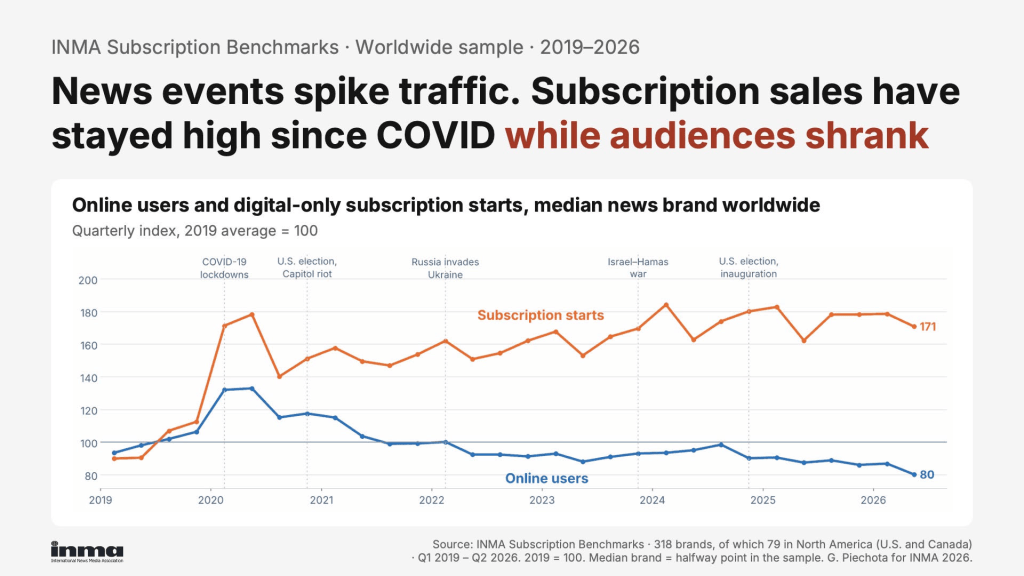
The core challenge facing modern newsrooms is a structural decline in open web discovery. According to research from the International News Media Association (INMA), the typical news publisher worldwide now reaches roughly 20% fewer unique monthly users than it did in 2019. In North America, traffic has dropped by a similar margin compared to the peak of the 2024 presidential election cycle.
Despite shrinking top-of-funnel traffic, however, subscription revenue has not stalled. On the contrary, the typical publisher is selling 50% to 85% more subscriptions per quarter than in 2019, albeit to a more consolidated and dedicated audience. This inverse relationship highlights a vital strategic pivot: because casual readers are harder to acquire via traditional social and search referral paths, major news events represent critical, rare windows of opportunity where audiences actively seek out independent, trusted journalism on their own terms.
National and metro publishers that successfully lean into this dynamic can capture valuable subscribers, though large regional newspaper chains continue to struggle with retaining users acquired through aggressive, low-cost election promotions. To counteract churn, major media outlets are actively re-engineering their digital products ahead of the midterms.
Chronology of Events: Preparing for the Midterm Wave
The run-up to the midterm elections has triggered a flurry of product launches, content expansions, and strategic realignments across the media landscape:
Early Summer 2026: Emerging subscription players, such as The Hill, begin rolling out advanced subscriber-only interactive features, partnering with data analytics firms to give readers deeper access to polling metrics and predictive models.
Late 2025 – Early 2026: Major global players like CNN expand their digital subscription offerings—such as CNN All Access—into international markets including the U.K. and Canada, explicitly treating elections as primary international subscription drivers.
Weeks Prior to the Midterms: Executive leadership teams across major newsrooms meet to map out dynamic paywall strategies. Organizations like The New York Times decide to drop paywalls entirely within their mobile apps for specific major news events to maximize top-of-funnel reach.
October 2026:Politico rolls out a unified global mobile app, consolidating its previously fragmented U.S. and European applications into a single ecosystem to streamline free and paid offerings. Simultaneously, The Wall Street Journal integrates cutting-edge AI forecasting tools to track real-time voter sentiment across unconventional media formats.
Election Week: Major publishers activate specialized Washington, D.C. "war rooms," expand national security and White House reporting teams, and launch content-sharing bundles (such as Reuters’ partnership with the USA Today Network) to capture immediate spikes in traffic and conversion rates.
Supporting Data and Industry Benchmarks
A closer look at current metrics underscores the volatility and opportunity defining the current media economy:
Traffic vs. Sales Growth: While website audiences have dipped significantly—for instance, Politico experienced a 49.1% year-over-year audience decline in September, and Vox noted a 36% drop—alternative engagement channels are surging. Vox reported an 86% year-over-year increase in social video views, while People Inc. saw its social-video sponsorship revenue skyrocket by 625%.
Conversion Metrics: Strategic product adjustments are yielding high intent among active users. The Hill reported a trial-to-paid subscription conversion rate exceeding 75% following the deployment of its interactive election tools.
Global Publishing Trends: INMA’s analysis of over 3,000 news brands reveals that while North American publishers saw a 16% overall contraction in subscriber bases from their early 2024 election peaks due to churn among regional chains, strong national and metro brands maintained steady growth of roughly 10% year-over-year.
Advertising Headwinds: Technical restrictions continue to impact programmatic revenue. Apple’s ongoing identity blocks have contributed to a 20% decline in publisher eCPMs on Mac devices, according to data from Aditude.
Official Responses and Industry Perspectives
Media executives have been vocal about how their organizations are positioning themselves to capitalize on the political cycle while safeguarding long-term growth.
Josh London, head of Reuters Professional—who oversees direct-to-consumer and direct-to-professional operations—noted an immediate surge in subscriber acquisition during global political events. On the Monday prior to the midterms, new subscriptions at Reuters rose by 50%, driven largely by U.S. audiences engaging with live blogs and international election coverage.
“Always, but especially with elections, readers turn to Reuters for trusted, unbiased election news at speed, and that trust and that independent, non-national coverage translates into new subscriptions,” London explained. While Reuters has maintained its established dynamic paywall, the organization has reinforced its product offering by expanding its Washington D.C. bureau and establishing content-bundling agreements with the USA Today Network.
At Politico, commercial leadership views the midterms as a vital proof-of-concept for its newly unified digital platforms. Cally Baute, chief commercial officer at Politico, emphasized the importance of demonstrating ongoing value:
“The midterms give us an opportunity to demonstrate why Politico’s journalism matters to the people who rely on it for their work, both in the lead-up to election night and long afterwards. We want people who discover us through election coverage to understand the value of that specialist intelligence in the decisions they make every day.”
Greg Piechota, researcher-in-residence at INMA, captured the underlying strategic reality for publishers navigating the modern funnel:
“Growth depends on attracting and converting casual readers, and that is getting harder. Social media and search send fewer people to news sites every year. A big news event is one of the few remaining moments when casual readers come to a news brand on their own, so what happens in those weeks matters more than it used to.”
Broader Implications for the Media Ecosystem
The Shift from Open Web to Direct Relationships
As generative AI search engines and platform algorithm changes continue to erode traditional referral traffic, publishers can no longer rely on passive, transient search traffic to maintain subscription funnels. Election cycles act as powerful, natural magnets that temporarily break through consumer apathy. By offering frictionless entry points—such as free app access or open live-blogs—publishers hope to capture user data, build direct communication channels via newsletters, and prove immediate utility.
Technological and Product Innovation
The battle for the reader’s attention has accelerated technological adoption within newsrooms.
AI Integration: Outlets like The Wall Street Journal are utilizing advanced AI tools—such as Doppler News AI—to scour millions of podcasts, social videos, and niche media segments to identify grassroots voter concerns that traditional polling might overlook.
App Consolidation: Publishers are aggressively pushing proprietary apps to bypass web browsers and third-party platforms. Politico consolidated its international apps, Vox launched its first unified membership app, and The Verge announced app development plans for 2027, all aimed at fostering direct, sticky relationships.
Interactive Tooling: Newer subscription entrants like The Hill are moving beyond static text, integrating Decision Desk HQ data tools into their paid tiers to provide bespoke analytical value that readers cannot easily find elsewhere for free.
The Post-Election Retention Challenge
Industry consensus highlights a stark warning: the election is the hook, not the habit.
When temporary political adrenaline fades, publishers face the immediate risk of steep subscriber churn. To mitigate this drop-off, INMA’s Greg Piechota stresses that post-election onboarding must immediately pivot toward breadth. Successful publishers will guide newly acquired readers away from single-topic political obsession and toward diversified content pillars—ranging from sports and lifestyle reporting to specialized newsletters and bundled non-news products like digital games.
Ultimately, while the U.S. midterms provide a crucial financial and audience boost, the long-term survival of digital journalism will depend less on the outcome of any single political race and more on how effectively newsrooms can leverage that fleeting attention into lifelong reader loyalty.