In a seismic shift for the media and technology landscape, Fox Corporation has officially confirmed that it has entered into a definitive agreement to acquire Roku, the streaming platform pioneer, in a transaction valued at approximately $22 billion. The deal, which has been the subject of intense industry speculation for months, marks a pivotal consolidation of traditional broadcast power and next-generation streaming distribution.
Under the terms of the agreement, Roku shareholders will receive $160 per share—a mix of 60% cash and 40% Fox common stock. To facilitate the massive cash component, Fox has secured $12 billion in fully committed bridge financing from Morgan Stanley, marking a significant leverage play for the media conglomerate.
The Transaction: A Strategic Integration
The acquisition is slated to close in the first half of 2027, subject to customary regulatory approvals and shareholder consent. Once the dust settles, the ownership structure of the combined entity will reflect the massive scale of the merger: existing Fox shareholders are expected to control approximately 73% of the company, while current Roku shareholders will hold the remaining 27%.
Fox’s interest in Roku is far from newfound. The media giant was an early believer in the platform, participating as a pre-IPO investor back in 2013. By bringing Roku under the Fox umbrella, the corporation is not merely acquiring a hardware manufacturer, but the operating system of the modern living room.
A Chronology of Roku’s Market Trajectory
To understand the significance of this $22 billion valuation, one must look at Roku’s tumultuous journey on the public markets.
- 2013: The Early Bet: Fox Corporation joins Roku’s funding rounds, recognizing the potential for connected TV (CTV) to disrupt traditional cable.
- 2017: IPO: Roku enters the public market, signaling the beginning of the cord-cutting revolution.
- 2021: The Pandemic Peak: Fueled by stay-at-home mandates, Roku’s stock reaches an all-time high of $479.50. The streaming ecosystem sees unprecedented growth in usage and ad spend.
- 2022: The Correction: As the pandemic-era tailwinds subside, Roku’s stock experiences a sharp decline, dipping below the $100 mark as investor sentiment shifts from growth-at-all-costs to profitability.
- 2023–2025: The Plateau: From April 2022 through late 2025, Roku struggles to reclaim its former glory, with shares only briefly and inconsistently peaking above the $100 threshold.
- 2026: The Acquisition: Fox moves to capitalize on the depressed valuation, viewing the platform as a foundational asset for its future digital strategy.
Financial Foundations: Why the Deal Makes Sense
Fox Corporation leadership has projected that the deal will be accretive to free cash flow per share by the second full year post-closing. Beyond simple cash flow, the synergy targets are ambitious: Fox expects to achieve approximately $400 million in run-rate cost synergies, with additional revenue upside anticipated through cross-selling and enhanced advertising technology.
The math behind the valuation is anchored in Roku’s shift toward a high-margin advertising business. Based on Wall Street estimates, the deal values Roku at roughly 24x FY27E EBITDA—a premium that suggests Fox is paying for the future of connected TV advertising rather than legacy hardware sales.
Analyzing the Q1 Earnings Report
Roku’s most recent quarterly performance serves as the bedrock for this acquisition’s justification. The company’s Q1 results highlighted a clear transformation from a hardware-centric business to a software and services powerhouse:
- Advertising Revenue: $613 million, up 27% year-over-year.
- Subscription Revenue: $519 million, up 30% year-over-year.
- Device Revenue: $118 million, down 16% (now representing less than 10% of total revenue).
- Total Revenue: $1.248 billion, a 22% increase year-over-year.
- Net Income: $85.7 million, proving the company’s pivot to profitability is maturing.
- Engagement: Streaming hours reached 38.7 billion, an 8% increase, proving the stickiness of the platform.
With $2.38 billion in cash on hand and zero long-term debt at the time of the deal, Roku enters the merger with a remarkably clean balance sheet, providing Fox with a stable foundation to accelerate its growth.
Implications for the Streaming Ecosystem
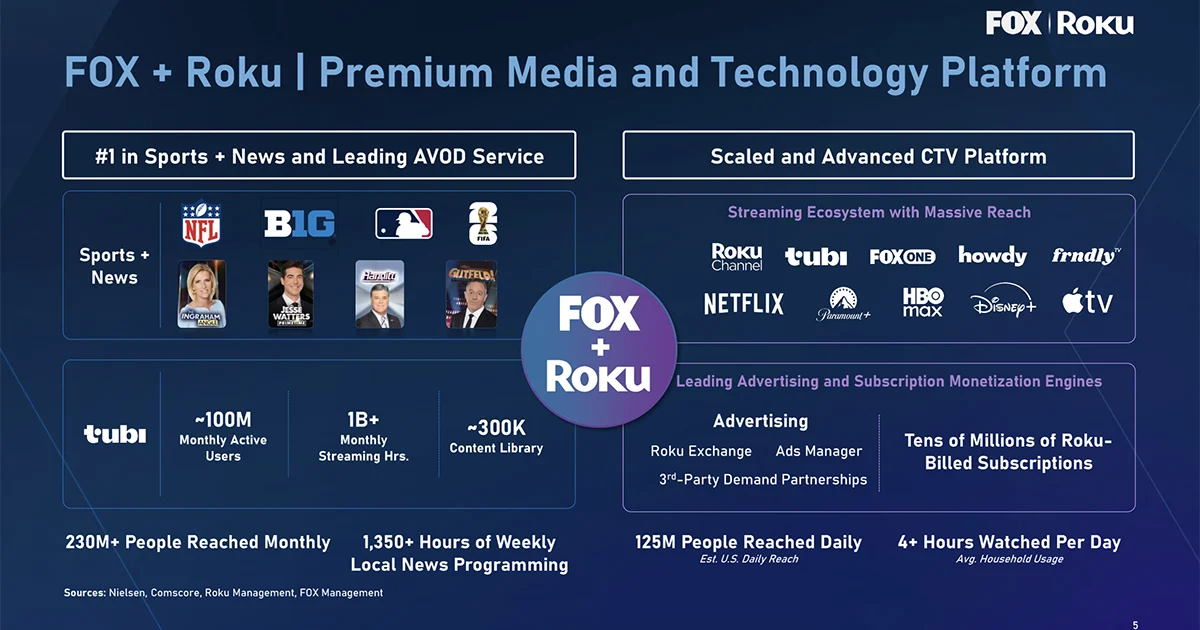
The industry is already dissecting the potential fallout of this acquisition. Perhaps most importantly, Fox has committed to keeping Roku an "open platform." This is a crucial assurance for content partners who fear that Fox might prioritize its own content at the expense of others.
The Aggregation Strategy
Fox has emphasized that the goal is to continue Roku’s role as an aggregator. By maintaining the platform’s neutrality, Fox secures the valuable data and distribution reach that comes with hosting third-party services. Interestingly, Fox has confirmed that it intends to keep Tubi and The Roku Channel as separate entities. Despite an approximately 33% audience overlap between the two free-ad-supported streaming television (FAST) services, the company believes there is more value in maintaining distinct brand identities for now.
The Power of Data
The true "crown jewel" of this deal is not the hardware or the streaming hours, but the advertising infrastructure. Roku’s ability to target audiences across the fragmented streaming landscape is arguably the best in the business. By combining this with Fox’s premium sports and news inventory, Fox creates a formidable advertising machine capable of offering advertisers unparalleled reach and precision.
Leadership and Governance
A key component of the deal involves the integration of leadership. Anthony Wood, the visionary founder, chairman, and CEO of Roku, will join the Fox Corporation board of directors. This move is designed to ensure continuity and provide Fox with Wood’s deep technical expertise as they navigate the integration of hardware and broadcast media.
Industry Outlook: A Bullish View?
Analysts are already weighing in on the implications for the broader media sector. For traditional broadcasters, the pressure to own the "pipes" has never been higher. With the decline of traditional cable carriage, owning a platform that controls the home screen is a defensive move of the highest order.
"Fox is essentially buying its way into the future of television," says one media analyst. "They are no longer just content creators; they are the platform. This puts them in direct competition with the likes of Amazon, Apple, and Google, but with a legacy media pedigree that none of those tech giants possess."
The $400 million in cost synergies will likely come from streamlining operations, consolidating cloud and infrastructure costs, and eliminating redundant administrative functions. However, the real test will be whether Fox can maintain Roku’s culture of innovation.
Final Thoughts: The Road to 2027
The road to 2027 will be paved with regulatory scrutiny. Given the current antitrust climate in Washington, particularly regarding the control of digital platforms, the DOJ and the FTC will undoubtedly take a long, hard look at this merger. Can a major content owner also own a dominant distribution platform without stifling competition? Fox will have to convince regulators that the "open platform" pledge is more than just marketing rhetoric.
If the deal passes, it will mark the end of the "streaming wars" as we have known them—a shift from a focus on subscriber counts to a focus on platform consolidation and advertising dominance. For Fox, the gamble is significant, but for a legacy media company facing the sunset of cable, it may be the only path to a sustainable, digital-first future.
For further reading and detailed financial breakdowns, the official investor presentation provided by Fox and Roku can be found on the Fox Investor Relations website.