By Bill Grueskin
In the modern media landscape, the line between a routine editorial error and a full-blown disinformation crisis is often thinner than a single preposition. As journalists, we are taught that our primary currency is accuracy; yet, in the high-speed race for engagement, that currency is frequently devalued by haste, ambiguity, or the intentional omission of nuance.
This week, we examine two contrasting case studies in journalism: one illustrating the profound, often quiet impact of photojournalism in the face of hatred, and another highlighting how a missing word in a headline can ignite a national firestorm of misinformation.
Part I: The Witness and the Lens
For many, the sight of a camera in a high-tension environment is an irritant—a catalyst for conflict. We are accustomed to seeing subjects flee from, or even threaten, the journalists documenting their lives. However, occasionally, the camera acts not as an intruder, but as an anchor.
The July 4th Confrontation
On July 4th in Washington, DC, the city was sweltering. Finn Gomez, a twenty-three-year-old Getty Images intern, was patrolling the streets on a scooter, looking for feature photography. His editor sent a prompt: a large group of masked Patriot Front demonstrators were spotted near the Capitol.
Gomez tracked the group to a Metro station. As he told me, "I get back on the scooter, and I’m just hauling. I went straight up Pennsylvania Avenue, towards the Eastern Market Metro station, and the first thing I saw was three hundred, four hundred of them."
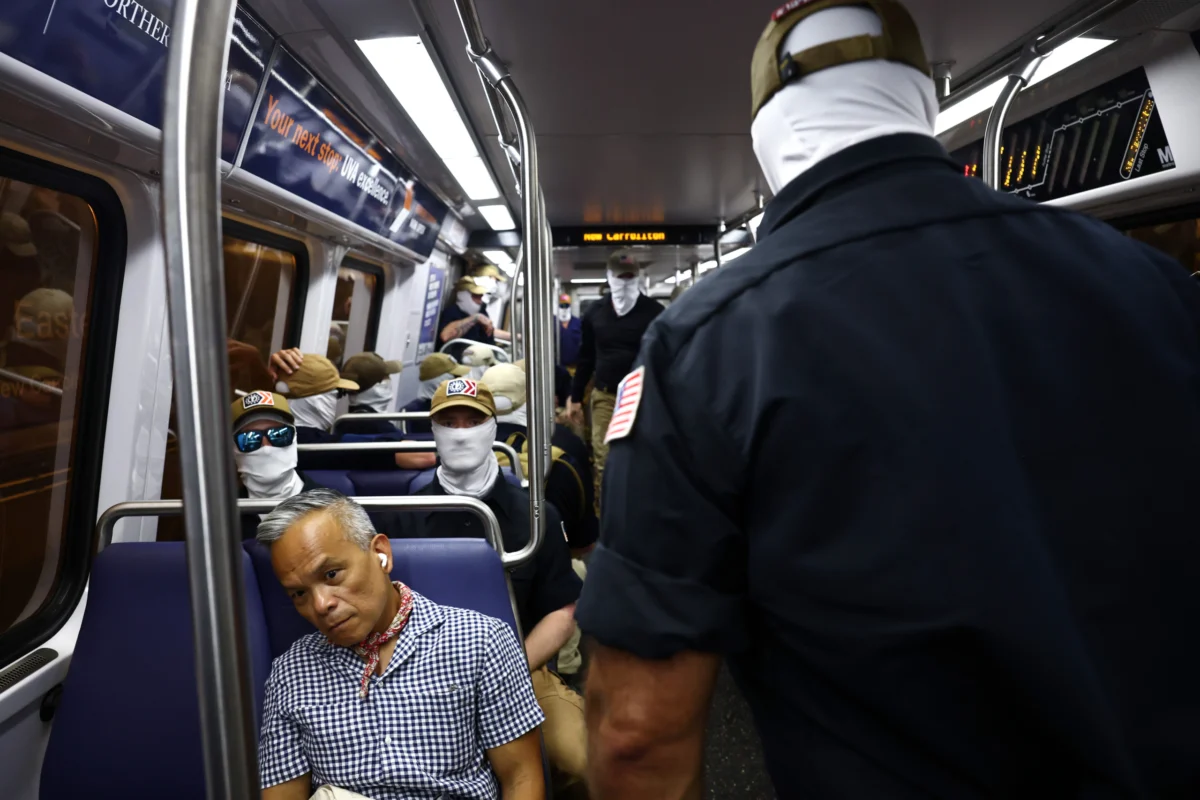
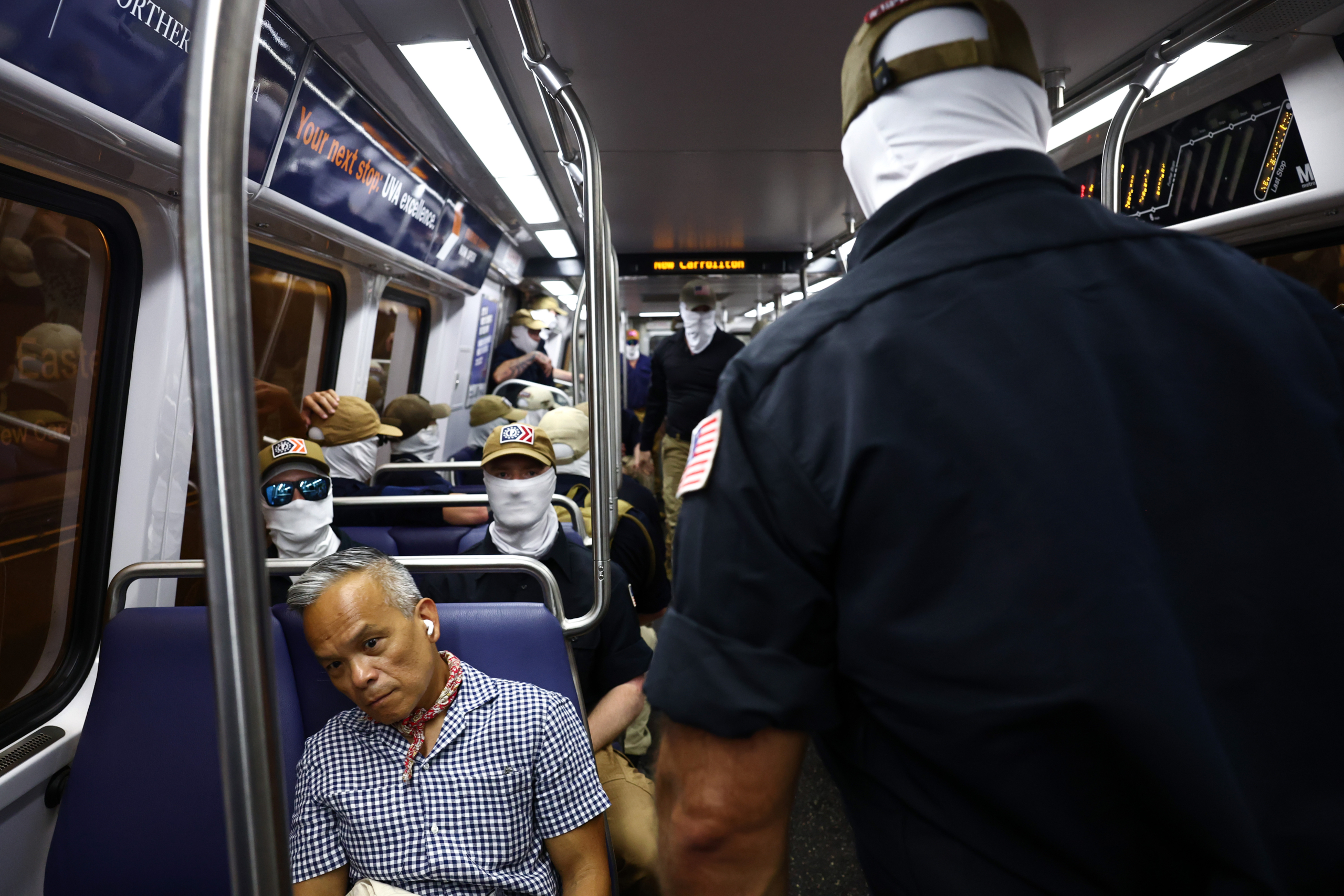
He squeezed into a subway car already occupied by the white nationalist group. Among them stood Roswell Encina, the president and CEO of the US Capitol Historical Society. Encina, a gay Filipino American man, was suddenly cornered by the hostile group. He later told The Advocate that while he initially didn’t identify them, the realization upon seeing their patches was chilling. "I would be lying if I said no," he said when asked if he was terrified. "I was terrified, honestly, just because I wasn’t sure what the motives were."
The Protective Shield of Documentation
Gomez, displaying an empathy and professional maturity that belies his young age, approached the scene with caution. He introduced himself to Encina and asked for permission to photograph the unfolding situation.
"He said, ‘Okay, go ahead, do whatever you need to do.’ He understood from the get-go that I was there to document this," Gomez recalled.
For seven stations, the photographer, the subject, and the group rode together to the terminus at New Carrollton, Maryland. Throughout the transit, Gomez continued to transmit images to his editors. The resulting photos, which gained global circulation, did more than just capture a moment of fear; they provided a sense of security for the victim.
In an Instagram post following the incident, Encina expressed his gratitude: "I came to this country as an infant and became a US citizen… So sitting there, on the Fourth of July, I couldn’t help but think about the promise of America and the work still required to protect it." He specifically thanked the young photographer, whose presence he described as "quietly reassuring."
Encina’s reaction reminds us that for those caught in the crosshairs of extremism, the presence of a journalist is not always an intrusion. To Encina, the camera was a shield. In an era where independent reporting is under constant assault, we should remember that our role as witnesses is a form of public service that provides, at the very least, the dignity of the record.
Part II: The Perils of the Preposition
While photojournalism provided a moment of clarity this July, the written word—specifically the omission of a two-letter preposition—triggered a different kind of chaos.
The Fed Paper: A Lesson in Complexity
In March 2026, the Federal Reserve Bank of Dallas released a working paper titled, "The Impacts of Unauthorized Immigration on US Labor and Housing Markets." The report was a dense, 65-page deep dive into economic microdata. The authors examined the 2021–2024 immigration surge and reached a nuanced conclusion: while employment levels remained stable without depressing wages, the surge contributed to price increases in housing and rentals.

Crucially, the report estimated that about 30 percent of the rise in home prices and 20 percent of the rise in rental prices could be attributed to the influx of immigrants. The distinction is critical: the immigration did not cause a 30 percent increase in prices; it accounted for a portion of the total market fluctuation.
The Anatomy of a Misinformation Cycle
On July 5, Fox Business published a headline: "Biden-era illegal immigration drove up housing costs, Fed economists find." Hours later, the New York Post ran the same story but added a "zesty" headline: "Biden’s illegal immigration surge triggered 30% rise in home prices, 20% in rents, Fed paper finds."
The missing word—of—transformed a nuanced economic finding into a inflammatory political weapon. The Post’s headline claimed a direct causal relationship: a 30 percent spike in home prices. This headline was shared on X, where it accumulated over eight million views.
The fallout was immediate:
- Political Amplification: President Trump shared the claim on Truth Social to his 12.9 million followers.
- Government Misuse: The Department of Homeland Security’s official account cited the Post piece, using it to advocate for "mass deportations."
- Secondary Spreading: Vice President JD Vance amplified the claim on X, using it to attack "the left," reaching an additional two million viewers.
Despite corrections from numerate social media users, the false narrative had already taken root.
Part III: The Aftermath and Institutional Accountability
The responsibility of media outlets extends beyond the initial publication. When a headline is objectively false, the correction must be as visible as the original error.
Correcting the Record
When I contacted Alison Rudnick, a spokesperson for the New York Post, to ask if the error would be addressed, the publication updated the story within 90 minutes. However, the original, erroneous post on X remained active, continuing to gather engagement.

The infection spread to Fox Business, where the Big Money Show featured a panelist promoting the incorrect figures. After I provided video evidence of the segment to a Fox spokesperson, the network deleted the post and ran a full-throated correction on Wednesday.
By Thursday, the Wall Street Journal editorial board—a sister property to the Post—denounced the politicians who had used the flawed data, stating that "politicians are misusing a Fed study on migrants and home prices." Notably, the Journal failed to mention that the misinformation originated from their own corporate sibling.
The Broader Implications
The "30 percent" incident serves as a stark reminder of the fragile ecosystem of truth. Economic studies are rarely black-and-white; they require the translation of complex statistical jargon like "heteroskedasticity-robust" into plain English.
The Post’s headline, while corrected in the body text, illustrates a dangerous trend: the prioritization of "zesty" headlines over factual precision. When a publication ignores the nuance of an economic report, it provides political actors with the ammunition they need to bypass fact-checking entirely.
When asked if the Post would reach out to the politicians who spread the incorrect numbers to correct the record, their spokesperson replied, "Nothing additional."
Conclusion
As journalists, our work is rarely about "gotcha" moments or viral traffic. It is about the slow, steady work of documentation—whether that means standing in a subway car with a stranger or parsing through 65 pages of Federal Reserve data.
We must hold ourselves to a standard where a single word—or the lack thereof—is treated with the gravity it deserves. If we fail to do so, we do not just lose our credibility; we provide the fuel for a wildfire of misinformation that no amount of subsequent correcting can fully extinguish. The public deserves better, and the integrity of our democracy depends on the precision of our pens.