Main Facts: The Anatomy of a Documented Trauma
Few images in contemporary cultural history carry the raw, devastating candor of those featured in Knife: The Attempted Murder of Salman Rushdie. Premiering to a rapt and deeply moved audience at the Sundance Film Festival, the documentary—directed by Oscar- and Emmy-winning filmmaker Alex Gibney—refuses to look away from the physical reality of violence.
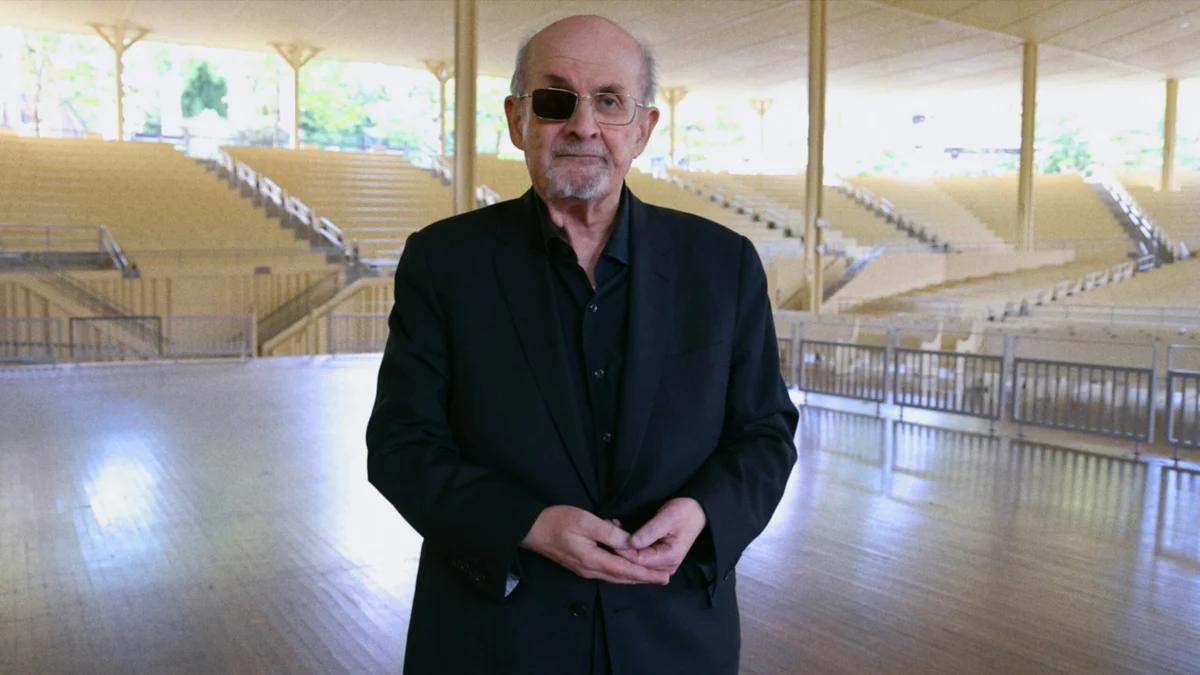
The documentary’s most arresting component is not its traditional biographical scaffolding, but rather its unprecedented visual intimacy. Gibney incorporates unvarnished, up-close footage shot by Rushdie’s wife, poet and novelist Rachel Eliza Griffiths, during the harrowing days and weeks following August 12, 2022. On that fateful summer afternoon, Rushdie was repeatedly stabbed while stepping up to a lectern at the Chautauqua Institution in upstate New York.
The camera lingers, without voyeuristic exploitation but with undeniable grit, over Rushdie’s mangled hand, the railroad-track pattern of thick surgical stitches running vertically up his abdomen, and his right eye—swollen, bloodied, and permanently altered. By choosing to share this footage, Rushdie and Griffiths transform private medical trauma into a public testament of survival. It serves as a visceral, uncompromising anchor for Gibney’s otherwise steady, reporter-style investigation into the enduring war over free speech, ideology, and individual liberty.
The film opens not with historical exposition, but with a feverish, subjective recreation of the attack itself, narrated in real time by Rushdie’s familiar, measured voice. Blinding stage lights reduce his assailant—identified as Hadi Matar, a young man from New Jersey—to a menacing, shadowy mass. Every strike of the blade is registered on the soundtrack not as cinematic gunfire, but as a dull, heavy, fleshy thud. Remarkably, Matar is mentioned by name only once throughout the documentary. In Rushdie’s framing, the individual attacker dissolves into a broader symbol: a physical manifestation of the decades-long punishment inflicted upon his life and liberties following the 1988 publication of his fourth novel, The Satanic Verses.
Chronology: From Literary Triumph to a Decades-Long Shadow
To understand the weight of the 2022 attack, Gibney’s documentary traces a complex, multi-decade timeline that defines modern literary martyrdom.
The Early Years and Identity Crisis
Using archival news footage and long-forgotten television interviews, the film takes viewers back to Rushdie’s formative years. Born in India before migrating to his adopted home of London, the young author grappled with a fragmented sense of identity—a displacement that would later fuel his mastery of magical realism. The documentary touches briefly on the emotional scars inflicted during his youth, particularly his relationship with an alcoholic father, painting a portrait of a sensitive intellect forged in emotional turbulence.
The 1988 Catalyst and the Fatwa
The true pivot of Rushdie’s life—and the documentary’s narrative arc—arrives in 1988 with the release of The Satanic Verses. The novel, which follows two Indian-Muslim men in London undergoing surreal spiritual transformations after surviving a miraculous plane crash, quickly became a global flashpoint. While literary critics lauded its linguistic acrobatics and imaginative scope, orthodox religious communities condemned its satirical treatment of Islamic history and the Prophet Muhammad.
The controversy escalated from literary debate to geopolitical crisis in February 1989, when Ayatollah Ruhollah Khomeini, then the Supreme Leader of Iran, issued a formal fatwa calling for Rushdie’s assassination, alongside a multi-million-dollar bounty. Overnight, the author’s life shifted fundamentally. Thrust into clandestine existence under British police protection (Operation Agincourt), Rushdie entered a Kafkaesque underworld of safe houses, constant relocation, and institutional isolation.
The Global Aftermath
The fatwa did not remain a localized threat; it unleashed a wave of international violence. Protests, riots, and coordinated book burnings broke out across the United Kingdom, Pakistan, India, and beyond. Bookstores stocking the novel were vandalized or destroyed, publishing houses received persistent bomb threats, and translators associated with the work faced mortal peril. Most tragically, Hitoshi Igarashi, the Japanese translator of The Satanic Verses, was stabbed to death in Ibaraki Prefecture in 1991, while Italian translator Ettore Capriolo and Norwegian publisher William Nygaard both survived targeted assassination attempts.
The Chautauqua Revival and Recovery
For years, as security measures gradually relaxed and Rushdie re-entered public life in New York City, many hoped the danger had receded into history. The August 2022 attack shattered that illusion. Following the stabbing, Rushdie spent weeks hospitalized, losing the sight in his right eye and enduring intensive rehabilitation. Gibney’s documentary chronicles this arduous physical and psychological recovery, utilizing Griffiths’ diaristic home videos—which capture moments of profound vulnerability interspersed with unexpected respites, such as a check-in phone call from family friend and auteur Wes Anderson.
Supporting Data and Creative Architecture
Gibney eschews standard documentary talking heads in favor of a layered, multimedia approach. While his upcoming HBO project Musk relies on controversial AI-generated simulations of the billionaire entrepreneur, Knife grounds itself firmly in human reality and artistic expression.
To bring The Satanic Verses back into the conversation, the documentary incorporates scratchy, impressionistic animated renderings of the novel’s core plotlines. These visual interludes serve a dual purpose:
- They underscore the purely imaginative, fictional nature of the text, highlighting the sheer absurdity of the violent, literalist backlash it provoked.
- They visually mirror Rushdie’s internal monologue, validating the power of literature to provoke, question, and destabilize dogmatic orthodoxies.
Statistical and historical markers underscore the film’s backdrop:
- Over three decades of police protection and public vigilance following the 1989 fatwa.
- Millions of dollars initially pledged by Iranian semi-official foundations for Rushdie’s assassination, a bounty that was intermittently increased well into the 2000s.
- Dozens of casualties worldwide linked directly to protests, riots, and attacks connected to the novel’s publication in the late 1980s and early 1990s.
Official Responses and Public Reactions
The release of Knife: The Attempted Murder of Salman Rushdie at Sundance has sparked widespread conversation across cultural, political, and literary spheres.
Literary organizations, PEN America (of which Rushdie is a former president), and global free-speech advocates have hailed the documentary as a timely, essential rallying cry. In press statements following the festival premiere, advocates emphasized that the film acts as a vital counterweight to rising global authoritarianism and increasing rates of violence against writers, journalists, and artists.
Governments in the West have consistently condemned the ongoing validity historically claimed by hardline factions in Iran regarding the fatwa. While official Iranian state bodies have periodically distanced themselves from active enforcement of the bounty in diplomatic settings, hardline foundations within the country have historically reaffirmed the decree, ensuring that the legal and physical threat never fully dissipated.
When asked why he chose not to physically fight back or flee during the 2022 attack, Rushdie reflects in the film on his complex relationship with fatalism. Rather than wallowing in bitterness, his public and on-screen posture has been one of defiant literary endurance. His wife, Rachel Eliza Griffiths, has emerged in public commentary not merely as a chronicler of his suffering, but as a fierce advocate for artistic freedom and the emotional bedrock that enabled his return to the written word.
Implications: The Fragility of Free Expression in the 21st Century
The ultimate resonance of Gibney’s documentary extends far beyond the biographical details of Salman Rushdie’s extraordinary life. Knife functions as an urgent, unsettling diagnostic of our current cultural moment.
In an era marked by online censorship, polarized political landscapes, and renewed attacks on intellectual autonomy, the 2022 assault on an aging novelist in rural New York serves as a stark warning. It reminds civil society that the hard-won right to free expression is never permanently secured; it remains as frighteningly vulnerable as human flesh.
For younger generations who may view the Salman Rushdie controversy as a distant historical footnote of the late 20th century, Gibney and Rushdie bridge the gap between past and present. They demonstrate that the impulse to silence dissenting voices through physical violence has not vanished—it has merely evolved.
Yet, against the backdrop of systemic hostility and personal devastation, Knife ultimately offers a message of profound resilience. Through Rushdie’s unbowed voice, Griffiths’ tender documentation, and Gibney’s unflinching lens, the documentary asserts that while ideas can be targeted, banned, or violently assaulted, the imagination remains fundamentally indomitable.