WASHINGTON — As generative artificial intelligence reshapes the contours of the American workplace, a subtle yet significant labor market divergence is coming to light. While tools like ChatGPT, Claude, and specialized automation software redefine daily efficiencies and administrative burdens, new data points to a growing gender gap in employment growth across occupations with high exposure to AI technologies.
According to a comprehensive analysis released by the Pew Research Center, employment growth has been notably slower for women than for men in professions heavily exposed to artificial intelligence. The findings underscore how technological integration is not impacting all segments of the workforce equally, raising fresh questions about the intersection of gender, education, and the future of work.
Main Facts: Measuring the AI-Driven Divergence
The national discourse surrounding artificial intelligence has predominantly focused on the binary question of job destruction versus job creation. However, recent employment data suggests that the more pressing concern may lie in who is experiencing job growth within AI-exposed fields.
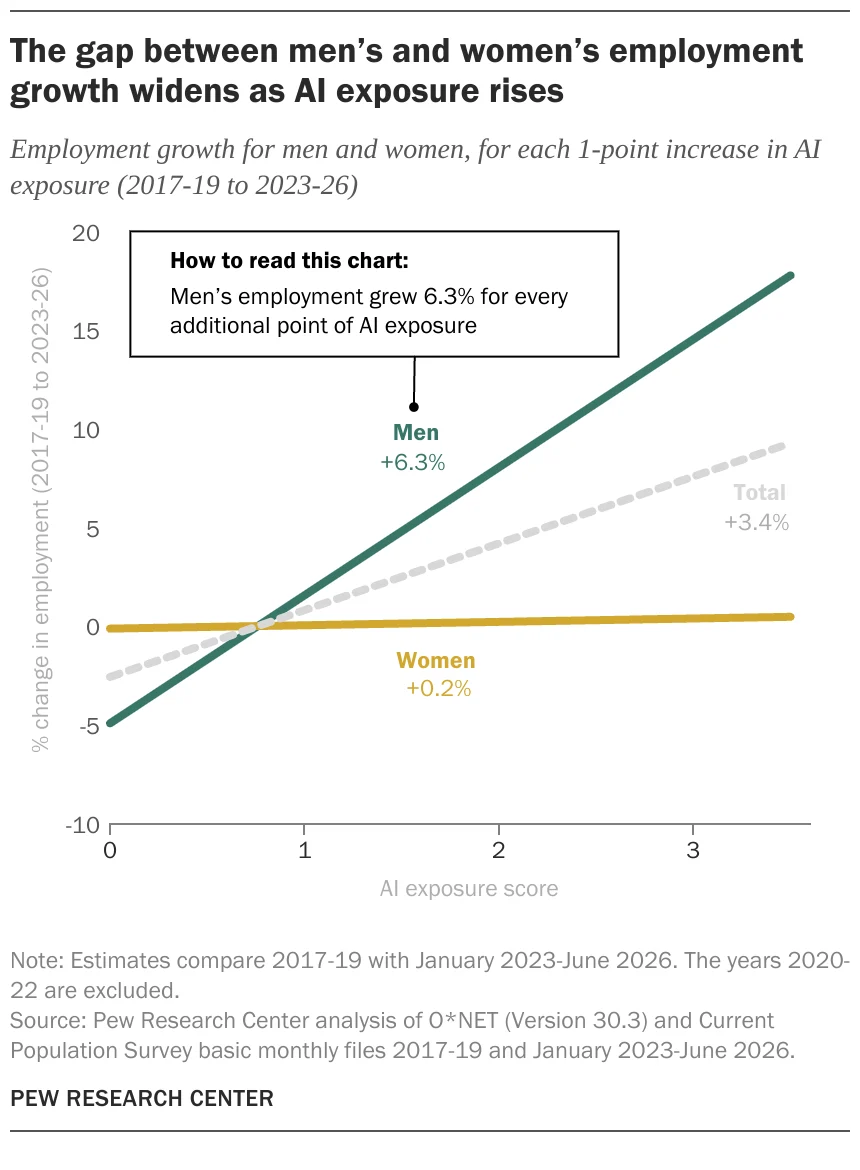
To evaluate this trend, researchers analyzed government data from the U.S. Department of Labor’s Occupational Information Network (O*NET) and the Current Population Survey (CPS) managed by the Bureau of Labor Statistics. By examining 480 distinct occupations, the study assigned an "AI exposure score"—ranging from 0 to 3.5—based on how extensively generative AI can perform or assist with the core tasks required in a given profession.
The central findings reveal a stark contrast:
- The Overall Gap: For every 1-point increase in an occupation’s AI exposure score, men’s employment grew by 6.3%, whereas women’s employment remained virtually static, moving by just 0.2%.
- The Educational Divide: The disparity is heavily influenced by educational attainment. Among workers with a high school diploma or less, men’s employment grew by 8.8% per 1-point increase in AI exposure, while women’s employment in the same category fell by 9.5%.
- The College-Educated Segment: Conversely, for workers holding a bachelor’s degree or higher, the gender gap largely vanishes. Neither men’s nor women’s employment changed significantly as AI exposure increased within higher-education brackets.
Chronology: From Pre-Pandemic Baselines to the Generative AI Boom
Understanding the trajectory of this workforce shift requires looking closely at the timeline of technological adoption and macroeconomic changes over the past decade.
2017–2019: The Pre-Generative Baseline
Prior to the widespread consumer and enterprise adoption of large language models, researchers established a baseline of occupational employment. During these years, employment growth patterns across industries followed traditional economic cycles, uninfluenced by the generative AI boom that would soon follow.

2020–2022: The Pandemic Disruption
To isolate the effects of artificial intelligence from external economic shocks, researchers deliberately excluded the years 2020 through 2022. The COVID-19 pandemic triggered historic volatility across the labor market—affecting remote work infrastructure, supply chains, and service-sector employment—for reasons entirely unrelated to AI capabilities.
January 2023–June 2026: The AI Integration Era
Marking the period following the public debut of advanced conversational AI tools, this timeframe captures the real-time labor market adjustments. As businesses rapidly integrated automation into administrative, creative, and analytical workflows, data from this window reveals the widening gap between men’s and women’s employment growth in exposed sectors.
Supporting Data: Understanding AI Exposure and Job Dynamics
To properly contextualize the numbers, analysts emphasize how AI exposure is distributed across the economy and how demographic sorting within occupations shapes the outcomes.
The Exposure Spectrum
AI exposure scores measure the degree to which an occupation relies on tasks that can be performed or assisted by AI, such as reading, writing, and processing information.
- Low Exposure (Scores under 1.0): Occupations like construction laborers (0.70), carpenters (0.80), and truck drivers (0.49) feature physical, manual tasks where AI integration is minimal.
- Medium Exposure (Scores 1.5 to 2.0): Roles such as medical assistants (1.54), tellers (1.64), and administrative assistants (2.04) experience moderate automation overlap.
- High Exposure (Scores above 3.0): Professions like accountants and auditors (3.09), software developers (3.10), and financial managers (3.20) handle information-heavy tasks where generative AI can significantly assist or accelerate output.
Educational Sorting and Occupational Clustering
The widening gender gap among non-college-educated workers is heavily tied to where men and women without degrees tend to work.
Men without a four-year college degree are largely concentrated in low-AI-exposure fields—such as freight moving, construction, and driving—where job growth has remained steady. When these men do appear in moderately exposed roles, their numbers have trended upward.
On the other hand, women without a bachelor’s degree are disproportionately represented in administrative and support roles—such as receptionists, secretaries, and customer service representatives—that fall squarely into the middle-to-high AI exposure bands. As automated chat systems and intelligent software absorb routine clerical and customer support duties, employment growth for women in these specific brackets has contracted.

Official Responses and Expert Perspectives
Economists, labor experts, and policy analysts have offered nuanced interpretations of the Pew Research Center findings, urging caution against misinterpreting the data.
- Clarifying the Scope: Researchers explicitly noted that the analysis compares employment growth within specific occupations (comparing the growth rate of men versus women inside the same profession) rather than pitting entirely different industries against one another. The authors stressed that the study does not categorize any profession as inherently "men’s work" or "women’s work."
- Economic Observers: Labor market specialists point out that correlation does not definitively prove causation. While the timeline aligns with the surge of generative AI, concurrent macroeconomic shifts—such as changing interest rates, shifts in remote work policies, and broader automation trends—may also be influencing these demographic trajectories.
- Workforce Advocates: Advocacy groups focused on gender equity in tech and corporate spaces have called for targeted reskilling programs. They argue that as administrative and support roles undergo structural transformation, ensuring equitable access to technical upskilling will be vital to preventing female workers from being disproportionately displaced by automation.
Implications: Navigating the Future of the Gender-AI Intersection
The revelation that employment growth diverges along gender lines in AI-exposed fields carries profound implications for policymakers, corporate leaders, and the future workforce.
1. Reassessing Workforce Development
Traditional vocational and educational training pipelines must adapt to the reality of AI integration. Because non-college-educated women are heavily concentrated in administrative roles facing high AI exposure, workforce development initiatives must focus on proactive upskilling. Equipping these workers with the digital literacy required to manage AI tools, rather than being displaced by them, is essential.
2. Corporate Responsibility and Inclusive Tech Adoption
As companies race to integrate artificial intelligence to boost productivity, human resources and diversity officers must monitor how automation impacts internal mobility and hiring. Ensuring that efficiency gains do not inadvertently hollow out gender-balanced or female-dominated support departments will be a major test for corporate governance.
3. Future Research Directions
Longitudinal studies will be necessary to determine whether the plateau in women’s employment growth within high-exposure fields is a temporary transition phase or a permanent structural shift. As generative AI evolves from an experimental tool into core infrastructure, continuous monitoring by institutions like the Pew Research Center will remain critical to maintaining labor market transparency and equity.