In an era often defined by deep political polarization, a new comprehensive study from the Pew-Knight Initiative reveals a surprising truth: when it comes to the mechanics of civic participation, the two major U.S. political parties are remarkably similar. While the ideological chasm between Democrats and Republicans remains a hallmark of modern American discourse, the way individuals show up—or fail to show up—in their communities, religious institutions, and the news cycle follows a consistent, non-partisan pattern.
The report, released in July 2026, draws on data from two major surveys conducted in late 2025. By analyzing 19 distinct measures of activity, researchers have successfully mapped the U.S. public into four distinct "engagement groups," offering a nuanced view of the American electorate that transcends the standard red-versus-blue binary.
The Four Pillars of Engagement: Defining the Groups
To move beyond anecdotal evidence of "voter apathy" or "political obsession," the Pew-Knight Initiative performed a cluster analysis of over 5,000 U.S. adults. This methodology identified four archetypes that define how Americans interface with public life:

- Mobilizers (The "Do-It-All" Cohort): The smallest but most active segment of the population. These individuals are deeply embedded in every aspect of public life, from political activism and civic volunteering to consistent news consumption and religious service attendance.
- Connectors (The Community Pillars): Larger than the Mobilizers, this group is highly active in community organizations, local groups, and charitable giving. While they are pillars of local society, they are significantly less likely to engage in the high-intensity political activities that define the Mobilizers.
- Spectators (The Passive Observers): As the name implies, these individuals are "keeping an eye on things." They follow the news cycle with high frequency but exhibit low participation in direct political or civic action.
- Outsiders (The Disengaged): This group represents those least likely to participate in any of the measured activities. They are the least likely to vote, volunteer, or follow the news, effectively existing on the periphery of the organized public square.
Chronology and Context: The 2024 Election Backdrop
Understanding these engagement patterns requires a look at the timeline. The study, conducted in the latter half of 2025, asked respondents to reflect on their behaviors over the previous 12 months. For the vast majority of participants, this window included the 2024 presidential election—a period of heightened political intensity.
The researchers emphasize that civic participation is not a static trait; it is highly sensitive to the political environment. During the initial months of the survey, the nation was processing the immediate aftermath of the 2024 election. In the later months, as the political landscape shifted to a new administration, the researchers noted that engagement levels for specific activities—such as contacting officials or attending marches—likely fluctuated.
This temporal context is vital. While the "Engagement Groups" provide a structural look at the public, the researchers acknowledge that the 2024 cycle served as a powerful catalyst. A Democrat living under a Republican administration, for instance, may be more prone to political mobilization than they would be in a different cycle, and vice-versa.
Supporting Data: The Partisan Parallels
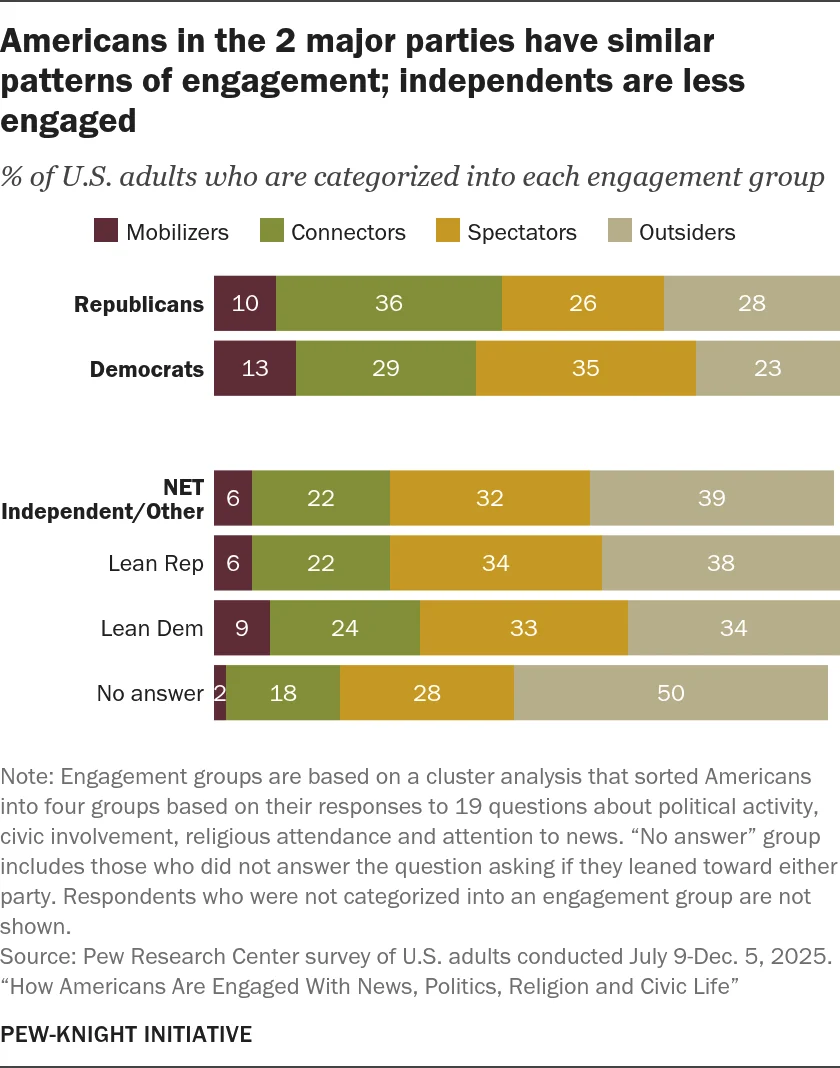
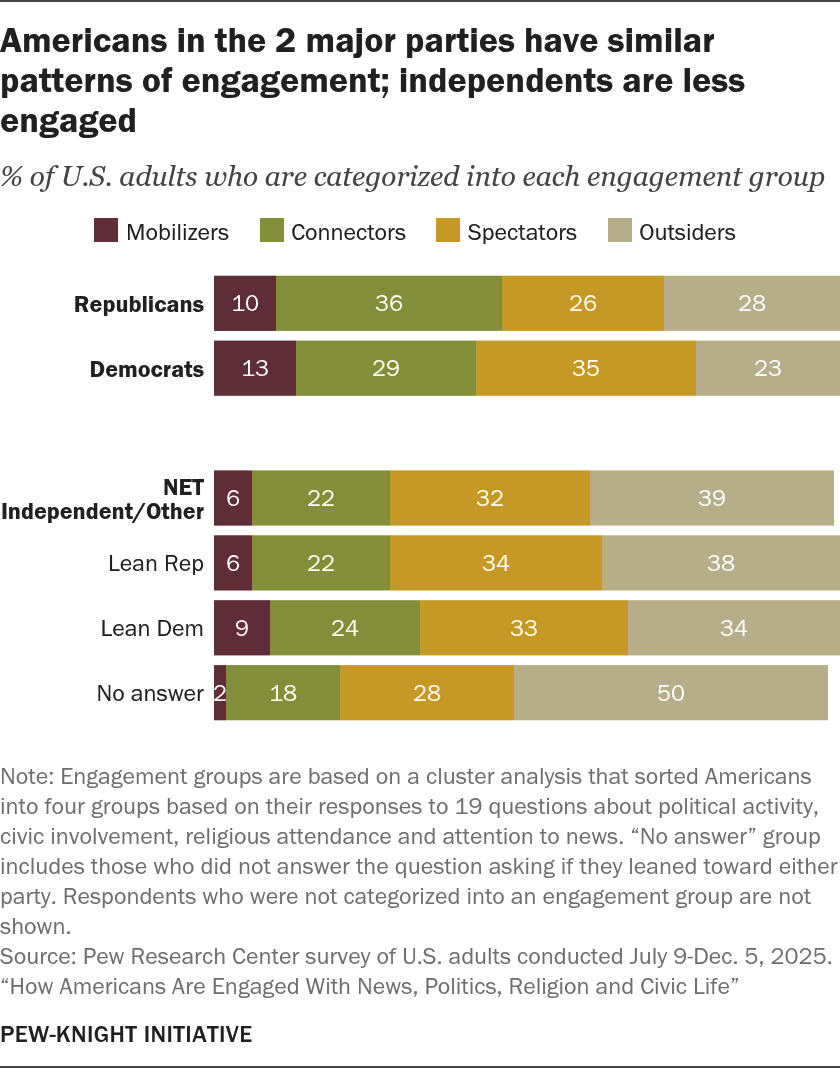
One of the most striking findings of the report is the structural symmetry between the two major parties. Regardless of their political leaning, Democrats and Republicans are distributed across the four engagement groups in nearly identical proportions.
For instance, Republicans show a slightly higher propensity to be "Connectors" (36% vs. 29% for Democrats), while Democrats are slightly more likely to be "Spectators" (35% vs. 26% for Republicans). However, when looking at the "Mobilizers"—the most active tier—the gap is minimal, with 10% of Republicans and 13% of Democrats falling into this category.
The real divergence occurs among political Independents. Those who do not lean toward either major party are significantly more likely to be "Outsiders." In fact, among the "No Answer" group—those who refused to identify a partisan leaning—a staggering 50% are categorized as Outsiders, and only 2% qualify as Mobilizers. This suggests that political detachment is intrinsically linked to civic and community disengagement.

Ideological Distribution
The study also explored how these groups perceive their own political identity. The results challenge the notion that high engagement is synonymous with extremism. While "Mobilizers" are split perfectly down the middle (37% conservative, 37% liberal), the "Outsiders" and "Spectators" are far more likely to identify as moderates. Specifically, 48% of Outsiders and 43% of Spectators describe their political views as moderate, suggesting that the most disengaged segments of the population are also the most likely to occupy the ideological center.
The 2024 Voting Reality
The data on self-reported voting in the 2024 election further underscores the differences between these groups.
- Mobilizers: 51% voted for Kamala Harris; 34% for Donald Trump.
- Connectors: Leaned toward Donald Trump (44% vs. 38% for Harris).
- Spectators and Outsiders: A significant plurality (49% and 56% respectively) reported that they did not vote at all.
Official Methodology: Ensuring Accuracy
The Pew Research Center took significant steps to ensure the study captured voices often missed by traditional polling. Recognizing that individuals who are less engaged in public life are also less likely to respond to surveys, the team utilized a mixed-method approach.
The primary data source, the "Cross-Sectional Engagement Survey," was conducted from July to December 2025 with 5,393 adults. The study utilized multiple contact methods—online, paper, and telephone—to reduce non-response bias. These findings were further validated using Wave 179 of the American Trends Panel (ATP), which provided a deep dive into the civic knowledge and political attitudes of the identified clusters.
Implications: The Future of the Public Square
The implications of this research are profound for policymakers, civic leaders, and the media. By identifying that "Outsiders" and "Spectators" represent a massive portion of the American electorate, the study highlights a significant challenge for democratic health.
If the most disengaged citizens are also the most likely to identify as moderate, there is a clear "missing middle" in active political discourse. The political noise is dominated by the most active "Mobilizers," while the broader, more moderate public remains largely on the sidelines, observing or opting out entirely.

For community leaders, the "Connectors" represent the most vital demographic. As individuals who are deeply embedded in civic and religious life but less focused on the high-octane political battles, they represent the glue of civil society.
Ultimately, the Pew-Knight Initiative’s research serves as a cautionary tale: a healthy democracy requires more than just partisan turnout. It requires a bridge between the hyper-engaged Mobilizers and the largely silent Spectators. As the nation moves forward, the challenge will be to determine whether these engagement patterns are fixed or if they can be shifted by fostering stronger, more inclusive community ties that incentivize participation regardless of one’s political badge.
The full dataset, including the specific questions asked and the detailed methodology, remains available for public review. As the 2026 political cycle progresses, this framework will undoubtedly become a benchmark for understanding the complex, multi-layered reality of the American public.