WASHINGTON — As artificial intelligence rapidly reshapes the global economic, social, and political landscape, questions surrounding who should govern the technology have taken center stage. A sweeping new multi-nation study conducted by the Pew Research Center reveals a striking geopolitical shift: across a surveyed group of primarily middle-income nations, China has emerged as the most trusted global power to effectively regulate artificial intelligence, outpacing both the United States and the European Union.
The findings, drawn from a massive global polling initiative surveying tens of thousands of adults across dozens of countries, underscore a fundamental realignment in how international populations view regulatory leadership in emerging technologies. While trust remains highest at home—with citizens in half of the surveyed nations expressing the most confidence in their own governments—the external balance of power has swung toward Beijing, challenging longstanding Western assumptions about global technological governance.
Main Facts: The New Landscape of AI Governance
The Pew Research Center’s latest international analysis exposes a complex map of trust, technological awareness, and geopolitical alignment. Conducted between February and May 2026, the study spans 36 countries globally, with specific deep-dives into how populations evaluate external superpowers for AI oversight.
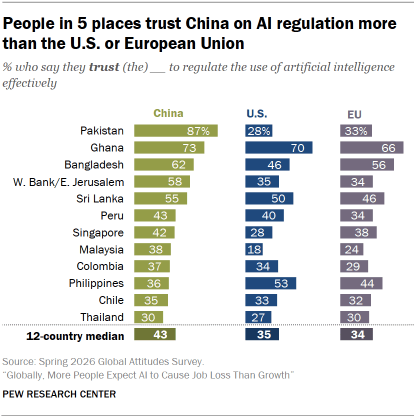
When asked how much they trust the United States, China, and the European Union to effectively regulate artificial intelligence, respondents across 12 targeted nations offered a median preference that places China at the forefront:
- China: Trusted by a median of 43% of respondents across the 12 countries.
- United States: Trusted by a median of 35%.
- European Union: Trusted by a median of 34%.
This represents a notable divergence from previous global baselines. In a similar 2025 Pew study covering 25 distinct countries, the European Union commanded the highest levels of global trust for AI regulation, followed closely by the United States, with China trailing behind. The 2026 data, however, reflects shifting perceptions, particularly within middle-income regions where overall favorability toward China tends to be higher.
Despite the appeal of external superpowers, local sovereignty remains paramount. In half of the nations surveyed in 2026, respondents expressed the highest degree of trust in their own national governments to handle AI regulation above any foreign power. This domestic confidence, however, varies wildly depending on geographic region, socio-economic context, and the public’s baseline awareness of artificial intelligence technologies.
Chronology: The Evolution of Global AI Perceptions
To fully understand the weight of the 2026 findings, it is necessary to trace the recent timeline of international public opinion regarding artificial intelligence and regulatory oversight:
- Spring 2025: Pew Research Center launches an expansive 25-country survey examining international perspectives on artificial intelligence. The resulting data shows that the European Union is viewed as the gold standard for tech regulation—largely driven by its proactive legislative frameworks like the EU AI Act. The United States holds the second position, while China registers lower trust scores globally.
- February 8 – May 13, 2026: Pew fields its comprehensive 36-country global attitudes survey, gathering responses from 42,151 adults. Concurrently, specialized panels are deployed in the United States via the American Trends Panel (with additional U.S. surveying conducted in late June 2026) to capture American sentiments.
- July 2026: Pew publishes parallel datasets examining international views of China and Chinese leadership, noting a gradual improvement in general favorability across various middle-income nations, contrasted with sliding international approval for U.S. leadership.
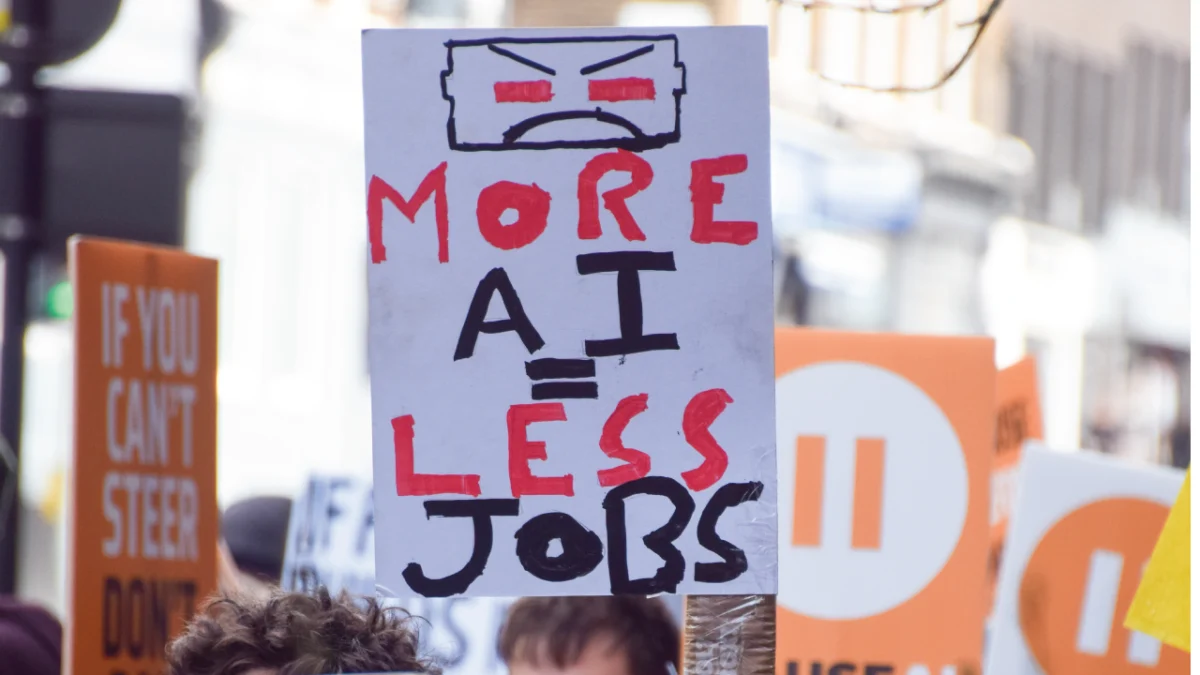
- September 17, 2026: Pew Research Center officially releases its flagship report on global views of AI, revealing that China has overtaken the U.S. and EU in regulatory trust across the 12-country comparative metric, and highlighting widespread global anxiety regarding AI-driven job displacement.
Supporting Data: Regional Breakdowns and Trust Dynamics
A granular look at the 12 countries where comparative trust in China, the U.S., and the EU was tested reveals fascinating regional nuances. The data demonstrates that public trust is rarely distributed evenly; instead, it is heavily mediated by geopolitical proximity, economic classification, and individual awareness levels.
Geographic Alignments and Superpower Preferences
- The China Bloc: In five distinct jurisdictions—Bangladesh, Malaysia, Pakistan, Sri Lanka, and the West Bank and East Jerusalem—China is definitively the most trusted external actor for AI regulation.
- Dual and Multi-Trust Zones: In Singapore, public trust is divided primarily between China and the EU. Meanwhile, in Chile and Thailand, citizens distribute their trust among China, the U.S., and the EU at roughly equal rates. In Ghana, Peru, and Colombia, public confidence splits evenly between the U.S. and China.
- The American Outlier: The Philippines stands alone as the sole surveyed nation where the United States enjoys higher trust for AI regulation than both China and the European Union.
The Domestic Confidence Gap
While external powers vie for influence, local trust remains a powerful baseline. In nations such as Pakistan and Bangladesh, domestic faith is exceptionally high, with approximately 80% of respondents expressing trust in their own national institutions to regulate AI effectively.
Conversely, skepticism plagues domestic governance in other regions. Roughly 40% or fewer of respondents in Chile, Colombia, Peru, and the West Bank and East Jerusalem trust their home governments to manage the technology. Furthermore, uncertainty remains a major hurdle: roughly a quarter or more of adults in Malaysia, Colombia, and the West Bank and East Jerusalem admitted they were "not sure" how to evaluate their government’s regulatory capacity.
The Role of Favorability and Awareness
Pew’s data highlights two critical psychological and informational drivers behind these trust metrics:
- Overall Favorability: Trust in an external regulator is inextricably linked to general feelings toward that country. Respondents who view China, the U.S., or the EU favorably are vastly more likely to trust them with AI governance. For instance, in Peru, 57% of individuals with a positive view of China trust the nation to regulate AI, compared to only 26% of those with a negative view.
- Technological Awareness: Familiarity breeds confidence—or at least crystallization of opinion. Individuals who have heard or read extensively about artificial intelligence exhibit higher levels of trust in external regulators compared to those with low awareness. In Sri Lanka, for example, 76% of respondents who have read "a lot" about AI express trust in the EU, contrasted with just 44% among those with lesser awareness. Those with low awareness are predominantly captured in the "unsure" demographic.
Official Responses and Contextual Analysis
The implications of the Pew Research Center study extend far into the corridors of international diplomacy, tech policy, and global economics. As governments race to draft legislation to control generative AI, autonomous systems, and algorithmic decision-making, public perception of regulatory competence acts as a vital form of "soft power."
International relations experts note that the rising trust in China’s regulatory capabilities among middle-income nations aligns with Beijing’s aggressive diplomatic push into the Global South through initiatives like the Digital Silk Road. By exporting technological infrastructure, smart city solutions, and digital governance models, China has cultivated an image of technological competence in regions where Western regulatory models may feel distant, overly bureaucratic, or culturally misaligned.
Meanwhile, the European Union’s relative decline in this specific 12-country metric—despite maintaining a reputation for stringent data protection and consumer rights—reflects the geographic composition of the surveyed nations, which lean heavily toward middle-income classifications. In high-income Western democracies, the EU’s regulatory footprint is more deeply felt and trusted, whereas middle-income populations often view Beijing’s state-directed industrial policy as an effective mechanism for managing disruptive technological forces.
The United States finds itself in a challenging intermediate position. While American tech companies dominate the global market for foundational AI models, public trust in the U.S. government’s ability to regulate the sector remains hampered by domestic political polarization and a shifting international perception of American reliability.
Implications: What the Future Holds for Global AI Governance
The shifting tides of international trust carry profound implications for the future architecture of global artificial intelligence governance.
1. Fragmentation of Regulatory Norms
If different regions place their trust in entirely different superpowers, achieving a unified global framework for AI safety, ethics, and security becomes increasingly difficult. Rather than converging on a single international standard—such as a global treaty on AI safety—the world may fracture into distinct regulatory spheres of influence, mirroring Cold War-era blocs or modern digital sovereignty divisions.
2. The Battle for the Global South
Middle-income nations represent the primary growth markets for future technology adoption. The fact that populations in regions like South Asia and parts of Latin America and Southeast Asia look increasingly toward Beijing for regulatory leadership suggests that China’s influence in shaping global tech norms will continue to expand. Western democracies will need to recalibrate their diplomatic and technical outreach if they hope to maintain normative leadership in AI safety and governance.
3. Domestic Pressures on Local Governments
With citizens in many developing nations expressing deep skepticism toward their own regulatory institutions, local policymakers face a dual challenge: they must not only build competent, forward-thinking legal frameworks for artificial intelligence within their borders, but they must also convince a wary public that domestic oversight is superior to foreign intervention.
As artificial intelligence continues to integrate into the daily lives of billions of people worldwide, the Pew Research Center data serves as a clear warning bell. Technology is no longer viewed merely as a commercial product; it is a geopolitical battleground where trust, regulation, and national sovereignty are inextricably intertwined.